 EN
EN
What filter matching rule for dust proof cabinet cooling fan operating in cement factories
2026/09/30
Cement cabinets choke on dust. Learn the filter rule for an industrial cabinet cooling fan: G4/F7 media, IP rating, and pre-filter care.

2026/08/29
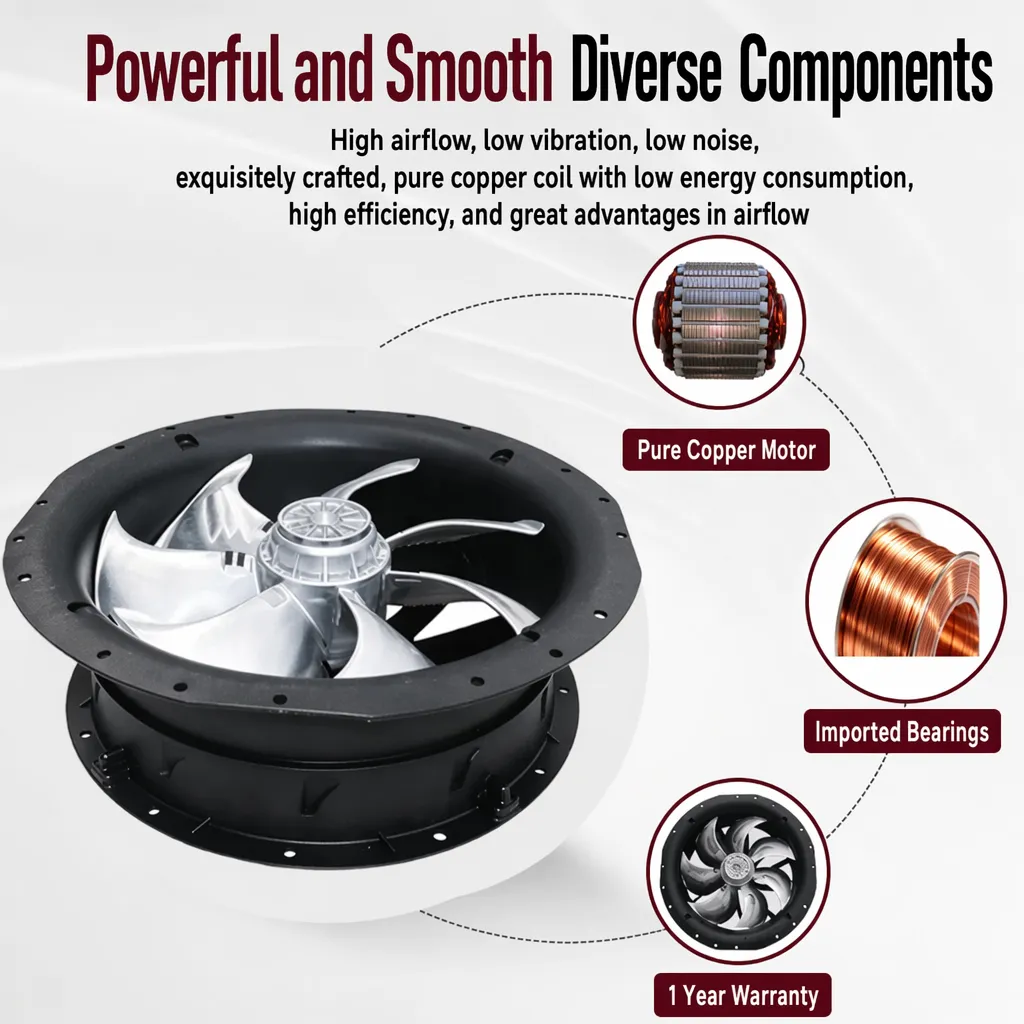
Pesticide formulation and packaging environments present one of the most punishing atmosphere combinations in process manufacturing. A single air stream frequently carries halogenated solvent vapors, hydrogen chloride acid mists, alkaline ammonia gas, sticky organophosphate particulate, and heavy humidity. Standard painted steel catalog fans designed for clean industrial spaces rarely survive a year under these conditions. Selecting the right corrosion resistant axial fan requires balancing structural integrity, aerodynamics, capture velocities, and explosion safety.
Standard commercial exhaust units fail prematurely in pesticide production environments due to three destructive physical processes happening simultaneously:
Chemical Condensation & Surface Pitting: Acidic mists and ammonia gas rapidly condense on cold metal blades, motor housings, and structural fasteners. This initiates rapid pitting corrosion, degrading blade geometry and compromising structural safety.
Particulate Buildup & Imbalance: Hygroscopic organic dusts from powder blending adhere unevenly to spinning impellers. As the residue hardens, it disrupts dynamic balancing, dramatically increasing vibration until bearing failure occurs.
Hazardous Vapor Ignition Risks: Solvent-rich mixing zones create localized explosive atmospheres. Standard non-sparking fans lack the mechanical grounding and explosion-proof motor ratings necessary to operate safely in regulated zones.
When a primary pesticide workshop exhaust system fails, local capture velocity drops instantly across open process vats, directly exposing operators to hazardous airborne concentration levels above standard occupational exposure limits.
Proper toxic gas ventilation design requires satisfying three independent fluid dynamic targets before finalizing hardware selection:
1. Room Dilution Rates
Facilities must maintain elevated air exchange rates based on space functionality:
Formulation & Blending Rooms: 12–20 Air Changes per Hour (ACH)
Packaging & Filling Lines: 8–12 Air Changes per Hour (ACH)
2. Hood Capture Velocity
To prevent dense solvent vapors or fine dust clouds from escaping open mixing tanks into worker breathing zones, capture velocity at the hood interface must maintain 0.5 m/s to 1.0 m/s.
3. Duct Transport Velocity
To keep organophosphate dust suspended in the airstream without settling along horizontal duct runs, maintaining an in-duct air velocity of 10 m/s to 12 m/s is essential.
| Design Parameter | Operational Target | Safety Impact |
| Capture Velocity | 0.5 – 1.0 m/s | Prevents vapor spillover into worker zones |
| Duct Transport Speed | 10 – 12 m/s | Stops toxic dust settling inside pipework |
| Dilution Rate (Formulation) | 12 – 20 ACH | Keeps room background TLV safely low |
| Dilution Rate (Packaging) | 8 – 12 ACH | Controls localized fugitive emissions |
Constructing an industrial axial exhaust fan for longevity depends almost entirely on choosing materials compatible with the facility's specific chemical footprint.
Polypropylene (PP): Exceptional performance against concentrated hydrochloric acid, hydrofluoric acid, and caustic vapors. Highly cost-effective for wet scrubbed airstreams at temperatures below 80°C.
Fiber-Reinforced Plastic (FRP): The industry standard for heavy industrial chemical duty. FRP composites offer exceptional mechanical strength, superior chemical resistance across acids, alkalis, and organic solvents, and extended service life.
316L Stainless Steel: Ideal for high-temperature applications or dry solvent vapors (e.g., xylene, toluene). However, stainless steel exhibits rapid pitting corrosion when exposed to wet chlorides or halogenated acids.
| Material Option | Corrosion Resistance | Typical Service Life | Relative Cost | Best Suited Duty |
| Painted Mild Steel | Poor | 6–12 Months | Baseline | Temporary utility work |
| Galvanized Steel | Moderate | 1.5–2.5 Years | 1.3x | Low-dust, non-acidic areas |
| 316L Stainless Steel | High (Chlorides excluded) | 5–8 Years | 2.8x | Dry solvent vapor |
| Polypropylene (PP) | Exceptional (Acid/Base) | 5–7 Years | 2.1x | Scrubbed wet acid exhaust |
| FRP Composite | Maximum Chemical Range | 8–12 Years | 3.2x | Continuous toxic gas duty |
If the air stream carries vapor from flammable solvents like xylene, toluene, or methanol, the equipment must comply with hazardous area regulations (such as ATEX 2014/34/EU or regional equivalent standards).
Compliance for hazardous area exhaust requires:
Explosion-Proof Drives: Flameproof (Ex d) or increased safety (Ex e) motors rated IP55, IP56, or IP66.
Non-Sparking Construction: Conductive FRP or antistatic Polypropylene impellers designed to prevent electrostatic charge accumulation.
Grounding Continuity: Integrated copper grounding straps bonding the impeller casing directly to the building earth grid.
Before finalizing fan specifications, always verify site zone classifications (Zone 1 or Zone 2) with the facility process safety engineer.
A major pesticide formulator operating in Southeast Asia experienced recurring exhaust failures on their primary organophosphate processing line.
Initial State: Coated steel roof exhaust units failed every 8 to 10 months due to severe corrosion from ammonia mists and acidic dusts. Pitch degradation on eroded blades reduced air turnover from a target 15 ACH down to 8.5 ACH.
Engineered Solution: The plant replaced the legacy units with high-efficiency FRP axial exhaust fans industrial spec units featuring IP56 explosion-proof motors, antistatic impellers, and direct-coupled drain ports.
Documented Results: Workshop ambient ammonia levels decreased by 62%. Over two years of continuous operation, maintenance downtime dropped to zero, and the upgrade fully amortized its capital expenditure within 11 months.
To maintain design airflow over extended operating campaigns, implement these baseline operational practices:
Static Pressure Monitoring: Log total differential pressure across the fan inlet monthly. A steady rise indicates particulate buildup in upstream ducts or scrubbers.
Condensate Drainage: Verify that low-point housing drain connections remain unblocked to prevent liquid pooling against shaft seals.
Vibration Diagnostics: Perform quarterly spectral vibration checks to identify early wheel imbalance or bearing degradation before catastrophic mechanical failure.
Executing reliable ventilation systems for aggressive chemical processing requires working with equipment manufacturers that prioritize verified performance and precise manufacturing tolerances.
LOBISONG manufactures industrial ventilation fans on automated production lines, offering full technical documentation, CE and UKCA compliance certification, and rigorous dynamic balancing test reports for global industrial supply chains.
Matching fan construction materials, hazardous zone certifications, and fluid dynamic sizing to exact process parameters ensures long-term operational safety and reduced cost of ownership in demanding chemical environments.

2026/09/30
Cement cabinets choke on dust. Learn the filter rule for an industrial cabinet cooling fan: G4/F7 media, IP rating, and pre-filter care.

2026/10/07
Right wall-mount height for an industrial axial exhaust fan: room volume, free clearance, brackets, and recirculation control.

2026/10/08
An ec motor fan links to BMS via Modbus, 0-10V and PWM for demand-based cooling, energy scheduling and automatic sensor-driven speed control.

2026/10/06
A radial exhaust fan removes grease, fumes, and odors from food-processing workshops with capture velocity and hygienic washdown design.

2026/10/05
Learn antistatic treatment for industrial cabinet cooling fan in electronics workshops—ESD-safe housing, ionizable plastics, and cleanroom compatibility.

2026/10/04
Discover how a brushless dc servo delivers precise wind speed control for laboratory cooling fans with closed-loop PID feedback and laminar airflow.
