 EN
EN
What filter matching rule for dust proof cabinet cooling fan operating in cement factories
2026/09/30
Cement cabinets choke on dust. Learn the filter rule for an industrial cabinet cooling fan: G4/F7 media, IP rating, and pre-filter care.

2026/09/05

Industrial procurement teams face a recurring challenge when standard air-moving components do not fit the mechanical envelope of a new machine. A backward curved centrifugal blower manufacturer that can compress the customized product delivery cycle gives OEMs a decisive advantage, especially when a launch date is fixed and tooling windows are short.
A European packaging-machine builder needed a non-standard air supply module on a tight schedule. The existing supplier quoted a sixteen-week lead time that would have pushed the product launch past a major trade show. A backward curved centrifugal blower manufacturer with modular impeller platforms proposed a redesigned wheel matched to a stocked outer-rotor motor, cutting the committed delivery to under three weeks. The background problem was clear: a fixed deadline with no off-the-shelf part in stock. The machine shipped on schedule, and the module passed field validation within the first month of operation, confirming the selection matched real load rather than a paper estimate.
Extended delivery windows ripple through the entire supply chain. When a single blower is missing, entire production lines wait, commissioning slips, and penalty clauses activate. The root cause is often a linear workflow where each custom request triggers fresh tooling, new drawings, and a separate procurement run for raw material. Modular thinking removes these serial steps and protects project momentum. A backward curved centrifugal blower manufacturer that plans around modular stock avoids these serial delays. Demand forecasting and buffer stock of common housings soften these shocks. When the air mover sits on the critical path, even a few saved days protect revenue recognition and customer confidence.
Ordering the wrong air mover carries hidden costs. A blower sized on airflow alone may fail under required static pressure, causing thermal overload and premature bearing wear. Mis-matched electrical parameters stress the drive and shorten service life. Early technical dialogue between the buyer and the engineering team reduces this risk before metal is cut. A backward curved centrifugal blower manufacturer with in-house test rigs catches such errors before shipment. Documented application data such as duct length, filter resistance, and ambient dust lets engineering pick the correct duty point. Careful derating for high ambient temperature keeps the unit inside its safe operating envelope.
A modular architecture separates the centrifugal wheel, the brushless motor, and the housing into standardized interfaces. Engineers select an impeller diameter and blade profile from a validated library instead of designing from zero. This approach lets a backward curved centrifugal blower manufacturer reconfigure performance without recertifying the whole assembly, preserving both speed and reliability. Standardized mounting footprints let the same blower serve several machine variants, reducing spare-part complexity across the fleet and simplifying long-term maintenance planning.
Computational fluid dynamics replaces guesswork with prediction. CFD modeling reveals turbulence, pressure distribution, and efficiency loss across the wheel before a prototype is built. Paired with CAD, the simulation output drives rapid design iteration. The result is a first-article that already meets the target curve, eliminating rounds of physical trial and error that consume calendar time. A backward curved centrifugal blower manufacturer running CFD in-house therefore returns a verified design faster than one depending on external labs. Mesh refinement around the blade trailing edge exposes flow separation that degrades efficiency. Correcting the geometry early avoids a later housing redesign and the requalification such a change would trigger.
Holding inventory of copper windings, precision bearings, and aluminum alloy housings turns a custom order into an assembly task rather than a sourcing project. Rapid prototyping then validates fit and balance within days. A backward curved centrifugal blower manufacturer that maintains this standard parts buffer converts a bespoke request into a fast, repeatable build. Kitting commonly specified sub-assemblies further shortens the final build. Tight incoming inspection on bearings and windings protects the mean time between failure the application expects.
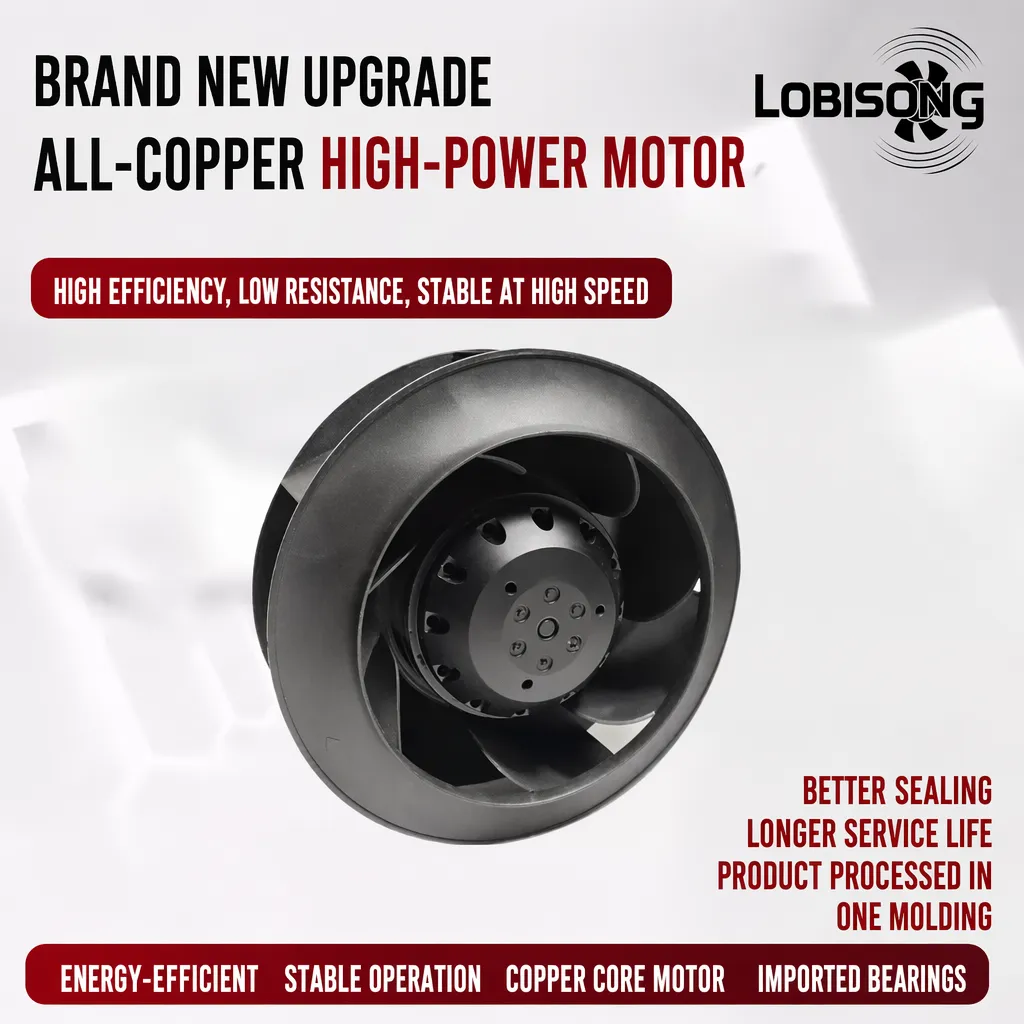
Speed means little without consistency. A disciplined quality process aligned with ISO 9001 controls incoming material, in-process checks, and final verification. Products built for European and global markets carry CE marking and meet IEC electrical safety requirements, so the delivered blower clears customs and passes end-customer audits without rework. A backward curved centrifugal blower manufacturer operating under ISO 9001 discipline delivers this consistency order after order. Traceable lot records link each unit to its material certificates, simplifying field service and recall preparedness for the buyer.
Every unit undergoes airflow and static pressure testing on a calibrated rig, plus vibration and noise level measurement. Leak testing of sealed enclosures confirms ingress protection to the rated IP54 level. These validation steps catch deviation early, protecting the duty cycle performance the application depends on and avoiding costly field returns. A backward curved centrifugal blower manufacturer that validates every unit protects the buyer's schedule and reputation. Burn-in under load reveals commutation and hall sensor issues that static checks miss, so only proven units reach the crate.
Choosing the right backward curved centrifugal blower manufacturer is less about the lowest quote and more about predictable, fast, and certified delivery. Modular platforms, in-house CFD, stocked components, and a structured quality process together compress the customized product delivery cycle from months to weeks, letting equipment builders protect launch dates and reduce supply chain risk.
What information should a buyer provide to get a fast custom blower quote? A clear request speeds response. Share the required airflow and static pressure, available mounting envelope, rated voltage and frequency, operating temperature range, and target noise level. CAD drawings or a sample help. With these inputs a backward curved centrifugal blower manufacturer can match an impeller and motor from existing platforms and return a validated proposal quickly, avoiding slow clarification rounds that extend the delivery cycle.
Why does modular design reduce lead time compared with fully bespoke builds? Modular platforms reuse validated impeller and motor interfaces instead of starting each project from a blank page. Engineers select proven components and confirm performance through CFD rather than physical trials. This removes tooling lead time and reduces procurement of rare parts. The assembly becomes a configuration task, so a custom blower reaches the production floor far sooner without sacrificing efficiency or reliability.
How can a buyer verify build quality before placing a large order? Request a first-article inspection report covering airflow, static pressure, vibration, and ingress protection. Ask for CE and IEC documentation and the quality process certificate. A short pilot batch reveals balance, bearing behavior, and duty cycle stability under real load. Confirming these parameters early prevents a full-volume shipment of non-conforming units and protects the project schedule.
Can a customized blower still meet international compliance marks? Yes. Modular designs built on certified motor platforms retain CE marking and satisfy IEC safety requirements when the manufacturing process follows ISO 9001 controls. The housing and impeller changes stay within validated electrical and mechanical envelopes, so compliance is preserved. Buyers should request the relevant certificates with each shipment to satisfy auditor and customs requirements without extra testing.
Where are standard parts stocked to support rapid customization? Stock is held for copper windings, precision bearings, aluminum alloy housings, and common impeller diameters. This inventory buffer turns a bespoke request into an assembly job rather than a sourcing project. When combined with in-house CAD and rapid prototyping, the inventory lets a supplier build and test a custom centrifugal blower within days, keeping the delivery cycle short even for non-standard performance targets.

2026/09/30
Cement cabinets choke on dust. Learn the filter rule for an industrial cabinet cooling fan: G4/F7 media, IP rating, and pre-filter care.

2026/10/07
Right wall-mount height for an industrial axial exhaust fan: room volume, free clearance, brackets, and recirculation control.

2026/10/08
An ec motor fan links to BMS via Modbus, 0-10V and PWM for demand-based cooling, energy scheduling and automatic sensor-driven speed control.

2026/10/06
A radial exhaust fan removes grease, fumes, and odors from food-processing workshops with capture velocity and hygienic washdown design.

2026/10/05
Learn antistatic treatment for industrial cabinet cooling fan in electronics workshops—ESD-safe housing, ionizable plastics, and cleanroom compatibility.

2026/10/04
Discover how a brushless dc servo delivers precise wind speed control for laboratory cooling fans with closed-loop PID feedback and laminar airflow.
