
 EN
EN

How backward inclined centrifugal fan stabilize indoor temperature of seed germination greenhouses
As someone who has spent years supporting ventilation selection decisions in controlled-environment agriculture, I find that the fan choice for a seed germination greenhouse is one of the most consequential — and most underestimated — decisions a facility manager can make. The first instinct is usually to focus on airflow volume. But in a sealed germination space where temperature tolerance can be as narrow as 4°C, what actually determines climate stability is how consistently and uniformly air moves through the structure, not just how much of it moves.
This is precisely where the backward inclined centrifugal fan earns its place in professional germination setups.
Why temperature precision matters more in germination than in any other growing phase
Most vegetable and flower seeds germinate optimally at soil temperatures of 18°C to 24°C (65°F to 75°F). Move outside that range and germination rates drop. Sustained temperatures above 30°C begin to inhibit germination in many common species, and anything above 38°C (100°F) can kill emerging transplants within hours. These are not conservative estimates — they reflect real physiological thresholds that agronomists have documented across major crop families.
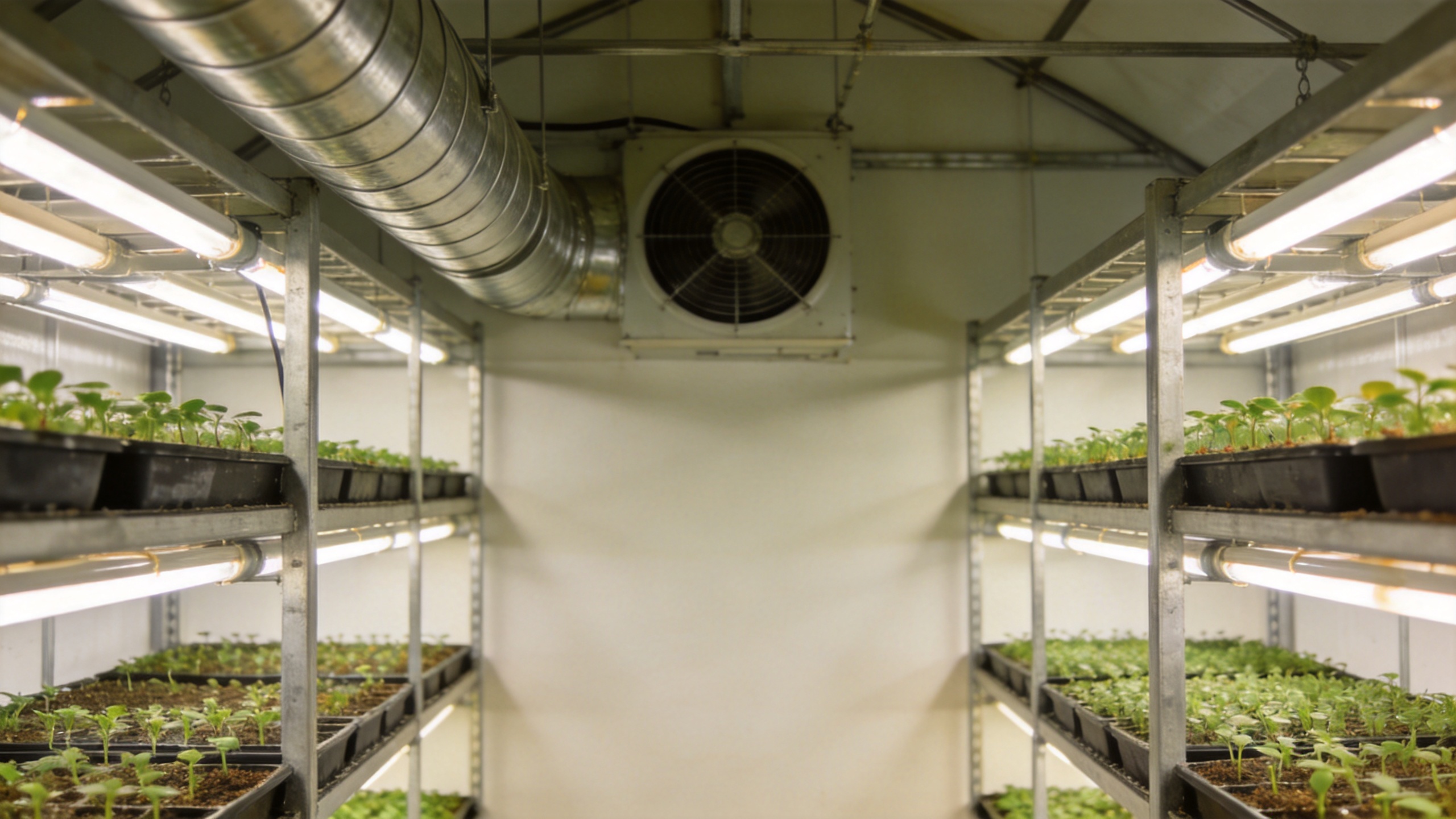
The challenge in a closed greenhouse is that heat accumulates unevenly. Solar gain through glazing panels, heat from grow lights, and moisture release from growing media all create localized hot zones. Without an airflow system designed to overcome internal resistance and distribute fresh air uniformly to every zone, the average temperature may look acceptable while corners and canopy-level pockets run 5°C to 8°C hotter. For seeds in those zones, that difference is the margin between normal germination and failure.
What sets a backward inclined centrifugal fan apart in this environment
The defining feature of a backward inclined centrifugal fan is the orientation of its impeller blades, angled rearward relative to the direction of rotation. This geometry produces a pressure-flow curve distinct from forward-curved or radial designs, and those differences are consequential in a ducted greenhouse ventilation circuit.
Stable pressure output across varying system resistance
Greenhouse ventilation circuits are not static. Dampers open and close, filter media loads up with pollen and dust, and seasonal changes affect air density. In a forward-curved fan, a drop in system resistance causes a steep, unpredictable rise in airflow , the type of surge that creates destructive drafts near young seedlings. A backward inclined fan's non-overloading pressure curve means airflow output shifts gradually and predictably as system conditions change. That stability is what allows a stable pressure industrial centrifugal fan to maintain consistent duct pressure throughout a multi-zone distribution network, even as individual zone dampers cycle.
Overcoming duct resistance in sealed, insulated structures
Modern seed germination greenhouses increasingly use insulated, sealed envelopes to maintain interior conditions independent of outdoor weather. These structures typically rely on ducted distribution systems rather than direct propeller-fan wall penetrations. Backward inclined fans handle static pressures across a wide range — from low-resistance open configurations up to demanding ducted layouts covering 0.5 to 40 inches water gauge without the motor overload risk that affects other designs. A heavy duty backward inclined ventilation unit scaled for the specific duct length and fitting configuration can deliver the same face velocity at every outlet register, which translates directly into uniform temperature distribution at bed level.
Low turbulence noise — relevant beyond simple comfort
It might seem secondary, but acoustic performance in a germination house matters more than in a storage facility. Excessive vibration transmitted through mounting structures can stress young root systems and disrupt the micro-environment at the soil surface. Backward-curved impeller geometry generates less turbulence noise than forward-curved designs at equivalent airflow because the blades shed air more cleanly. In practice, this means less structural vibration and a more mechanically stable operating environment for emerging seedlings.
How the airflow pattern prevents temperature stratification
Temperature stratification , the tendency for warm air to rise and cold air to settle near the floor, is a persistent problem in tall-roofed germination structures. An axial fan mounted high on a gable wall moves large volumes of air in a straight line, but it does little to break up the thermal layers between floor and ridge. The discharge pattern of a centrifugal fan installed in a central duct system is notably different: air is distributed through multiple registers positioned at consistent intervals across the growing area, at controlled face velocities, directed to intersect the thermal gradient rather than bypass it.
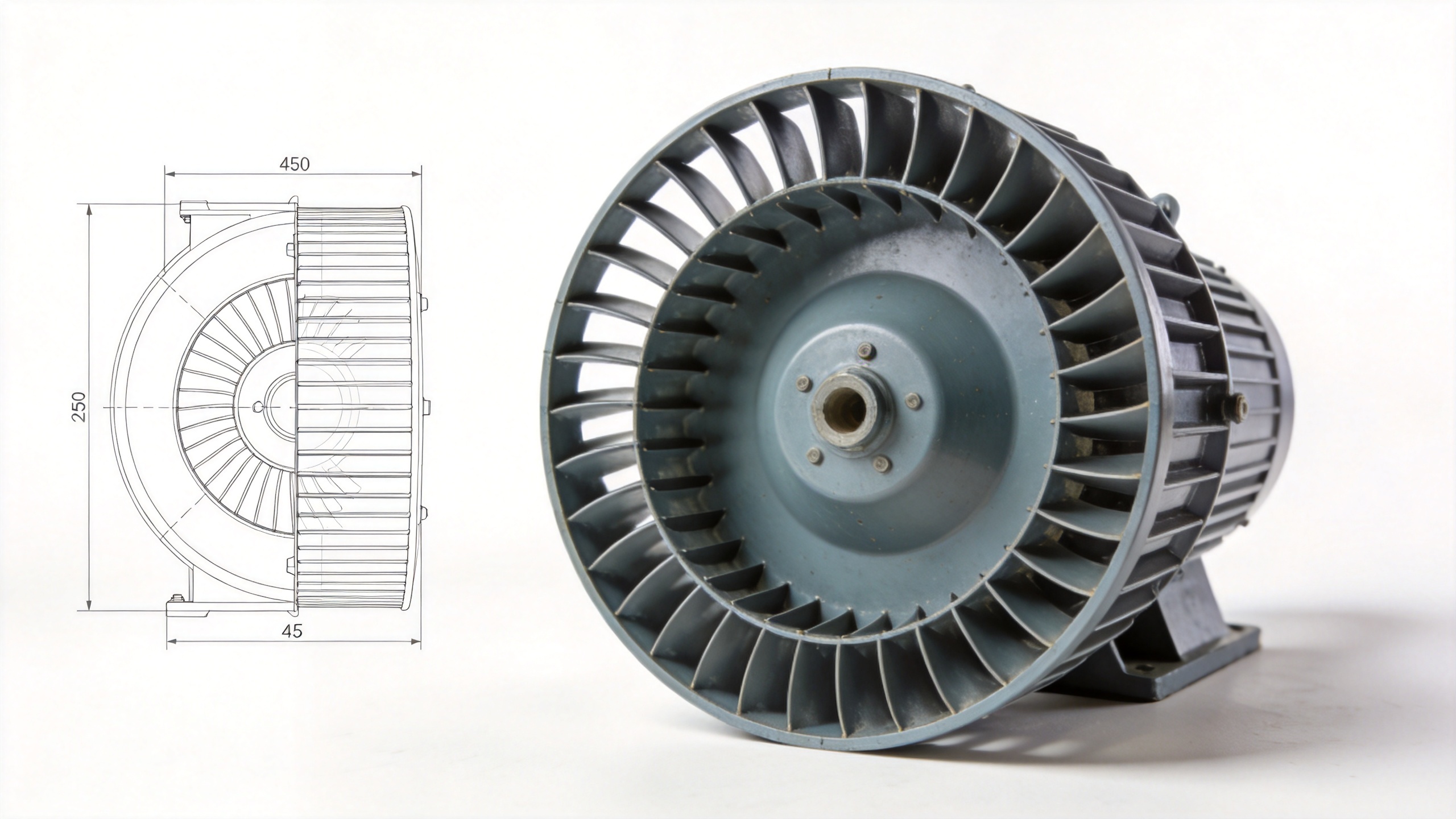
Have you ever replaced a ventilation fan only to find the temperature uniformity problem persists? In most cases, the fan itself is rarely the root cause — the distribution geometry is wrong. A correctly specified backward inclined centrifugal fan connected to a properly designed duct layout pushes conditioned air into the occupied zone at face velocities low enough to avoid cold drafts but high enough to prevent stagnation. That combination is what prevents the 5°C to 8°C inter-zone differentials that compress the viable germination window.
Comparing backward inclined centrifugal fans with axial fans for germination use
Axial fans are appropriate for high-volume, low-pressure tasks — flushing accumulated heat out of an unconditioned structure on a hot afternoon, for instance. But they cannot generate the static pressure needed to push air through a distribution duct network, and their discharge pattern makes uniform zone coverage difficult without additional baffling or ducting. For a controlled germination environment where temperature must be maintained within a narrow band regardless of outdoor conditions, a backward inclined centrifugal fan connected to a ducted distribution system provides a level of precision that axial alternatives cannot match.
For facilities that also manage livestock or other agricultural functions in adjacent spaces, the same fan platform used in a germination greenhouse — sourced from a reputable livestock ventilation fan factory with experience in agricultural climate control — can be adapted across multiple building types with consistent performance expectations and a unified spare parts inventory.
Selection considerations for greenhouse integrators
When specifying a backward inclined centrifugal fan for a germination greenhouse, several parameters deserve attention beyond catalog airflow ratings:
- System static pressure: Calculate total pressure drop through duct runs, fittings, filters, and registers before sizing the fan. A backward inclined centrifugal fan manufacturer with application engineering support can validate your duct calculation and confirm the operating point on the fan curve.
- Motor protection class: Germination environments combine high relative humidity with fertilizer-containing air. IP55 or higher motor enclosures prevent premature winding failures in these conditions.
- Speed control compatibility: EC motor variants allow stepless speed adjustment via analog or BACnet control, enabling the fan to reduce output at night when cooling load is lower . They also ramp up smoothly rather than surge at startup, which protects seedling root zones from abrupt airflow changes.
- Non-overloading operating envelope: Confirm the selected unit's power curve is genuinely non-overloading across the expected range of system resistance variation. This is a design feature of backward inclined geometry, but specific implementations vary by manufacturer and impeller configuration.
Conclusion
The backward inclined centrifugal fan stabilizes indoor temperature in seed germination greenhouses through a combination of properties that other fan types do not share: a non-overloading pressure curve that maintains consistent output as system conditions shift, the static pressure capacity needed to drive a ducted distribution circuit, and low-turbulence airflow that reaches every zone at face velocities appropriate for fragile seedlings. For germination facilities where a 4°C deviation can mean the difference between a successful crop and a failed tray, matching the fan type to the application requirement is not a secondary consideration — it is the starting point for any reliable climate control design.






