 EN
EN
What filter matching rule for dust proof cabinet cooling fan operating in cement factories
2026/09/30
Cement cabinets choke on dust. Learn the filter rule for an industrial cabinet cooling fan: G4/F7 media, IP rating, and pre-filter care.

2026/09/21
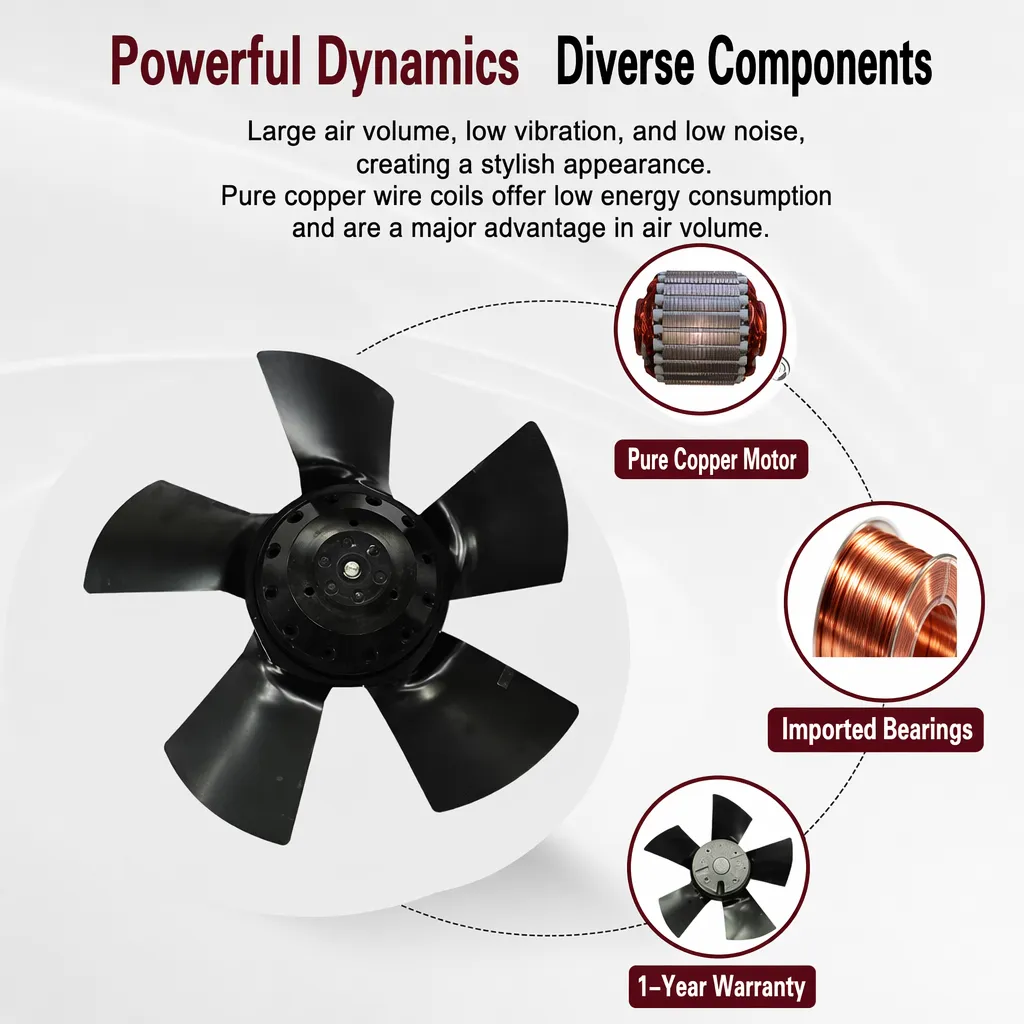
A motor driver brushless circuit is what keeps a high-speed industrial fan stable once the rotor spins up.
A high-speed industrial fan depends on precise energy delivery to its rotor. A motor driver brushless circuit replaces carbon brushes with semiconductor switches that energize stator phases in a timed sequence. Electronic commutation eliminates brush wear, sparking, and friction losses that limit conventional motors. The driver reads rotor position from hall sensors and switches current to the correct winding at the right moment. This allows the fan to spin faster with less heat and a longer service life. Pure-copper windings and precision ball bearings reduce resistive loss, letting the driver reach target speed with lower current. Stable commutation forms the foundation for every other control function discussed below. Without it, even a balanced impeller cannot reach or hold its rated speed reliably.
Rotor speed in a brushless DC system is governed entirely by switching accuracy. The driver compares desired speed with actual feedback and adjusts phase advance to keep torque smooth. Poor timing causes torque ripple, vibration, and acoustic noise that degrade bearings over time. A well-tuned driver maintains consistent phase alignment even as load and temperature change. Commutation precision directly affects whether the fan reaches rated RPM without hunting or stalling. Proper driver logic therefore decides the difference between steady operation and premature mechanical failure. Without an external motor driver brushless controller, timing drifts and efficiency falls.brushless motor driver, BLDC controller, electronic commutation, closed-loop speed control
Closed-loop speed regulation holds fan RPM within a narrow band despite disturbances. The driver applies PID control to the error between target and measured speed, then modulates a PWM signal that sets average voltage to the windings. A robust motor driver brushless controller pairs fast PID loops with high-frequency switching to react before speed visibly changes. Pulse width modulation lets the controller fine-tune power thousands of times per second. This reduces speed drift when supply voltage fluctuates or duct resistance changes. Accurate regulation keeps airflow constant, which protects downstream equipment from thermal variation and supports predictable process cooling across shifts.
Industrial loads rarely stay constant. A filter screen clogs, a cabinet door opens, or ambient pressure shifts. The driver detects the resulting speed drop through hall sensors or back-EMF and raises phase current to recover setpoint. Sensorless schemes estimate rotor position from voltage feedback when hall devices are unavailable. By continuously correcting, the motor driver brushless system prevents the slow speed sag that lowers cooling capacity. Sustained RPM stability is what lets a high-speed fan deliver rated air volume hour after hour. AMCA 210 and ISO 5801 define the airflow and pressure tests that confirm such stability in finished units.brushless motor driver, BLDC controller, electronic commutation, closed-loop speed control
High-speed fans face electrical and thermal stress. The driver monitors phase current and winding temperature every cycle. When current exceeds a safe threshold, over-current protection cuts or limits output to avoid demagnetizing the magnets or burning copper windings. Over-temp protection reduces power or stops the motor before insulation fails. These interlocks stop a single fault from cascading into permanent damage. A modern motor driver brushless board fuses current and thermal sensing so both limits are enforced together. Combined, they extend service intervals and keep the outer-rotor motor within its designed thermal envelope under continuous duty.
A blocked impeller creates a dangerous stall condition with high current and no airflow. The driver identifies missing commutation transitions and trips within milliseconds. Soft-start ramps speed gradually, limiting inrush current that would otherwise stress bearings and the power supply. Such protection aligns with IEC 60034 for rotating electrical machines and IEC 60529 for ingress protection on enclosed units. ATEX 2014/34/EU applies where explosive atmospheres exist. UL 507 also governs electric fan safety in North America. Following these standards helps specifiers choose drivers that fail safely rather than catastrophically during abnormal events. RoHS and REACH compliance should be checked for units sold into the EU market. A certified motor driver brushless module simplifies compliance documentation for global shipments.
A metalworking plant operated a row of VFD cabinets on a cooling line where AC fans ran loud and drifted in speed as ambient temperature rose. Cabinet internals approached thermal limits during summer, risking inverter trips that halted production. The maintenance team needed steadier airflow without enlarging the enclosures, since panel space was fixed. Brush friction in aging fans also raised replacement frequency, creating recurring downtime on the production line and stretching the spare-parts budget across many identical cabinets.
The plant retrofitted the enclosures with outer-rotor brushless fans driven by a closed-loop controller. The motor driver brushless unit held RPM steady against rising cabinet heat and filter loading. Electronic commutation removed brush maintenance, while over-temp protection prevented thermal shutdown during peak load. After the upgrade, airflow stayed consistent through peak shifts, inverter trips from overheating dropped markedly, and the cabinets met CE and UKCA markings for exported equipment. The line gained reliable cooling with less intervention, and operators reported quieter running across the upgraded section. Buyers should request the driver's protection list and rated ambient range before purchase. During use, keep filters clean and avoid sustained overload beyond the nameplate. Regular bearing checks and a documented maintenance schedule protect the investment.
Stable high-speed fan operation comes from intelligent control, not just a stronger motor. A motor driver brushless architecture delivers clean electronic commutation, precise closed-loop speed regulation, and layered protection that keep the rotor within safe limits. Procurement teams should verify certifications, inspect bearings and filters, and maintain cooling paths on a schedule. With sound selection and care, high-speed industrial fans deliver dependable, efficient cooling across demanding industrial environments.
What does a brushless driver do for a high-speed fan?
Answer: A brushless driver switches stator current electronically to spin the rotor without carbon brushes. It reads position feedback and sets precise timing so the fan reaches rated speed with low heat and long life. The motor driver brushless approach also enables speed control and fault protection that mechanical brushes cannot provide. Stable commutation reduces vibration and noise, supporting reliable cooling in demanding industrial duty.
Why is closed-loop speed regulation important for fan stability?
Answer: Closed-loop control compares actual RPM with the target and corrects errors continuously. Without it, voltage drops or filter clogging would let speed drift and lower cooling capacity. PID loops and PWM adjustment hold airflow steady through changing loads. Stable regulation protects downstream equipment from thermal swings and supports predictable process cooling. This control logic is what keeps a high-speed fan dependable across long operating hours.brushless motor driver, BLDC controller, electronic commutation, closed-loop speed control
How is over-current protection activated in the driver?
Answer: The driver measures phase current every switching cycle against a safe limit. When current exceeds the threshold, the controller cuts or limits output within milliseconds to protect magnets and copper windings. Over-temp protection acts similarly when winding temperature rises. These interlocks stop a single fault from spreading into permanent damage. Such protection aligns with IEC 60034 and supports safe, continuous fan duty.
Can a brushless driver operate in explosive atmospheres?
Answer: A brushless driver can support fans in hazardous areas when the assembly meets ATEX 2014/34/EU requirements for explosive atmospheres. Non-sparking materials and sealed enclosures reduce ignition risk, while over-temp limits prevent overheating. Selection must match the zone classification and gas group of the site. UL 507 and IEC 60529 also guide safe construction. Proper certification, not the driver alone, determines whether installation is permitted.
Do high-speed fans need regular maintenance with brushless drivers?
Answer: Brushless drivers remove brush replacement, but the fan still needs care. Inspect bearings and clean filter screens on a schedule to avoid clogging that forces the driver to work harder. Verify cooling paths stay open and avoid sustained overload beyond the nameplate. Check certifications during procurement and keep a maintenance log. Sound upkeep preserves airflow, extends service life, and protects the reliability of the whole cooling system.

2026/09/30
Cement cabinets choke on dust. Learn the filter rule for an industrial cabinet cooling fan: G4/F7 media, IP rating, and pre-filter care.

2026/10/07
Right wall-mount height for an industrial axial exhaust fan: room volume, free clearance, brackets, and recirculation control.

2026/10/08
An ec motor fan links to BMS via Modbus, 0-10V and PWM for demand-based cooling, energy scheduling and automatic sensor-driven speed control.

2026/10/06
A radial exhaust fan removes grease, fumes, and odors from food-processing workshops with capture velocity and hygienic washdown design.

2026/10/05
Learn antistatic treatment for industrial cabinet cooling fan in electronics workshops—ESD-safe housing, ionizable plastics, and cleanroom compatibility.

2026/10/04
Discover how a brushless dc servo delivers precise wind speed control for laboratory cooling fans with closed-loop PID feedback and laminar airflow.
