
 EN
EN
How centrifugal blower high pressure remove water vapor inside food packaging workshops
When I first started working on ventilation layouts for food processing lines, I underestimated how much moisture a busy packaging workshop could generate in a single shift. Steam from washdown operations, condensation from chilled conveyor sections, and ambient humidity from open product handling all add up fast. If the air exchange system cannot keep pace, moisture accumulates on walls, equipment surfaces, and product packaging. That creates a hygiene and quality problem that no facility manager wants to explain to a customer.
This is where a properly specified centrifugal blower high pressure system earns its place. It is not simply about moving air volume; it is about pushing that air through a duct network that fights back with system resistance at every bend and filter stage. This article walks through why water vapor builds up, why high-pressure centrifugal blowers handle this application better than axial alternatives, and what to look for when selecting one.
Why water vapor accumulates inside food packaging workshops
Food packaging workshops are, almost by definition, humid environments. Cleaning and sanitizing routines introduce large amounts of moisture. Product handling — particularly chilled, frozen, or wet goods — generates condensation. In some facilities, steam-based sealing equipment adds a further moisture load to the air.
The challenge is not the moisture itself, but the rate at which it must be removed. If exhaust capacity lags behind the generation rate, relative humidity inside the workshop climbs. Above roughly 70% relative humidity, condensation begins forming on cooler surfaces — packaging machinery, electrical enclosures, conveyor frames, and structural steelwork. In a food production context, standing moisture is a food safety risk. It supports mold and bacterial growth, accelerates metal corrosion, and can cause slips and falls on wet floors.
Effective moisture control, then, is a continuous process air exchange problem, not a one-time fix. The ventilation system must provide enough exhaust capacity to keep the workshop below a target humidity level even during peak production hours and after washdown cycles.
Why a centrifugal blower high pressure system is the right tool for this environment
Axial fans are common in general industrial ventilation, and for good reason — they move large volumes of air efficiently in low-resistance applications. But a food packaging workshop is not a low-resistance application. Ducting runs must often navigate through ceiling voids, around processing equipment, and through grease or particulate filters required by food safety standards. Each of these elements adds system resistance that an axial fan cannot overcome without a significant performance penalty.
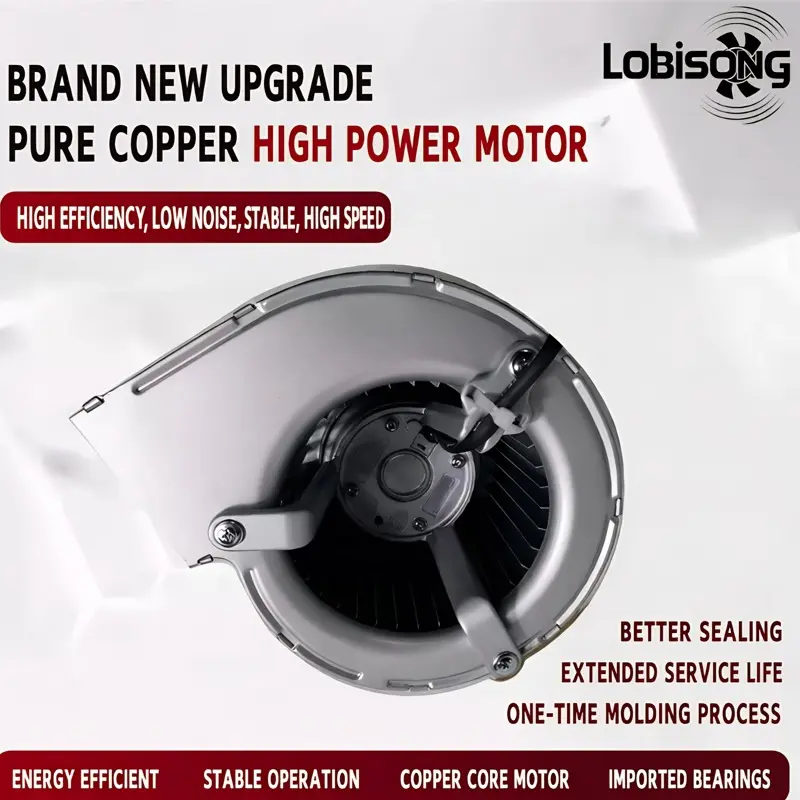
A centrifugal blower high pressure works differently. As the impeller rotates inside the scroll casing, it accelerates air outward by centrifugal force. The scroll casing converts this velocity into static pressure — meaning the blower can maintain effective airflow even as resistance in the duct network increases. Backward curved centrifugal blowers, in particular, can generate static pressures up to 500 mbar while maintaining stable, non-overloading power characteristics. That stability is valuable in a food workshop where filters load up over time and duct conditions change.
Additionally, a workshop waste gas high pressure centrifugal exhaust fan can be configured to handle air streams that carry fine particulates, steam, and light contaminants — exactly the conditions found at the exhaust points of a food packaging line. Unlike axial fans, which are more sensitive to back pressure spikes, centrifugal designs maintain a flatter performance curve, making them more forgiving in variable-resistance applications.
Key selection factors for a centrifugal blower high pressure in food workshops
Selecting the right blower requires moving beyond the datasheet airflow figure and thinking about the actual operating point in your specific workshop layout.
- Required static pressure: Calculate the system resistance along the longest or most restrictive duct run, including all elbows, transitions, grilles, and filter stages. Your blower must deliver the required airflow volume at this resistance level — and not at the free-delivery zero-pressure figure.
- Impeller material and surface finish: Food processing environments often involve corrosive cleaning agents. Stainless steel or epoxy-coated impellers provide better resistance to washdown chemicals than untreated mild steel.
- IP protection rating: The blower motor and housing should carry at least IP54 if located in a space subject to water spray. Depending on proximity to washdown zones, IP55 or higher may be more appropriate.
- Drive configuration: A direct drive centrifugal blower eliminates belt slippage, belt maintenance, and the efficiency loss that belt-drive units can develop as belts stretch. For continuous-duty applications like workshop exhaust, direct drive offers better long-term reliability and lower maintenance frequency.
- Noise output: Centrifugal blowers at high static pressure can generate significant noise. For workshops where operators are present throughout the shift, check the dB(A) rating and consider acoustic enclosures or sound-attenuated mounting where necessary.
Practical installation and placement guidance
Even a well-specified blower will underperform if it is poorly positioned. One of the most consistent field observations is that inlet restriction reduces effective airflow more than buyers expect. This typically happens when the blower is positioned too close to a wall, column, or other obstruction that limits free intake. Maintain adequate clearance — generally at least one impeller diameter — on the intake side.
For exhaust applications in food workshops, locate the extraction points where moisture concentrations are highest: above active washing stations, at the outlets of steam-producing equipment, and near chilled zones where condensation rates are elevated. A centralized factory ventilation centrifugal blower on the roof or in a remote plant room can serve multiple extraction points through a branched duct network, providing both flexibility and reduced workshop-floor noise.
When the duct network is branched, size the blower for the calculated system resistance at the worst-case design point — typically with all zones at full load and filters at mid-service life, not clean. A blower sized only for clean filter conditions will fall short of performance targets within a few weeks of operation.
Maintaining performance over time
Centrifugal blowers are robust pieces of equipment, but they do require some routine attention. In food workshops, the main maintenance items are:
- Regular filter inspection and replacement — clogged pre-filters are one of the most common causes of unexpected airflow reduction and blower overload.
- Impeller cleaning — grease and particulate buildup on the impeller causes imbalance, increased vibration, and accelerated bearing wear. The schedule depends on the air quality at the intake.
- Bearing lubrication or inspection, depending on bearing type. Sealed bearings require periodic replacement; grease-nipple bearings need scheduled lubrication.
- Belt tension checks for belt-drive units — though a direct drive centrifugal blower eliminates this task entirely.
One practical lesson from retrofit projects is that maintenance planning is most effective when it starts at the design stage. Selecting a blower with accessible impeller cleaning panels, standard bearing sizes, and a readily available motor frame reduces both downtime and parts procurement delays when service is due.
Putting it into practice
Managing water vapor inside a food packaging workshop is ultimately a continuous air exchange problem. A properly specified centrifugal blower high pressure system — sized for real system resistance, configured with appropriate materials and IP rating, and installed with clear intake and exhaust access — gives the facility a reliable foundation for humidity control. The gap in most existing installations comes down to specification errors: underestimating duct resistance, selecting on clean-filter performance data, or defaulting to an axial fan in an application that needed a centrifugal design. Getting these factors right from the start is substantially less expensive than correcting them after commissioning.
If you are specifying a centrifugal blower for a food packaging application, the team at Guangdong Lebisen Fan Co., Ltd can support the selection process with technical guidance based on your specific workshop layout and target performance parameters. Contact us at [email protected] or visit www.lobisong.com for more information on our industrial fan and blower range.






