 EN
EN
What filter matching rule for dust proof cabinet cooling fan operating in cement factories
2026/09/30
Cement cabinets choke on dust. Learn the filter rule for an industrial cabinet cooling fan: G4/F7 media, IP rating, and pre-filter care.

2026/09/14
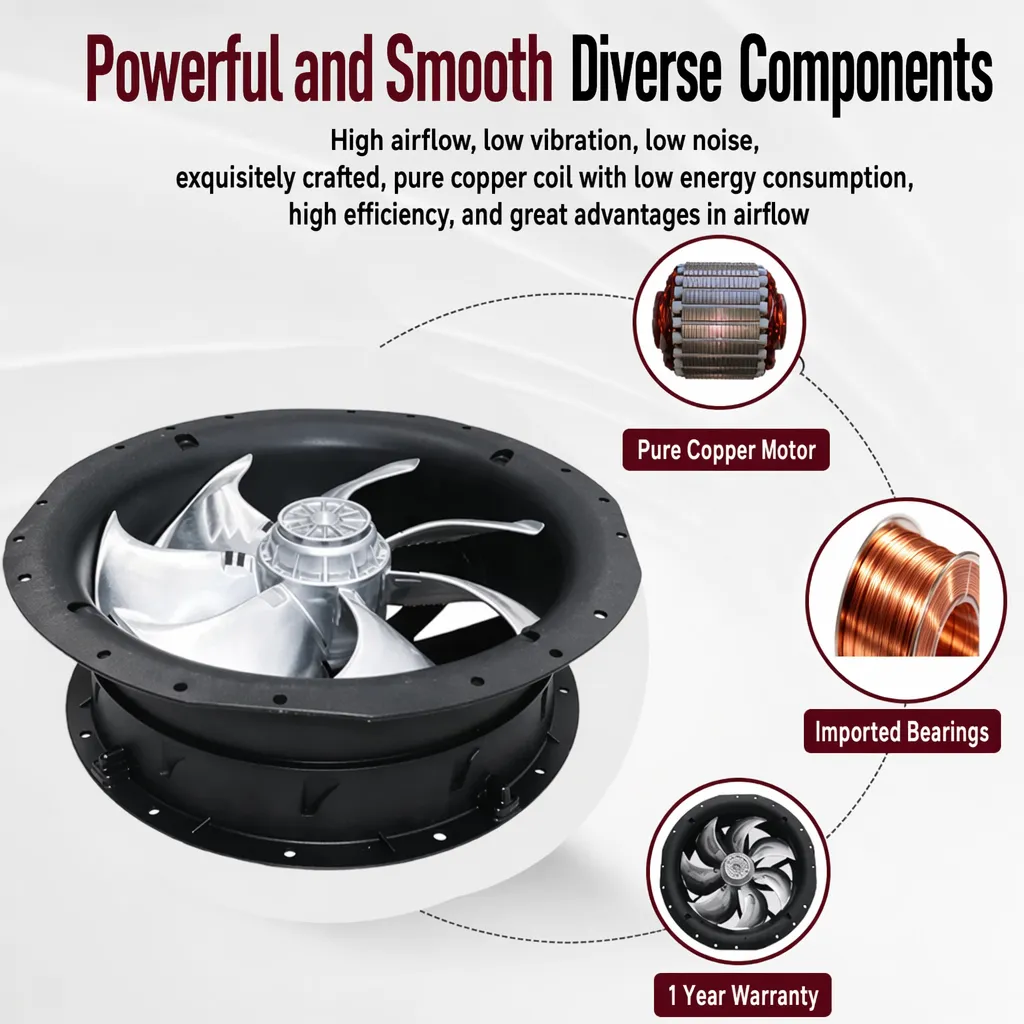
A livestock circulation system rarely runs on a standard airflow curve. A broiler house, a free-stall dairy barn and a nursery each carry different animal heat load, stocking density and manure moisture, so ventilation that works in one building fails in the next. A custom backward curved fan answers that mismatch by shaping impeller geometry, motor speed and static pressure to the exact air volume a specific enclosure needs, instead of forcing a catalogue unit to fit.
A custom backward curved fan earns its place only when the impeller and drive are matched to a measured air volume profile rather than a generic CFM label. Field teams first log the peak summer heat load, then subtract cooling from pad walls and natural draft, leaving the mechanical airflow the fan must supply. Blade count, chord width and outlet angle are then tuned so the wheel sits near its highest efficiency island at the duty point, avoiding oversizing that wastes power and sheds dust unevenly across the barn floor.
Static pressure climbs as stocking density rises and evaporative pads, curtains and bird blockers choke the free area. Choosing a custom backward curved fan against the measured pressure keeps the design honest, because the wheel is selected for the resistance it will fight rather than a light workshop figure. A backward curved wheel holds a flatter pressure-volume slope than a forward curved wheel, so delivered airflow falls less when a pad wall wets down, protecting dairy comfort and milk yield.
The backward curved impeller throws air off the blade trailing edge with lower turbulence, tolerating the fine dust and feather dander in poultry houses. A custom backward curved fan keeps the wheel clean because the engineer can pick a wider, smoother blade with a steeper backward angle, trading a little peak volume for a quiet wheel through a full cycle between washdowns. Custom geometry also lets outlet diameter shift to match a galvanized or aluminum housing. A forward curved wheel loads up with lint and scale, raising vibration and shortening bearing life.
Livestock heat load swings from a cool night lull to a hot afternoon peak, so a fixed-speed wheel either starves the barn at noon or over-cools it at midnight. A custom backward curved fan paired with an EC drive or frequency converter lets the duty point slide along the curve instead of stepping between relays. The controller reads temperature and humidity sensors and trims rpm to hold a target air change rate, keeping animals in a steady thermal zone and the motor out of hard start currents that wear windings and seals. Smooth speed control also lowers the noise that stresses birds during the dark period.
Fans for European and UK farm buildings fall under machinery and electromagnetic compatibility expectations, so CE and UKCA marking signals the unit meets the relevant EN and UK conformity regimes. Specifying a unit that carries the right marking means asking for the declaration and test basis rather than a sticker. Where the fan sits in a dusty, washdown-rated enclosure, an IP44 or IP54 option with sealed ball bearings and pure copper windings gives the ingress protection humid agricultural air demands.
A regional integrator ran a 12-house broiler site on oversized forward curved units that roared at full speed yet left dead corners near the backend wall. The engineering team logged static pressure at several points, mapped the cold spots, and specified a custom backward curved fan set with wider blades and a lower, steadier rpm band. After retrofit the grower reported steadier bird distribution, quieter houses and lower procurement cost, with selection advice taken before order rather than after a failed season.
A custom backward curved fan order should state the duty airflow, worst-case static pressure, ambient temperature and humidity range, and the dust or ammonia load the wheel will see. Ask the supplier for the performance curve at the proposed rpm, the IP rating, bearing type and balance grade from blade-balancing test. OEM and ODM support lets blade material, outlet diameter and motor winding shift to match a galvanized or aluminum housing, so confirm certification and enclosure rating before tooling starts.
A fan in livestock service lives in feather dander, feed dust and moisture, so a monthly look at blade buildup, bearing temperature and vibration signature catches trouble early. Check the inlet cone for scale, confirm the gasket and seal still block spray, and verify the filter upstream of any control cabinet stays clean. Listen for a rising tone that hints at imbalance, and keep a lubrication and torque-check note in the maintenance log so a small correction avoids a full impeller strip during peak production.
A custom backward curved fan remains the practical answer when a barn's air volume demand sits outside any catalogue curve, because blade, pressure and motor can all be tuned to the building instead of the other way round. Specifying from measured duty points, holding the right IP rating and following a simple inspection rhythm keeps livestock circulation steady through heat, dust and seasonal swings, and gives procurement teams a defensible basis for choosing the correct unit over a generic catalogue part.
What airflow rate should a poultry house fan deliver?
Answer: Poultry house airflow depends on bird weight, stocking density and summer design temperature, usually expressed as air changes per hour rather than a single CFM. A custom backward curved fan is sized from the measured heat and moisture load, then tuned so the wheel runs near its efficiency island at that duty point. Confirm the worst-case static pressure with pads and curtains closed before fixing the rate, and review the curve with the supplier.
Why does static pressure rise in a densely stocked barn?
Answer: Static pressure rises because more animals, tighter stocking and wet evaporative pads shrink the free area the air must cross, so the fan works against greater resistance. A backward curved wheel keeps a flatter pressure-volume slope than a forward curved one, so delivered airflow drops less when the barn chokes up. Logging pressure at several points during a hot day shows where the curve bends, and that reading drives the correct blade and motor choice for the livestock circulation system.
How does blade tuning change barn ventilation performance?
Answer: Blade tuning shifts where the impeller sits on its pressure-volume curve by changing blade count, chord and backward angle. A wider, smoother blade sheds feather dander and lint instead of collecting it, which protects bearing life and holds noise down. Custom work also lets the outlet diameter and motor winding match the housing, so the fan reaches target airflow at a lower, steadier rpm and avoids the imbalance and vibration that fixed oversized wheels build up in dusty service.
Can a custom fan serve both dairy and broiler houses?
Answer: A single custom platform can serve both when the duty points stay close, since blade material, outlet diameter and motor winding can shift between orders under OEM or ODM support. Dairy free-stalls and broiler houses differ in dust load and pressure, so the wheel and IP rating should match each building's air and moisture. Specify the worse case for both sites, then confirm the performance curve and certification so one supplier covers the livestock fleet without a separate tooling run.
Where should pressure sensors be placed in a livestock system?
Answer: Pressure sensors belong at the fan inlet and at the far wall or pad face, because the gap between those readings shows the true resistance the wheel fights. A third sensor near dead corners catches weak spots that a single point hides. Mount them away from direct spray and bird blockers, and route the signal to the controller that trims fan rpm. Steady sensor data lets the fan hold target air changes instead of guessing from one location.

2026/09/30
Cement cabinets choke on dust. Learn the filter rule for an industrial cabinet cooling fan: G4/F7 media, IP rating, and pre-filter care.

2026/10/07
Right wall-mount height for an industrial axial exhaust fan: room volume, free clearance, brackets, and recirculation control.

2026/10/08
An ec motor fan links to BMS via Modbus, 0-10V and PWM for demand-based cooling, energy scheduling and automatic sensor-driven speed control.

2026/10/06
A radial exhaust fan removes grease, fumes, and odors from food-processing workshops with capture velocity and hygienic washdown design.

2026/10/05
Learn antistatic treatment for industrial cabinet cooling fan in electronics workshops—ESD-safe housing, ionizable plastics, and cleanroom compatibility.

2026/10/04
Discover how a brushless dc servo delivers precise wind speed control for laboratory cooling fans with closed-loop PID feedback and laminar airflow.
