
 EN
EN
How Custom Cabinet Fan Matches Industrial Heat Exchange Equipment to Lower Overall Power Consumption
When I first started reviewing industrial enclosure cooling setups, I noticed the same pattern repeating: the heat exchange equipment was reasonably well-sized, but the fan driving airflow through the circuit was either over-spec'd and running at full speed continuously, or it was a standard-catalog unit that fell short of the thermal resistance requirements of the exchanger core. Both situations resulted in unnecessary energy draw — not because the cooling system was fundamentally wrong, but because the fan integration had not been properly evaluated as part of the overall thermal circuit.
In most of the industrial cabinet cooling configurations I have reviewed, the fan is rarely the single largest energy consumer in isolation — but it is consistently the easiest component to optimize when you are looking to reduce total system power consumption. The challenge is knowing how to select the right unit and match its operating characteristics to the specific thermal demands of the enclosure.
Why Fan Selection Directly Affects Heat Exchanger System Efficiency
Heat exchange equipment achieves its rated thermal transfer performance — typically in the 80–95% effectiveness range under controlled conditions — only when airflow through the unit is consistent with its design operating point. That operating point is defined by two variables: volumetric flow rate (CFM or m³/h) and static pressure resistance across the exchanger core.
A unit that delivers too little airflow reduces the system's thermal transfer rate, causing enclosure temperatures to rise and forcing longer run times to compensate. Conversely, a fan running above the exchanger's optimal flow range consumes more power without proportional thermal benefit. Neither situation serves the goal of lowering overall power consumption — and both are preventable with proper matching at the specification stage.
The datasheet shows airflow looks ideal under standard test conditions, but in high-ambient-temperature or heavily loaded industrial environments, actual performance will show measurable degradation. This is why selecting a fan from a static spec sheet — without accounting for the back-pressure introduced by the heat exchange equipment's internal fin geometry — is a step that frequently gets skipped and later regretted.
How to Match a Custom Cabinet Fan to Industrial Heat Exchange Equipment
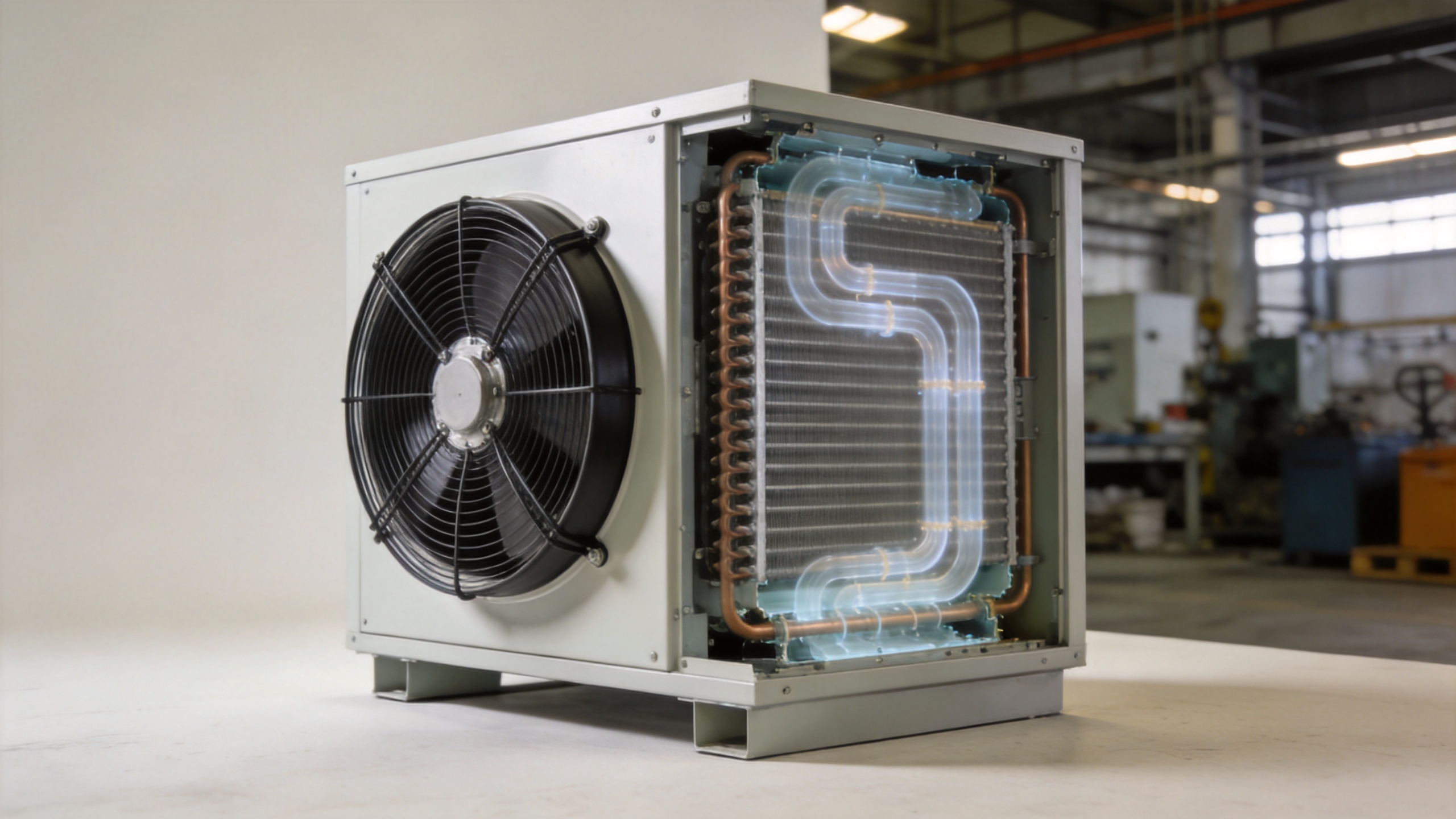
Matching a custom cabinet fan to heat exchange equipment starts with understanding the pressure-flow (P-Q) curve of the exchanger core. Most manufacturers publish thermal resistance values (W/K) and corresponding airflow requirements. The selection task is then to identify a fan whose operating point — at the intersection of its performance curve and the system resistance imposed by the heat exchanger — delivers the required airflow at the lowest practical power input.
Key matching parameters to verify before ordering:
- Rated airflow vs. required airflow: The fan's rated free-delivery CFM should exceed the exchanger's minimum required airflow by a margin that accounts for filter resistance and installation back-pressure. A 15–25% buffer above the minimum is a practical starting reference.
- Static pressure capability: The unit must maintain its target airflow against the combined static pressure of the heat exchanger core, filter media, and duct losses. Fan models with backward-curved or backward-inclined blade profiles typically perform better than forward-curved types in higher-resistance configurations.
- Voltage and control interface compatibility: Specifications should be verified against the cabinet's available supply voltage and any thermostat or BMS control signals already integrated into the cooling enclosure.
- Frame size and mounting footprint: Industrial heat exchange equipment is designed for specific airflow duct dimensions. Confirming that the fan frame aligns with the heat exchanger's air inlet or outlet opening avoids airflow bypass — a common source of efficiency loss that is easy to miss until the system is running.
EC Variable Speed Cabinet Fans and Their Role in Power Reduction
Among the available technology options for heat exchanger system integration, ec variable speed rack cabinet cooling fans represent one of the most effective paths to reducing continuous power consumption. The reason comes down to the physics of fan power laws: a 20% reduction in fan speed delivers approximately 50% savings in input power, because power consumption scales with the cube of rotational speed.
In industrial cabinet applications where heat exchange equipment is running in a closed-loop configuration — isolating internal electronics from external contaminants — the cooling load fluctuates with ambient temperature and internal heat generation. A fixed-speed unit cannot respond to these variations. An EC variable-speed unit adjusts its output in real time, running at lower speeds during cooler periods and ramping up only when the thermal load actually demands it.
EC fans are generally more efficient than their AC counterparts — at least in variable-speed applications where partial-load operation is common. The built-in speed control in EC motors eliminates the need for external variable frequency drives, simplifying the complete cabinet cooling fan circulation system and reducing the component count that contributes to both capital cost and long-term failure risk.
Building a Complete Cabinet Cooling Fan Circulation System
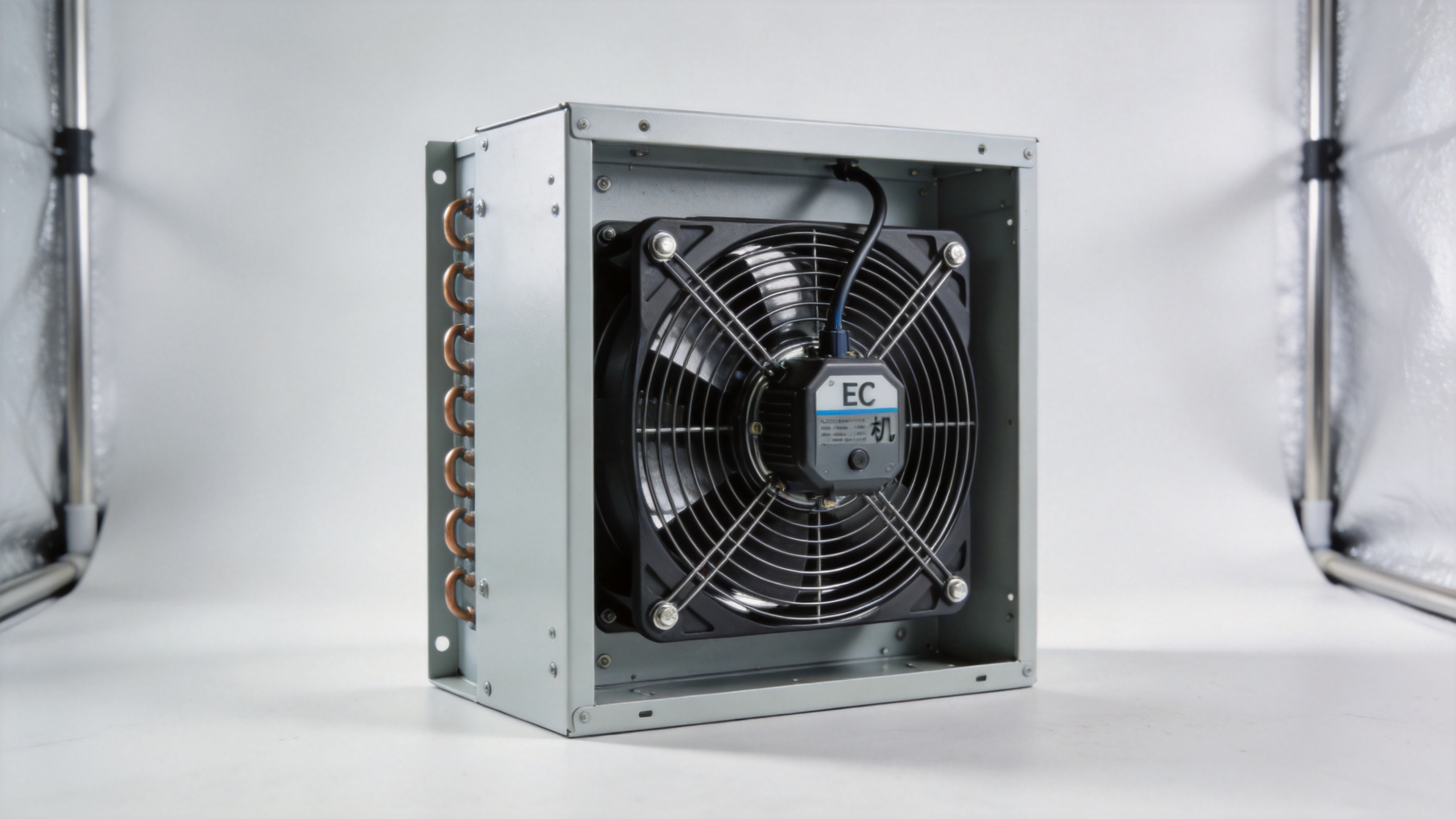
When evaluating options, it is easy to focus only on the fan unit itself — but real-world projects have consistently shown that the inlet and outlet layout of the enclosure has far more impact on actual cooling performance than any single component specification. A complete cabinet cooling fan circulation system that effectively reduces overall power consumption typically includes:
- A fan matched to the specific P-Q curve of the industrial cooling system (not a generic unit pulled from a standard parts catalog).
- A thermostat or temperature sensor that provides closed-loop speed control to the drive electronics, preventing unnecessary full-speed operation during low-load periods.
- A filter system matched to the fan's rated airflow at the expected filter loading condition, avoiding the common mistake of specifying a filter that chokes airflow well before its next scheduled replacement.
- Clear separation of inlet and outlet airflows to prevent short-circuiting, where warm exhaust air recirculates back into the heat exchanger inlet and reduces the effective temperature differential driving heat transfer.
Some industrial fan suppliers offer heat exchange equipment with an integrated brushless motor fan, providing a pre-tested combination with documented P-Q performance data. For applications where standard catalog configurations do not match the installation requirements, a custom cabinet fan designed to the heat exchanger's specific airflow and static pressure parameters provides a more reliable path to the target power consumption profile than a generic substitute.
Practical Guidance for Procurement and Specification
For trading companies and engineering teams sourcing industrial enclosure cooling components, the most common friction point is that the fan and heat exchange equipment are often procured from different suppliers, with each side optimizing their component independently. Where continuous-duty performance is a priority, ec variable speed rack cabinet cooling fans offer a practical path to reducing ongoing power draw without requiring system redesign — provided the fan's operating point has been validated against the heat exchanger's P-Q curve. The power savings identified above only materialize when all components in the cooling circuit are properly matched.
Before finalizing a specification, it is worth requesting the following from the fan supplier:
- The fan P-Q curve at the specified operating voltage, showing performance at the expected static pressure imposed by the heat exchanger.
- Confirmation of the fan's power input (watts) at the matched operating point, not just at free delivery.
- Speed control range and control signal compatibility for EC variable-speed models.
- MTBF or bearing lifespan data for continuous-duty cabinet applications.
Matching a custom cabinet fan to the actual operating requirements of the industrial heat exchange equipment — rather than treating each as a standalone specification item — is what makes the difference between a cooling system that runs efficiently over its service life and one that draws more power than necessary from day one. Suppliers like Lebisen, which produce both cabinet cooling fans and heat exchange equipment, can provide matched product combinations with verified airflow performance data, simplifying the specification process for international buyers sourcing industrial enclosure cooling solutions.






