 EN
EN
What filter matching rule for dust proof cabinet cooling fan operating in cement factories
2026/09/30
Cement cabinets choke on dust. Learn the filter rule for an industrial cabinet cooling fan: G4/F7 media, IP rating, and pre-filter care.

2026/09/12
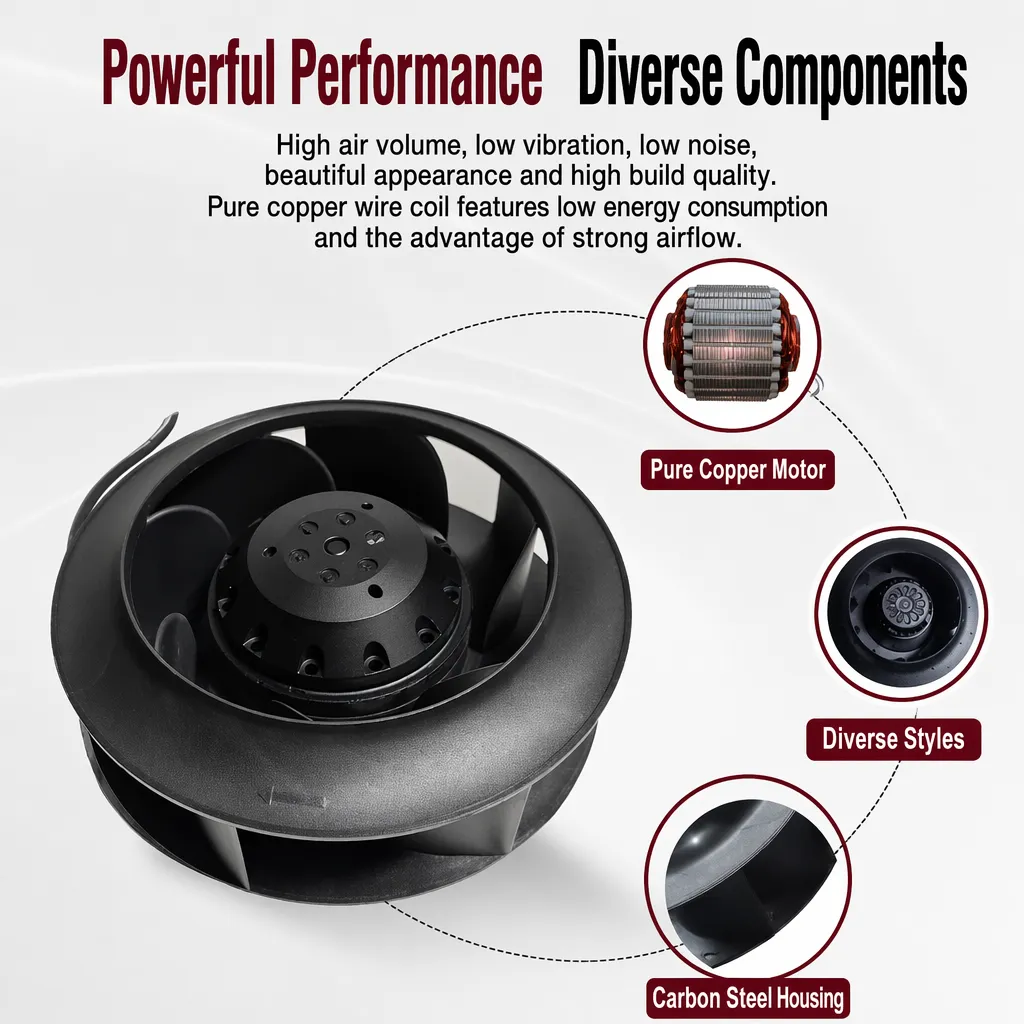
Industrial heat-exchange equipment lives or dies on temperature control. When a closed-loop circuit leaks process heat into the surrounding air, the plant pays twice: to make it and to remove it. A high efficiency backward curved fan attacks the second cost directly, moving more airstream per watt at the ductwork pressure to keep the heat exchanger near design temperature with less electrical input.
A heat exchanger only works when the temperature difference between the two fluid sides stays wide enough to transfer energy. Poor airflow lets the cold side warm and forces the compressor or burner to run longer, raising power consumption. Poor airflow also starves the airstream that scrubs heat off the fins, letting them insulate instead of conduct.
One heat-exchanger OEM built closed-loop units around forward-curved AC fans. At the working static pressure those fans drew about 180 W yet let the cold side creep up, so standby heat loss warmed the plant and the energy target slipped. Swapping in high efficiency backward curved fans with EC motors and a re-matched volute cut part-load draw to roughly 95 W per fan and held the cold side within 1.5 °C of setpoint.
Specifying a fan by motor size alone misses the real operating condition. What matters is the curve point where static pressure and airflow volume meet the system resistance of the actual duct, filter, and coil. System resistance climbs as filters load and coils collect dust, so a fan tuned only for free delivery falls short when cooling is needed most.
Reading the fan curve against measured system resistance predicts real thermal loss better than nameplate watts and lifts impeller efficiency at the working static pressure.
Selecting a high efficiency backward curved fan is about the part of the curve where the unit actually runs, not only the peak rating. That is where forward-curved wheels shed energy in turbulent recirculation near the blade tips.
Forward-curved wheels shed energy in turbulent recirculation near the blade tips even at low speed. A high efficiency backward curved fan uses blades that curve away from rotation, so the airstream leaves the impeller with lower swirl and converts more motor work into useful pressure. At the static pressure a real heat exchanger demands, the backward-curved wheel holds its efficiency while the forward-curved wheel fades.
The impeller does not work alone; a high efficiency backward curved fan depends on a matched volute housing that collects discharged air and converts velocity into steady pressure. A well-shaped volute matches the volute to the impeller tip speed, so the airstream leaves in an ordered spiral instead of a chaotic jet. CFD studies show where low-pressure pockets form so engineers reshape the tongue and cutoff to recover energy.
A matched volute and impeller yields higher impeller efficiency at the working static pressure and a flatter curve across the load range.
An AC fan at fixed speed keeps drawing near-full power even when the heat load drops at night or during light production. A high efficiency backward curved fan on an EC drive changes that picture: the EC motor integrates the controller and uses permanent-magnet rotor technology to vary speed efficiently, avoiding the slip losses of an induction design and throttling cleanly with a 0–10 V or PWM signal.
For a heat exchanger below peak load most of the time, that part-load efficiency is where the savings live, removing standby heat loss and keeping power consumption near the process minimum.
In some closed-loop systems the exhaust airstream carries usable energy; routing it through a recovery stage, or coasting near free delivery at tiny load, avoids fighting system resistance. Energy recovery with speed-controlled fans lets the plant reclaim heat while the fan idles at low rpm.
The control logic should treat airflow volume as a servo to temperature, not a constant. When the setpoint is met, the EC motor eases back; when the coil warms, it advances. This closed loop keeps the heat exchanger efficient without operator intervention.
Before a fan enters production, CFD and bench testing confirm the curve against the real volute housing and duct. After installation, monitoring tied to an ISO 50001 routine tracks power consumption per unit of cooling delivered. IEC and CE markings confirm the motor and wiring meet European and Asian safety and electromagnetic requirements, keeping commissioning straightforward.
Recording the fan's static pressure and airflow volume at commissioning gives a baseline; later drift signals a fouled coil or failing bearing long before a breakdown.
Quarterly checks should cover the inlet for dust, the filter pressure drop, and bearing noise. Imported precision ball bearings and pure copper windings, as used in the Lobisong backward-curved range, tolerate harsh duty, but no fan survives a blocked filter. Cleaning the coil restores system resistance toward design and recovers lost impeller efficiency. Verify the EC motor's speed signal and current draw against the commissioning baseline each season.
Reducing thermal loss in industrial heat exchangers is rarely about more horsepower; it is about the right airstream at the right static pressure with the least waste. A high efficiency backward curved fan earns its place by holding impeller efficiency under real system resistance, letting an EC motor relax at part load, and keeping the heat exchanger on its design point shift after shift. The payback shows up as lower power consumption, steadier temperatures, and a cooler plant floor.
What causes heat exchangers to lose efficiency over time?
Answer: Thermal loss grows as coils and filters accumulate dust, raising system resistance and starving the airstream that scrubs heat from the fins. Once airflow volume drops, the cold side warms, narrows the temperature gap, and forces longer run times. Regular cleaning of the coil and filter restores design conditions and keeps impeller efficiency where it belongs, avoiding the slow creep that raises power consumption.
Why does a backward-curved impeller beat a forward-curved one?
Answer: Backward-curved blades curve away from rotation, so the leaving airstream carries less swirl and converts more motor work into useful static pressure. At the working pressure of a real heat exchanger, the forward-curved wheel loses efficiency while the backward-curved wheel holds. That stability under rising system resistance is what protects against thermal loss spikes when filters load and coils collect dust.
How does an EC motor reduce standby power draw?
Answer: An EC motor embeds the controller and uses a permanent-magnet rotor to vary speed without the slip losses of an induction design. Part-load efficiency stays high, so the fan draws only the watts the current heat load needs. During light production or night idle, airflow volume drops to match demand, removing standby heat loss from the room instead of running at full power and wasting energy.
Where does the volute housing fit in fan performance?
Answer: The volute housing collects discharged air and converts velocity into steady pressure, shaping the airstream into an ordered spiral. A matched volute reduces turbulence at the cutoff and recovers energy that a poorly shaped one would waste. Treating impeller and volute as one aerodynamic unit lifts impeller efficiency at the working static pressure and flattens the efficiency curve, so the fan holds performance as system resistance rises.
Can energy recovery work with a closed-loop cooling fan?
Answer: A high efficiency backward curved fan supports recovery when the exhaust airstream still holds usable heat. Routing that flow through a recovery stage reclaims energy instead of dumping it, while speed control lets the fan idle near free delivery at low load. The approach lowers power consumption and keeps the heat exchanger efficient without constant operator attention.

2026/09/30
Cement cabinets choke on dust. Learn the filter rule for an industrial cabinet cooling fan: G4/F7 media, IP rating, and pre-filter care.

2026/10/07
Right wall-mount height for an industrial axial exhaust fan: room volume, free clearance, brackets, and recirculation control.

2026/10/08
An ec motor fan links to BMS via Modbus, 0-10V and PWM for demand-based cooling, energy scheduling and automatic sensor-driven speed control.

2026/10/06
A radial exhaust fan removes grease, fumes, and odors from food-processing workshops with capture velocity and hygienic washdown design.

2026/10/05
Learn antistatic treatment for industrial cabinet cooling fan in electronics workshops—ESD-safe housing, ionizable plastics, and cleanroom compatibility.

2026/10/04
Discover how a brushless dc servo delivers precise wind speed control for laboratory cooling fans with closed-loop PID feedback and laminar airflow.
