 EN
EN
What filter matching rule for dust proof cabinet cooling fan operating in cement factories
2026/09/30
Cement cabinets choke on dust. Learn the filter rule for an industrial cabinet cooling fan: G4/F7 media, IP rating, and pre-filter care.

2026/09/13
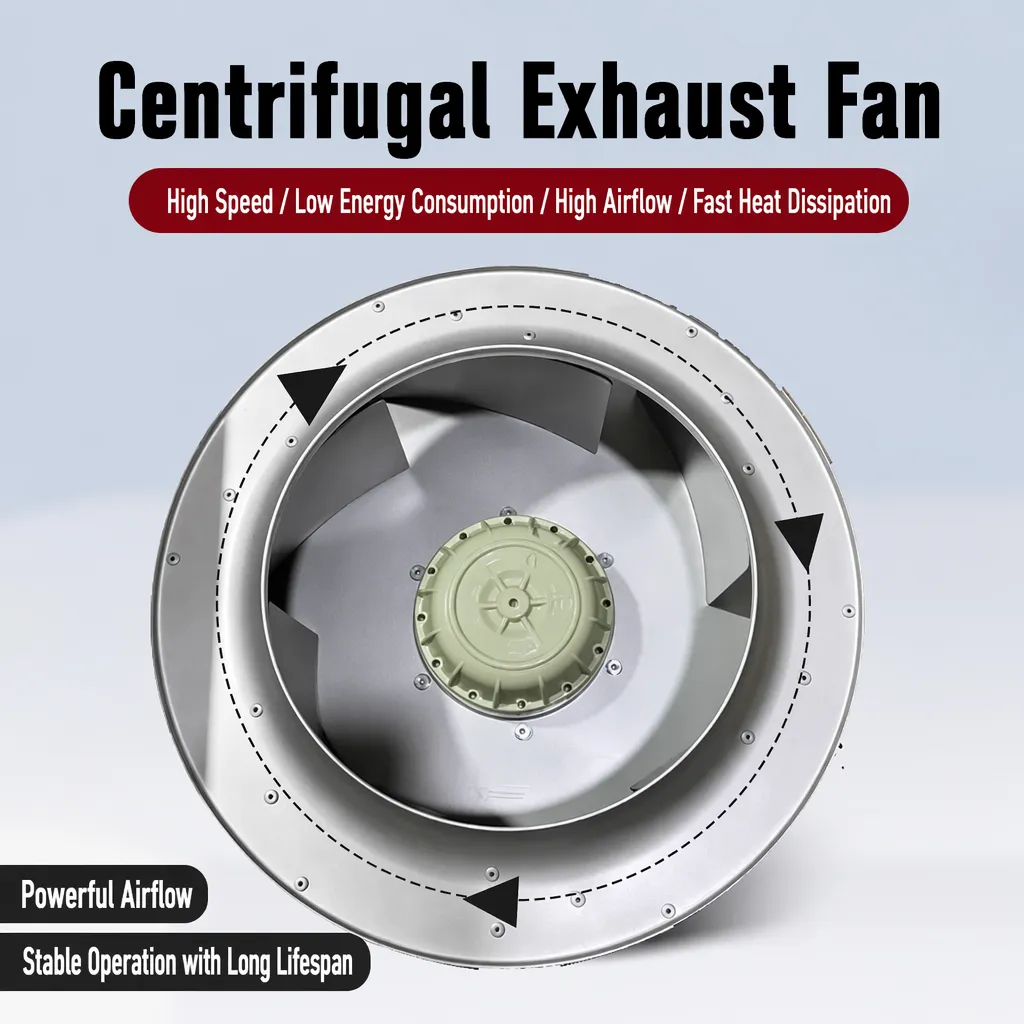
Workshops in summer can become unbearable heat traps. A metal shop floor near a welding line often climbs past 38°C, and the usual reflex is to specify a refrigerated air-handling unit. An industrial air cooler fan takes a different path: it pushes large volumes of air through water-saturated pads and lets evaporation do the cooling. No compressor, no refrigerant, no chiller. For many fabrication and assembly halls, that single change removes the need for mechanical refrigeration entirely while still cutting the felt temperature by several degrees.
An industrial air cooler fan relies on an adiabatic process: heat leaves the air as water evaporates, so the air temperature drops while the moisture content rises. The limit of that drop is the wet-bulb temperature of the incoming air. On a dry summer day with an ambient temperature near 35°C and a wet-bulb around 22°C, the unit can deliver air close to that wet-bulb figure. The evaporative pad is where the exchange happens, and the fan's job is to move enough air across it to keep the workshop supplied with cooled, moving air.
Cellulose pad media holds water on a large surface area, giving air time to pick up moisture and shed heat. The cooled air leaving the pad is then distributed by the fan. A well-matched industrial air cooler fan sustains the airflow (CFM) and pad saturation efficiency needed to approach the wet-bulb limit. A thicker pad raises that efficiency, but only if the motor can sustain the duty cycle without overheating. Good thermal management here means the motor winding stays within its rated class while running long summer shifts.evaporative cooling, workshop ventilation, adiabatic cooling, wet-bulb depression
Cooling only works if the cold air reaches the people and machines. Air changes per hour (ACH) is the metric that matters: a fabrication bay typically needs 20–40 ACH to flush heat faster than it builds. An industrial air cooler fan supports that rate only with an open relief path, so cross-ventilation through opposite walls or roof vents is essential. Without a relief opening, static pressure builds and the delivered CFM falls, defeating the design.evaporative cooling, workshop ventilation, adiabatic cooling, wet-bulb depression
Fan placement drives the whole result. Mount units high on the upwind wall and let gravity-assisted airflow carry cooled air across the floor. An industrial air cooler fan must overcome the static pressure of the pad and any ducting while still delivering target CFM. Outer-rotor brushless motors with precision ball bearings handle that load quietly and keep the duty cycle stable across a shift. When airflow velocity at the worker zone stays above a modest threshold, the perceived temperature drops even before the air fully equilibrates.
A metal-fabrication workshop in a hot inland region regularly hit 40°C at the peak of summer, with welders and cutting tables adding radiant load. The owner rejected a refrigerated AHU because of cost and complexity. Instead, a row of industrial air cooler fan units was installed along the prevailing wind side, backed by louvered exhaust on the opposite wall. With cross-ventilation established, the measured ambient temperature at the workstations fell into the low 30s and the felt temperature dropped 5–8°C. Workers reported the floor was workable through the afternoon without a chiller running.
The win came from three choices. First, pads were sized for the local wet-bulb depression, not a generic guess. Second, exhaust openings matched the fan's CFM so air changes per hour stayed high. Third, the installed industrial air cooler fan units used pure-copper winding and sealed bearings rated for continuous duty, so they ran all day without thermal trips. This is heat dissipation done by moving air, not by refrigeration — and it fits OSHA's ventilation guidance for hot indoor workplaces.
Evaporative cooling has a hard ceiling: it adds moisture. In already-humid coastal or monsoon climates the wet-bulb sits close to the ambient temperature, so the possible depression shrinks and the method loses punch. ASHRAE comfort guidance notes that evaporative approaches work well where relative humidity stays below roughly 60%. Where that limit is exceeded, the fan still helps with ventilation and heat dissipation, but a refrigerated system may be needed for the deepest cooling.
Sustained performance depends on upkeep. Cellulose pads clog with dust and scale; a seasonal rinse and annual replacement keep saturation efficiency up. Motors need clean power and an enclosure suited to the site — IP54 suits dusty or wash-down bays, while IP44 covers drier shops. Precision ball bearings and a balanced impeller cut vibration and extend life. CE-marked units meet the EU machinery and low-voltage directives, which simplifies import and site acceptance for European buyers.
Cooling a workshop without extra refrigeration is practical when the climate and layout cooperate. An industrial air cooler fan moves air through saturated pads, leaning on wet-bulb depression to pull the felt temperature down several degrees while cutting the load a chiller would otherwise carry. Buyers should size pads to local wet-bulb data, confirm cross-ventilation, and pick motors built for continuous duty with sealed bearings and copper winding. For dry and moderate-humidity regions, this adiabatic approach delivers comfortable, low-cost workshop cooling.
How does an industrial air cooler fan lower workshop temperature without a chiller?
Answer: Evaporative units pull warm air through water-saturated cellulose pads, where evaporation absorbs heat and drops the air toward its wet-bulb temperature. No compressor or refrigerant is involved. The cooled air is then moved across the floor by the fan, lowering the felt temperature by several degrees while flushing heat from machines and people. Dry, moderate-humidity climates see the strongest effect, often a 5–8°C perceived drop.
Why does cross-ventilation matter for evaporative cooling?
Answer: Evaporative cooling adds moisture to the air, so stale humid air must leave as fast as cooled air arrives. Without an open relief path on the opposite wall or roof, static pressure rises and delivered CFM drops. Good cross-ventilation keeps air changes per hour high, which flushes heat before it builds. Louvered exhaust matched to fan output is the simplest way to sustain that flow across a full shift.
Which humidity level limits evaporative workshop cooling?
Answer: The method loses punch as relative humidity climbs because the wet-bulb sits closer to the ambient temperature, shrinking the possible depression. ASHRAE comfort guidance places the practical ceiling near 60% relative humidity for evaporative approaches. Above that, the fan still aids ventilation and heat dissipation, but the cooling gain shrinks. Coastal and monsoon regions often exceed the limit, where a refrigerated system may be required for the deepest temperature reduction.
How often should cellulose pads and motors be maintained?
Answer: Cellulose pads trap dust and mineral scale, so a seasonal rinse and an annual replacement keep saturation efficiency high. Motors need clean, stable power and an enclosure matched to the site — IP54 suits dusty or wash-down bays, IP44 covers drier shops. Precision ball bearings and balanced impellers cut vibration and extend service life. A simple log of runtime hours helps schedule upkeep before performance drifts during peak summer demand.
Can evaporative cooling replace a refrigerated AHU completely?
Answer: In dry and moderate-humidity regions, evaporative cooling often covers the whole comfort load without a chiller, which removes the compressor, refrigerant and high electrical draw. The trade is added moisture and a dependence on good ventilation. Where humidity stays low, the running cost and simplicity beat a refrigerated AHU. In humid climates, the two are sometimes combined: evaporative pre-cooling feeds a smaller refrigerated unit for the final degrees.

2026/09/30
Cement cabinets choke on dust. Learn the filter rule for an industrial cabinet cooling fan: G4/F7 media, IP rating, and pre-filter care.

2026/10/07
Right wall-mount height for an industrial axial exhaust fan: room volume, free clearance, brackets, and recirculation control.

2026/10/08
An ec motor fan links to BMS via Modbus, 0-10V and PWM for demand-based cooling, energy scheduling and automatic sensor-driven speed control.

2026/10/06
A radial exhaust fan removes grease, fumes, and odors from food-processing workshops with capture velocity and hygienic washdown design.

2026/10/05
Learn antistatic treatment for industrial cabinet cooling fan in electronics workshops—ESD-safe housing, ionizable plastics, and cleanroom compatibility.

2026/10/04
Discover how a brushless dc servo delivers precise wind speed control for laboratory cooling fans with closed-loop PID feedback and laminar airflow.
