
 EN
EN
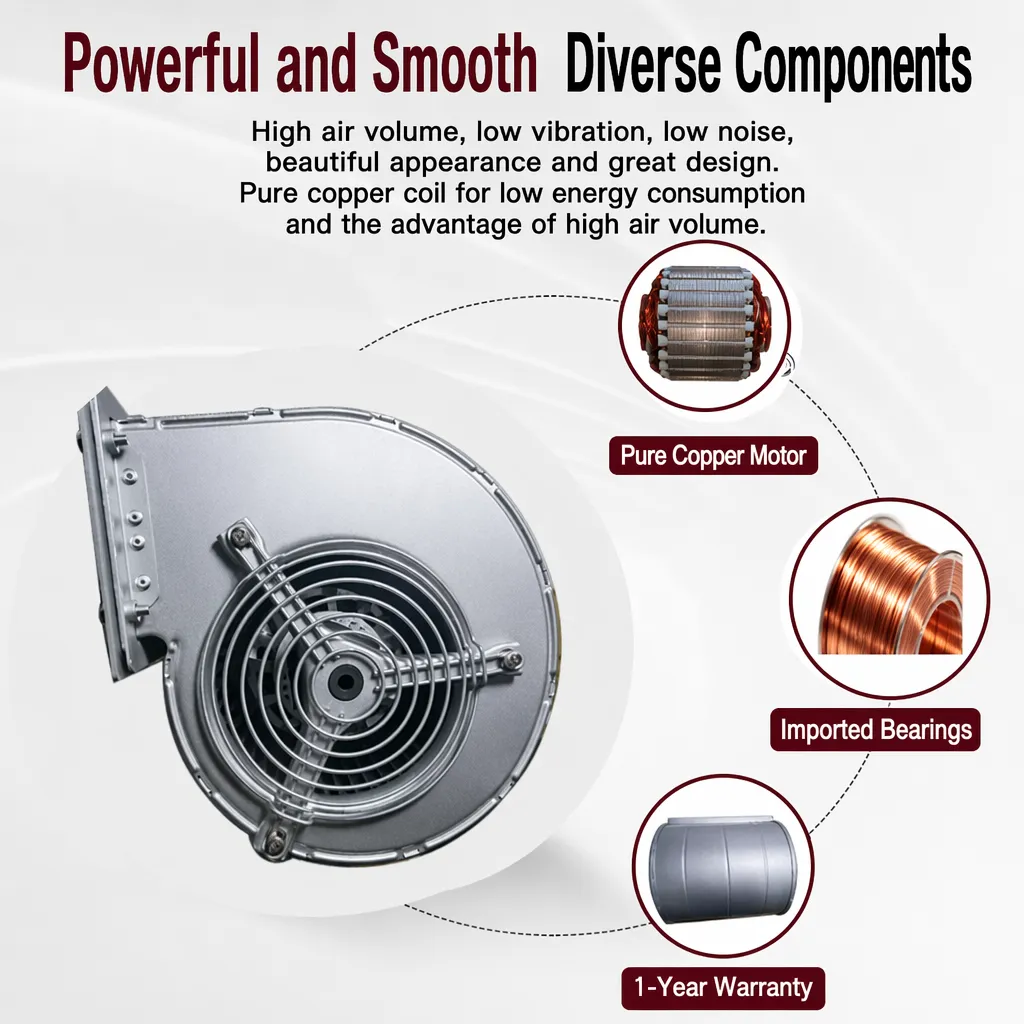
How Industrial Blower Fans Eliminate Hot Air Stratification Inside High Rise Factory Workshops
Have you ever walked the production floor of a high-rise factory workshop and noticed that workers near ground level are sweating while the ceiling area feels like a different climate entirely? That temperature imbalance has a name — thermal stratification — and it is one of the most persistent and underestimated problems in large industrial buildings. The right industrial blower fans do not just move air. They change how heat distributes across the entire space.
What Is Hot Air Stratification and Why Does It Happen?
Thermal stratification occurs when hot air accumulates near the ceiling while cooler air settles near the floor. The physics are straightforward: warm air is less dense than cold air, so it rises. In a standard building with a 3-meter ceiling, this gradient is manageable. In high-rise factory workshops where ceiling heights routinely reach 8, 12, or even 20 meters, the effect becomes severe.
Field measurements consistently show that the temperature rise in industrial spaces is approximately 0.5°F (about 0.28°C) per foot of height above the floor. For a 15-meter workshop, that translates to a floor-to-ceiling differential that can reach well above 8°C. In environments with significant heat sources such as furnaces, welding stations, or heavy machinery, temperature discrepancies of 15–20°C between floor and ceiling are not uncommon.
In real installations, it is common to find that heat is not evenly distributed across the factory floor — upper zones run hotter consistently — and addressing the issue requires more than simply increasing roof-level ventilation. The root cause is the absence of forced convective mixing, not a shortage of fresh air.
The Real Cost of Stratification in Production Facilities
Hot air stratification creates problems across three dimensions that factory managers often track separately but should understand together.
Worker comfort and safety: Ground-level workers bear the heat load from production equipment while cooler air sits uselessly overhead. In summer months or regions with high ambient temperatures, this creates genuine heat stress risk during extended shifts.
Energy waste: When heating systems operate in stratified spaces, thermostats at worker height trigger heating cycles even though large volumes of hot air are already present near the ceiling. Industry estimates suggest effective destratification can reduce heating energy consumption by 20–30%. Research examining buildings equipped with destratification fans has documented heating energy reductions in the range of 19% — worth noting for facilities that run heating systems through long cold periods.
Equipment and process variability: Many manufacturing processes are sensitive to ambient temperature consistency. Stratified air creates microclimates within a single workshop, introducing variability into processes that assume stable conditions. This is particularly relevant in precision machining, painting, or electronics assembly environments.
How Industrial Blower Fans Work Against Stratification
Industrial blower fans eliminate stratification not by cooling the air, but by forcing it to mix. When a properly sized and positioned blower fan drives air horizontally or at an angle across a workshop, it creates turbulent mixing that breaks up the stable temperature layers. Hot air near the ceiling gets pulled down and blended with cooler air at lower levels, establishing a more uniform temperature throughout the full height of the space.
The underlying mechanism is forced convection overcoming buoyancy. Left undisturbed, hot air will consistently stratify vertically as long as buoyancy forces remain uninterrupted. Industrial blower fans introduce enough momentum into the air mass to overcome that tendency — pushing warm ceiling air back into circulation with the air that workers actually breathe and work in.
This approach works particularly well in buildings with ceiling heights over 4–5 meters, where natural convection cannot prevent distinct thermal layers from forming. The higher the ceiling, the more pronounced the stratification — and the bigger the impact a well-designed blower fan installation can have.
Selecting the Right Industrial Blower Fan for Your Workshop
Contrary to what many assume, pushing industrial blower fans to maximum RPM does not reliably improve overall thermal performance. It can create excessive turbulence near work surfaces and introduce noise or dust recirculation that was not there before. The goal is to select a fan that delivers enough air throw and coverage for the workshop dimensions at a speed that achieves mixing without disrupting what is happening on the production floor.
Key parameters when selecting industrial blower fans for stratification control:
- Air volume (CFM/m³/h): The fan must move enough air to achieve meaningful mixing across the full floor area. Workshops with ceiling heights above 8 meters typically require higher capacity than standard ventilation calculations suggest.
- Throw distance: Industrial blower fans for destratification must project airflow across the full workshop width or length, not just circulate air near the unit. Match throw capacity to your longest unobstructed floor dimension.
- Motor type and efficiency: EC (electronically commutated) motor options allow variable speed control, making it possible to throttle back during cooler periods without losing the ability to ramp up when stratification risk increases.
- Mounting and positioning: Fans aimed at a slight downward angle from an elevated position — typically around 60–70% of ceiling height — outperform ceiling-mounted units blowing straight down. The diagonal airpath produces more thorough whole-space mixing.
If the workshop has clear inlet and outlet zones, this approach tends to work well. Significant internal obstructions — production lines, large equipment arrays, or mezzanine structures — require the positioning strategy to be adapted accordingly.
Avoiding Common Implementation Mistakes
In my experience selecting industrial blower fans for large workshops, the system-level factors matter more than the fan specification itself: where the unit is positioned, how many are needed for the floor area, and whether the installation actually creates cross-space mixing rather than local recirculation near the fan.
A single heavy duty industrial air blower positioned near one end of a 50-meter workshop will not eliminate stratification across the full space. It will create a well-mixed zone near the fan and leave the far end of the building largely unchanged. A distributed approach — multiple units positioned to create overlapping airflow coverage — consistently outperforms a single high-capacity unit in large workshop environments.
Destratification also works better when the system runs continuously or responds to temperature differential sensors, rather than being switched on reactively when workers report discomfort. By the time stratification becomes noticeable at floor level, the thermal layers are already established. Preventing stratification from forming in the first place is more energy-efficient than trying to break it down after the fact.
Choosing an Industrial Fan Supplier
Selecting industrial blower fans for a high-rise factory workshop is not a standard procurement decision. Manufacturers with genuine product expertise across industrial fan types — centrifugal and axial designs with industrial-grade motor options — are in a better position to support this kind of selection than general HVAC distributors who may not have encountered the specific stratification dynamics of large production buildings.
Guangdong Lebisen Fan Co., Ltd specializes in industrial fan products including EC axial fans and external rotor fan systems suited to industrial ventilation and destratification applications. Their product range is designed for international markets and includes technical documentation to support buyer evaluation. Details at www.lobisong.com.
Summary
Hot air stratification in high-rise factory workshops is a real, measurable problem with a clear technical solution. Industrial blower fans address it by introducing forced convection that disrupts the stratification gradient and redistributes heat throughout the workshop. Getting the outcome right depends on matching fan selection, positioning, and operational approach to the actual dimensions and thermal conditions of the space. When those elements come together, industrial blower fans can meaningfully reduce heating energy use, improve conditions on the production floor, and deliver more consistent ambient temperatures throughout even the tallest factory buildings.






