 EN
EN
What filter matching rule for dust proof cabinet cooling fan operating in cement factories
2026/09/30
Cement cabinets choke on dust. Learn the filter rule for an industrial cabinet cooling fan: G4/F7 media, IP rating, and pre-filter care.

2026/09/13
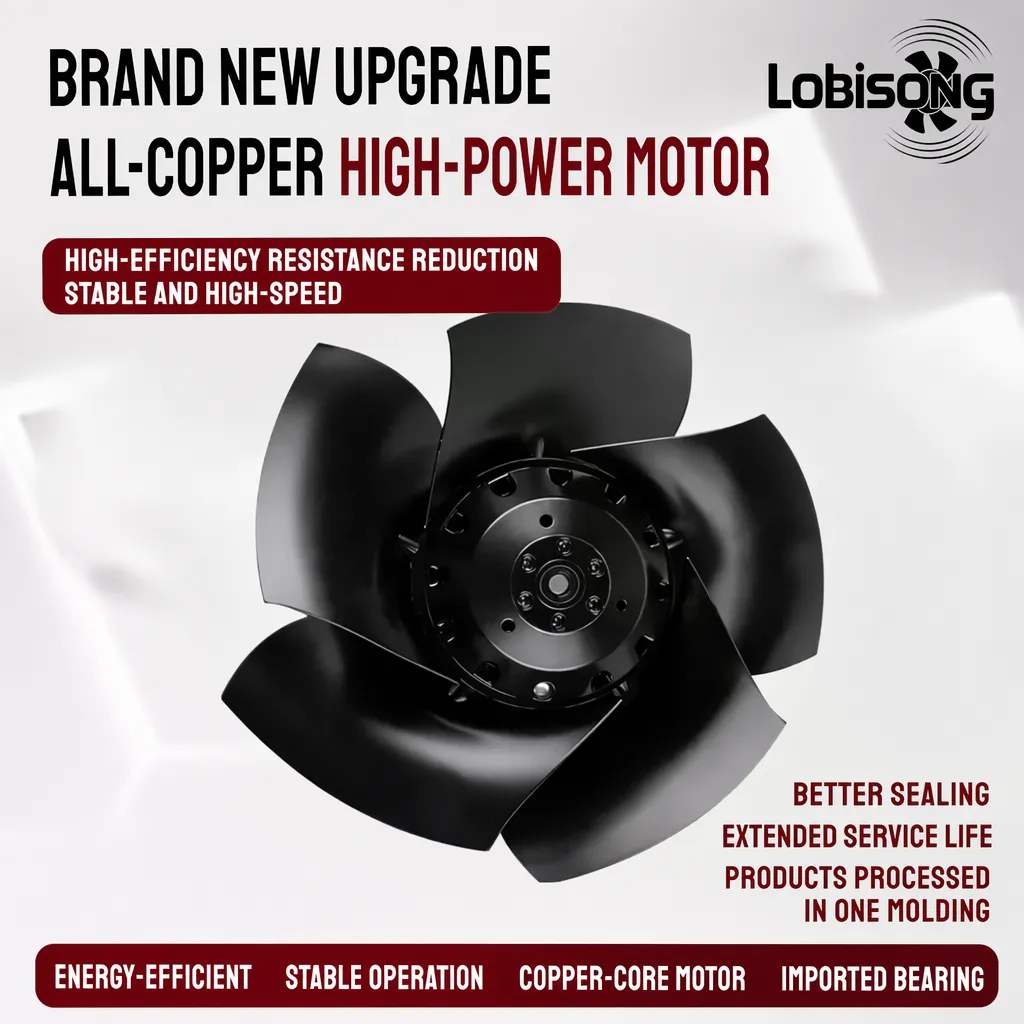
Hot process lines in plastic extrusion, injection molding and metal curing vent large volumes of warm air outdoors without a second thought. An industrial centrifugal blower fan placed at the exhaust collar can intercept that stream and push it into a recovery circuit instead of the atmosphere. The payoff is concrete: less burner gas for intake air and a shorter path to payback. Recovery starts not with a new heater but with capturing heat that already exists on the line.
An industrial centrifugal blower fan earns its place at the source of the heat, not halfway down a long duct where the stream has cooled and mixed. On an extrusion or injection-molding line the barrel, the die and the cooling zone radiate and convect warmth into the surrounding air, which a local hood captures at 80–120°C. That exhaust air carries real enthalpy, roughly the energy needed to raise the same mass of fresh air from ambient to process temperature. Treat the collar as a heat mine rather than a nuisance vent, and the recovery case writes itself.
Untended, that warm stream leaves through the roof and takes its heat with it. A single mid-size line moving a few thousand CFM at 100°C is a steady thermal load the burner must later replace from cold. In winter the penalty grows, because cold make-up air entering the building widens the gap between exhaust and intake. Capturing part of it through thermal recuperation lowers the duty cycle of fired heating and shrinks total plant draw at peak make-up air demand. Measure first: log exhaust temperature, airflow velocity and run hours before sizing.
The double-inlet layout draws air from both sides of the impeller, balancing axial thrust and letting the wheel spin smoothly under load. In a recovery loop the fan fights static pressure from filters, the heat exchanger and long duct runs, so a unit that holds its curve matters more than peak free-air numbers. Centrifugal airflow tolerates dust and grease better than axial styles, keeping CFM at the design target as filters load. An industrial centrifugal blower fan with a flat pressure curve keeps recovery mass flow steady as conditions drift.
Heat near the inlet raises the motor's ambient, so the motor winding and bearing must be specified for the real duty cycle, not a catalog average. Pure-copper winding and precision ball bearings limit temperature rise and extend service intervals; an outer-rotor brushless motor places the windings close to the airstream for effective heat dissipation. Sizing the enclosure to IP54, per EN 60529, keeps moisture and condensation from the terminals during cool-down. A robust industrial centrifugal blower fan planned this way survives the thermal cycling that defeats cheaper, lighter units.
A plate heat exchanger transfers energy from the hot exhaust air to the colder make-up air without mixing the two streams, so contaminant carryover stays low. Thermal recuperation of this kind recovers a large share of the exhaust enthalpy and delivers it to the intake side, where the burner faces a warmer charge. Laminated plates keep pressure drop modest while presenting ample surface for the exchange. The exchanger is the heart; the fan keeps it fed with consistent mass flow despite filter loading.
The warmed make-up air feeds the building or the combustion air inlet, cutting the gas needed to reach setpoint. Where the line also uses hot water, a second coil on the same exhaust air can preheat process water before the main heater, stacking the savings. The industrial centrifugal blower fan sets the mass flow on both sides, so matching its CFM to the heat exchanger rating prevents starvation on the cold leg. Operators often see steadier oven temperatures once the intake charge stops swinging with the weather.
Confirm the static pressure budget covers the heat exchanger, filters and duct before the fan ships. Verify the impeller and bearing match the exhaust temperature, and that the motor winding class suits the inlet heat. Request test data against IEC 60034 for the motor and a declaration of conformance to CE where the equipment enters European sites. A duct layout that shortens runs and limits elbows protects both CFM and enthalpy recovery, and a washable snap-on filter screen keeps grease off the core during the first messy months.
Grease the bearing on the interval the duty cycle implies, not a calendar guess, and watch motor winding temperature trends for early warning of imbalance. Wash the snap-on filter screens before static pressure climbs, since a blocked core starves the heat exchanger and the make-up air side alike. Logging exhaust and intake temperatures each shift turns energy recovery into a managed, auditable routine that supports an ISO 50001 energy-management program and gives procurement a defensible basis for the next upgrade. Records also reveal when a worn impeller begins to slip from its design curve.
Waste-heat recovery turns a nuisance vent into a second fuel source for the plant. A well-specified industrial centrifugal blower fan, paired with a plate heat exchanger and disciplined maintenance, returns exhaust enthalpy to the intake air and trims burner gas without touching product quality. The economics close fastest on lines that run long duty cycles at high exhaust temperature, which is exactly where the recovery loop pays for itself.
What is waste-heat recovery with a centrifugal blower? Answer: Waste-heat recovery captures warm exhaust from process equipment and returns its energy to the plant instead of venting it outdoors. A centrifugal blower moves the hot stream through a heat exchanger that warms incoming make-up air or process water. The burner then needs less gas to reach setpoint. The method suits lines running long duty cycles at high exhaust temperature, where recovered enthalpy justifies the duct and exchanger cost.
Why capture exhaust air instead of adding insulation? Answer: Insulation slows heat loss through walls but does nothing for the warm air already leaving through the exhaust collar. Capturing exhaust air recovers energy that would otherwise be thrown away, while insulation only reduces new losses. On a plastic-extrusion line the hood air at 80–120°C is a concentrated, movable heat source the fan can target directly. The blower-driven recovery usually pays back faster because it attacks the largest, hottest leak on the line.
How is the heat exchanger matched to the fan? Answer: Matching starts with the exhaust CFM and temperature, which set the thermal duty the plate exchanger must handle. The industrial centrifugal blower fan is then selected so its pressure curve covers the static pressure of the exchanger, filters and duct at that flow. Undersize the fan and the cold leg starves; oversize it and noise and power climb. Test data against IEC 60034 for the motor confirms the unit holds its curve across the real duty cycle.
Which standards apply to a recovery blower system? Answer: For the motor, IEC 60034 defines rotating-machine performance and testing that buyers can request as evidence. The enclosure rating follows EN 60529, where IP54 resists moisture and condensation during cool-down. Where the equipment enters European sites, a CE declaration of conformance applies to the relevant directives. An ISO 50001 energy-management program then gives the recovered-energy figures a documented home, turning isolated savings into auditable, repeatable performance the plant can report with confidence.
When should maintenance be scheduled for the recovery loop? Answer: Bearing lubrication follows the duty cycle implied by run hours and temperature, not a fixed calendar date, because hotter lines age grease faster. Filter screens need washing before static pressure climbs, since a loaded core cuts both exhaust capture and make-up air delivery. Logging exhaust and intake temperatures each shift flags drift early. A planned interval, recorded against the ISO 50001 routine, keeps enthalpy recovery steady and avoids the efficiency loss unattended loops suffer over time.

2026/09/30
Cement cabinets choke on dust. Learn the filter rule for an industrial cabinet cooling fan: G4/F7 media, IP rating, and pre-filter care.

2026/10/07
Right wall-mount height for an industrial axial exhaust fan: room volume, free clearance, brackets, and recirculation control.

2026/10/08
An ec motor fan links to BMS via Modbus, 0-10V and PWM for demand-based cooling, energy scheduling and automatic sensor-driven speed control.

2026/10/06
A radial exhaust fan removes grease, fumes, and odors from food-processing workshops with capture velocity and hygienic washdown design.

2026/10/05
Learn antistatic treatment for industrial cabinet cooling fan in electronics workshops—ESD-safe housing, ionizable plastics, and cleanroom compatibility.

2026/10/04
Discover how a brushless dc servo delivers precise wind speed control for laboratory cooling fans with closed-loop PID feedback and laminar airflow.
