 EN
EN
What filter matching rule for dust proof cabinet cooling fan operating in cement factories
2026/09/30
Cement cabinets choke on dust. Learn the filter rule for an industrial cabinet cooling fan: G4/F7 media, IP rating, and pre-filter care.

2026/08/26
Arc welding, spot welding, and automated resistance welding operations generate intense thermal energy within concentrated zones. Without proper airflow management, localized heat rapidly spreads into welding torches, cables, automated sensors, and electronic control units. This heat buildup accelerates insulation degradation, shortens electrode life, and causes premature equipment failure.
To maintain continuous production uptime, workshop managers implement targeted thermal strategies. Deploying a compact small industrial blower fan directly at the workstation provides focused air movement that pulls heat away from critical components. This targeted approach to welding equipment cooling keeps essential tools running smoothly without wasting energy cooling entire workshop halls.
Why Targeted Air Movement Outperforms General Facility Ventilation
Standard ambient ventilation systems circulate large volumes of air across an entire building. While general ventilation helps maintain overall air quality, it cannot handle extreme localized heat spikes generated right at the welding joint where surface temperatures soar.
Integrating a small industrial blower fan directly onto a welding jig, workstation frame, or robotic arm delivers high-velocity air right to the thermal source. This specialized form of local spot cooling increases convective heat transfer right where heat accumulates.
Because concentrated airflow removes thermal energy before it radiates into surrounding structural frames and wire harnesses, critical welding tools remain within safe operating temperatures. Concentrating airflow on specific high-heat areas achieves superior cooling efficiency compared to relying on ambient facility HVAC systems alone.
Engineering Features Built for Harsh Industrial Workstations
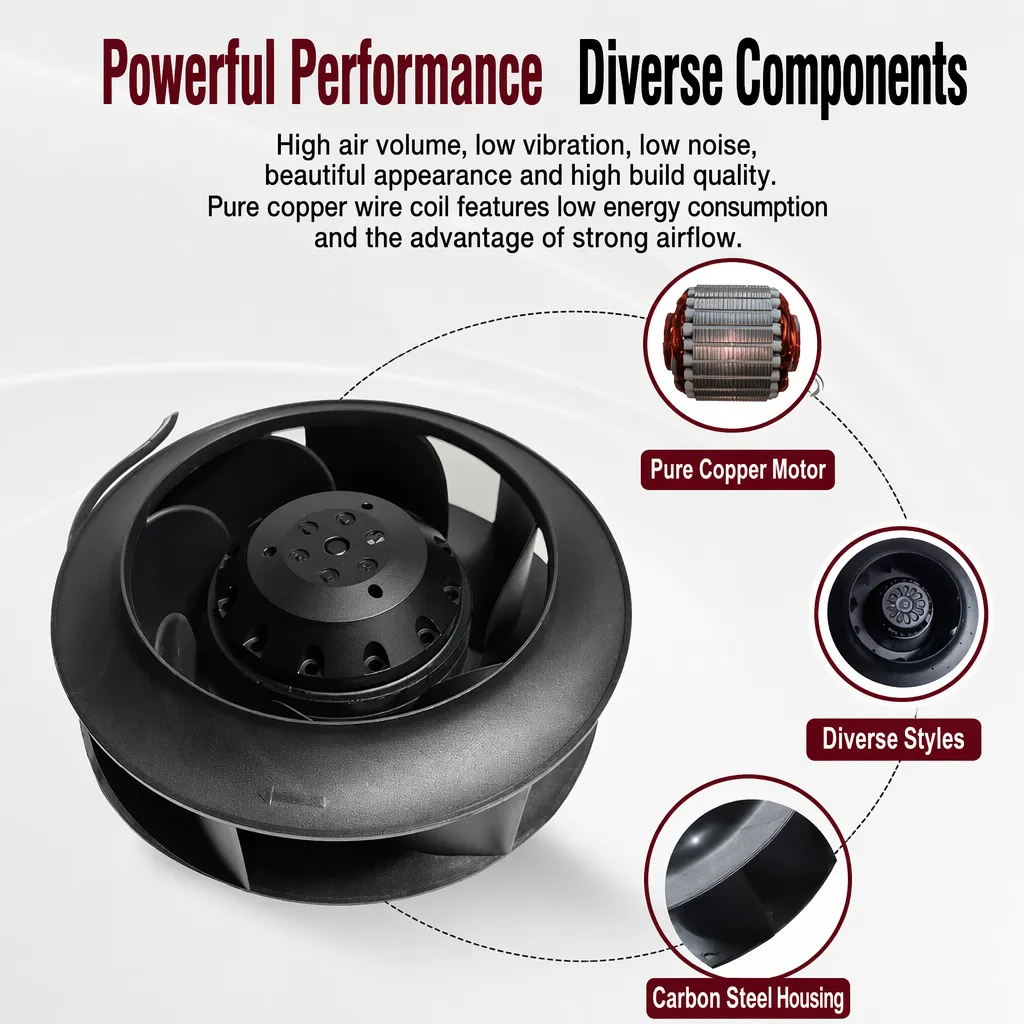
Standard commercial fans break down quickly when placed near welding operations due to flying spatter, fine metallic airborne dust, and high radiant heat. A heavy-duty small industrial blower fan designed for local spot cooling incorporates specialized design features:
Heat-Resistant Materials: Die-cast aluminum housings or flame-retardant thermoplastics withstand radiant heat and occasional welding spatter without warping or melting.
High Static Pressure Impellers: Centrifugal blade designs generate the static pressure required to push air through narrow nozzles, flexible ducting, or protective mesh guards.
Sealed IP-Rated Motor Enclosures: Motor housings carrying IP54 or higher protection ratings keep fine metallic dust and flux residue from entering internal motor windings.
Variable Speed PWM Drivers: External rotor motors equipped with electronic speed control allow operators to tune airflow velocity based on material thickness and welding amperage.
Comparing Thermal Control Strategies for Welding Operations
Comparing different thermal control methods highlights why a small industrial blower fan setup remains the practical choice for most welding workstations:
Local Blower Cooling: Delivers targeted air movement directly to the heat source with minimal power consumption, simple mounting, and low maintenance overhead. Highly effective for local spot cooling around torches and fixtures.
Spot Cooler Systems: Supply refrigerated air to specific zones. While effective at reducing air temperatures, spot coolers require high capital investment, consume substantial power, and need regular refrigerant maintenance.
General Ambient Workshop Ventilation: Moves large air volumes across the entire room. It maintains overall air balance but fails to remove extreme thermal spikes at individual welding joints.
For most manual and automated workstations, deploying a small industrial blower fan delivers the ideal balance between low operational cost, simple installation, and targeted welding equipment cooling performance.
Practical Implementation Guidelines for Welding Workstations
Successfully deploying local spot cooling equipment requires paying attention to practical installation details:
Calculate Required CFM Capacity: Select a fan delivering 100 to 300 cubic meters per hour of airflow per workstation, scaling up for higher welding amperages.
Align Airflow Direction Carefully: Position fan nozzles to direct airflow parallel to the workpiece surface. Never blow air directly across the arc tip, as turbulent airflow disrupts shielding gas coverage and causes weld porosity.
Isolate Mechanical Vibration: Use rubber vibration isolators when mounting a small industrial blower fan onto precision welding fixtures or robotic arms to prevent micro-vibrations from affecting seam accuracy.
Automate Fan Operation: Connect fan power relays to weld controller signals. Automatically triggering the small industrial blower fan during active arc striking conserves energy and extends motor life during idle periods.
Sizing and Selecting the Right Blower Units
Selecting the ideal small industrial blower fan for specialized welding equipment cooling requires matching mechanical specs against real-world shop conditions:
Static Pressure Headroom: Factor in the friction loss caused by narrow airflow nozzles, protective grills, or flexible ducting attachments.
Operating Temperature Limits: Verify that motor bearings and housing materials maintain rated operational life under elevated ambient temperatures near welding arcs.
Power Supply Compatibility: Choose models supporting common shop voltages, including 115V, 220V, or 380V single and three-phase configurations.
Dust and Moisture Ingress Ratings: Ensure all motor housings and cable entry glands carry IP54 or higher ratings to block conductive metallic dust.
Manufacturing Expertise and Global Supply Support
Building durable industrial air-handling equipment requires working with specialized fan manufacturers that maintain strict production controls and engineering standards.
Lobisong (lobisong.com) manufactures AC and DC industrial blower fans engineered specifically for demanding equipment enclosures and industrial workstations. Operating five automated production lines equipped with motor winding, precision welding, assembling, and dynamic blade balancing testing stations, Lobisong delivers consistent quality across every unit built.
Holding international CE and UKCA certifications, Lobisong supplies custom OEM and ODM small industrial blower fan solutions to equipment manufacturers across nineteen countries in Europe, Russia, India, and the Americas. Offering custom voltage choices, high IP-rated motor protection, and reliable delivery performance, Lobisong provides global industrial clients with reliable welding equipment cooling solutions and long-term supply chain support.

2026/09/30
Cement cabinets choke on dust. Learn the filter rule for an industrial cabinet cooling fan: G4/F7 media, IP rating, and pre-filter care.

2026/10/07
Right wall-mount height for an industrial axial exhaust fan: room volume, free clearance, brackets, and recirculation control.

2026/10/08
An ec motor fan links to BMS via Modbus, 0-10V and PWM for demand-based cooling, energy scheduling and automatic sensor-driven speed control.

2026/10/06
A radial exhaust fan removes grease, fumes, and odors from food-processing workshops with capture velocity and hygienic washdown design.

2026/10/05
Learn antistatic treatment for industrial cabinet cooling fan in electronics workshops—ESD-safe housing, ionizable plastics, and cleanroom compatibility.

2026/10/04
Discover how a brushless dc servo delivers precise wind speed control for laboratory cooling fans with closed-loop PID feedback and laminar airflow.
