 EN
EN
What filter matching rule for dust proof cabinet cooling fan operating in cement factories
2026/09/30
Cement cabinets choke on dust. Learn the filter rule for an industrial cabinet cooling fan: G4/F7 media, IP rating, and pre-filter care.

2026/09/07

Electrical cabinets concentrate drives, contactors, and power supplies that all shed heat into a closed box. A variable speed ec fans setup keeps that box within a tight temperature band instead of swinging between too hot and too cold. The approach trades a fixed full-speed blast for measured modulation, which protects the electronics and the energy bill at the same time. For facilities running panels around the clock, that steady control is the thermal management that prevents the silent drift into failure.
A metal-panel fabricator ran its control cabinets on fans that switched on at a high setpoint and off at a low one. On hot afternoons the cabinets spiked past 55 °C and the PLCs dropped into protective shutdown, stopping the line. After fitting variable speed ec fans tied to a cabinet temperature sensor, the internal temperature held near 42 °C through the same heat, and the shutdowns ended. The air moved was similar; the control was the difference.
A thermostat that only switches a fan on or off leaves a wide dead band, so the cabinet heats and cools in cycles rather than holding steady. During the off phase the temperature climbs toward the danger zone; during the on phase the fan runs flat out and then stops, wasting the energy used to accelerate it. Worse, the repeated thermal cycling stresses solder joints and shortens component life. Variable speed ec fans remove the step by easing output up and down with the load. The same on/off habit also hides problems, because a fan that is simply on gives no signal about whether the cabinet is actually within range. Modulated speed is itself a diagnostic: when the fan sits near full output on a cool day, something in the load or the sensor has changed.
The EC motor is a brushless design with integrated electronics, so its speed is set by a control signal rather than by line frequency. A variable speed ec fans system takes a 0–10 V or PWM input and translates it into precise rotor speed through electronic commutation. That means the wheel turns only as fast as the cooling demand requires. Because variable speed ec fans carry the drive inside the motor, there is no separate inverter to mount, wire, and maintain on the cabinet wall. The integrated drive also soft-starts the wheel, which avoids the current spike that a direct-on-line fan draws every time it kicks in.
A thermostatic loop reads the cabinet air with a temperature sensor and feeds a controller that adjusts fan speed to hold the setpoint. In practice a PID routine trims the output so the temperature settles without overshoot or oscillation. This closed-loop behavior is what makes variable speed ec fans effective: they use airflow modulation to match the heat, not the clock. The result is a cabinet that stays at one temperature whether the shop is empty at night or running three shifts in August. The loop also protects the electronics from the slow creep that fixed cooling misses, because it reacts to the actual temperature rather than a timer. That continuous correction is why the same setup holds up through seasonal swings that would trip a simpler system.
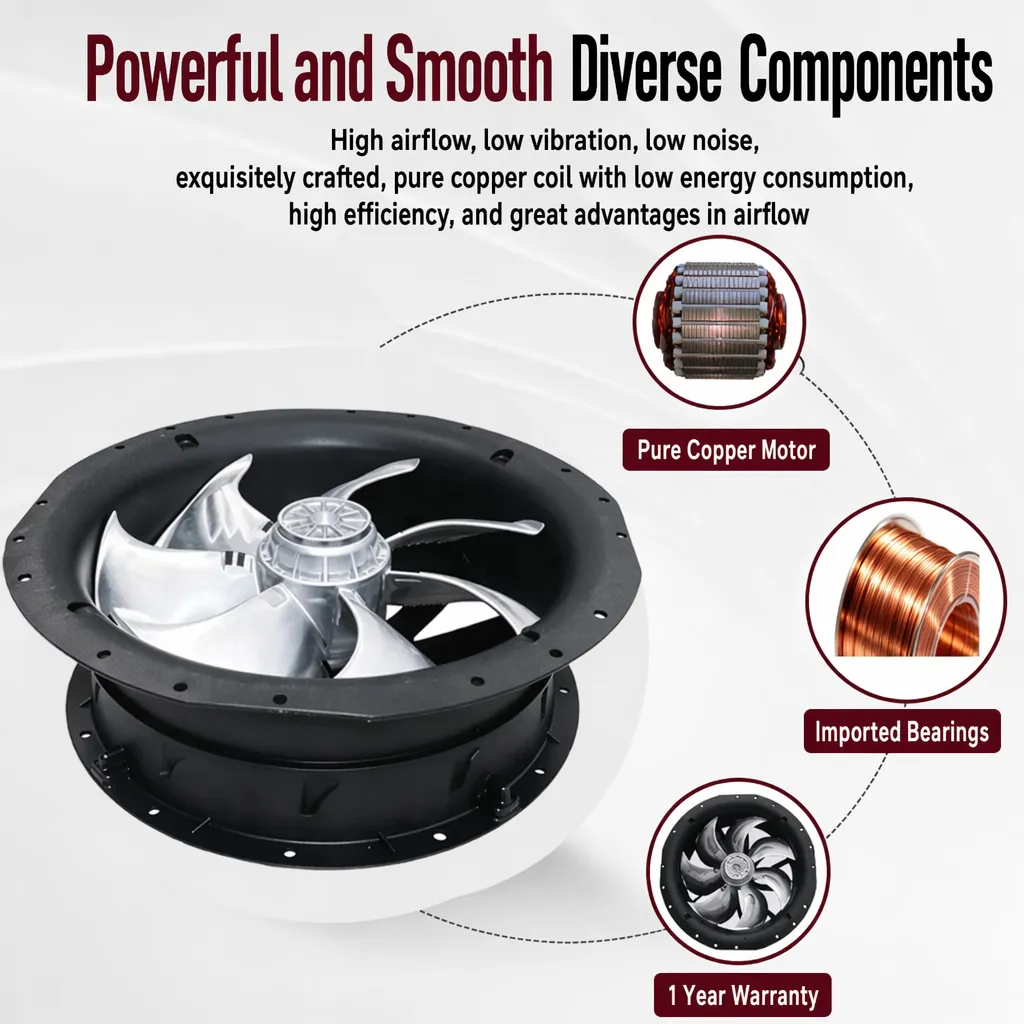
Pick a fan whose maximum airflow covers the worst-case heat load, then let the controller spend most of its life at part speed. Check the duty cycle the application demands, because a fan sized to run flat out all summer will simply sit at full output and gain nothing from the speed control. Set the setpoint with the equipment's rated range in mind, and confirm the EC motor's control input matches the building's available signal type before purchase. It also helps to review the cabinet's own heat path, since a blocked vent or a missing blanking panel forces the fan to work harder than its rating assumes. Good airflow starts with the enclosure, not just the wheel.
Mount the sensor where it reads the real cabinet air, not in a pocket behind a breaker, and verify the loop during a controlled load test. Inspect the wheel and filter every quarter, because a clogged inlet forces the fan to higher speed and erodes the energy saving. A variable speed ec fans installation that is commissioned properly and logged at each service keeps its tight temperature band for years. IEC 60529 defines the ingress protection that suits the cabinet environment. A log that records the fan speed at a given temperature each visit turns the setpoint from a number into a trend, so a drifting sensor shows up long before the cabinet overheats.
Stable cabinet cooling is a control problem before it is a hardware problem. A variable speed ec fans solution earns its place when the sensor, controller, and fan are matched to the real heat load and commissioned together. Procurement gains the most by confirming the control signal type, requesting the performance curve across speed, and funding a commissioning step. The payoff is steady temperature, fewer shutdowns, and lower fan energy.
Question: How do speed-controlled EC fans save energy? Answer: They run only as fast as the heat demands, instead of blasting at full speed or cycling on and off. By modulating airflow to the load through electronic commutation, variable speed ec fans avoid the wasted acceleration and steady over-cooling of a fixed fan, which delivers real energy saving across a full shift or season.
Question: Can they hold a tighter cabinet temperature? Answer: Yes. A closed loop with a temperature sensor and PID trimming keeps the setpoint without the wide dead band of a thermostat switch. The fan eases output up and down with the load, so the cabinet stays near one temperature instead of cycling between hot and cold through the day.
Question: What signal controls the fan speed? Answer: Most EC motors accept 0–10 V, PWM, or a communication signal from a PLC or building HVAC system. That input maps to rotor speed through the integrated drive, so the fan needs no separate inverter. Matching the signal type to the site's controller is the step to confirm before ordering. A wrong signal type means an extra converter and a weaker loop, so this check protects both budget and performance.
Question: Do speed-controlled EC fans need more maintenance? Answer: No more than a fixed fan, and often less, because they avoid hard starts and stops that wear bearings. Keep the wheel and filter clean, verify the sensor placement at commissioning, and log the baseline current. Sealed bearings last for years when the inlet stays clear and the loop is tuned.
Question: Are they suitable for harsh cabinet environments? Answer: Many carry an IP rating suited to dusty or humid enclosures, and the EC electronics are sealed inside the motor. Choose the ingress protection that matches the site, such as the levels defined by IEC 60529, and keep the inlet filter serviced so the fan does not have to fight a clogged path.

2026/09/30
Cement cabinets choke on dust. Learn the filter rule for an industrial cabinet cooling fan: G4/F7 media, IP rating, and pre-filter care.

2026/10/07
Right wall-mount height for an industrial axial exhaust fan: room volume, free clearance, brackets, and recirculation control.

2026/10/08
An ec motor fan links to BMS via Modbus, 0-10V and PWM for demand-based cooling, energy scheduling and automatic sensor-driven speed control.

2026/10/06
A radial exhaust fan removes grease, fumes, and odors from food-processing workshops with capture velocity and hygienic washdown design.

2026/10/05
Learn antistatic treatment for industrial cabinet cooling fan in electronics workshops—ESD-safe housing, ionizable plastics, and cleanroom compatibility.

2026/10/04
Discover how a brushless dc servo delivers precise wind speed control for laboratory cooling fans with closed-loop PID feedback and laminar airflow.
