
 EN
EN
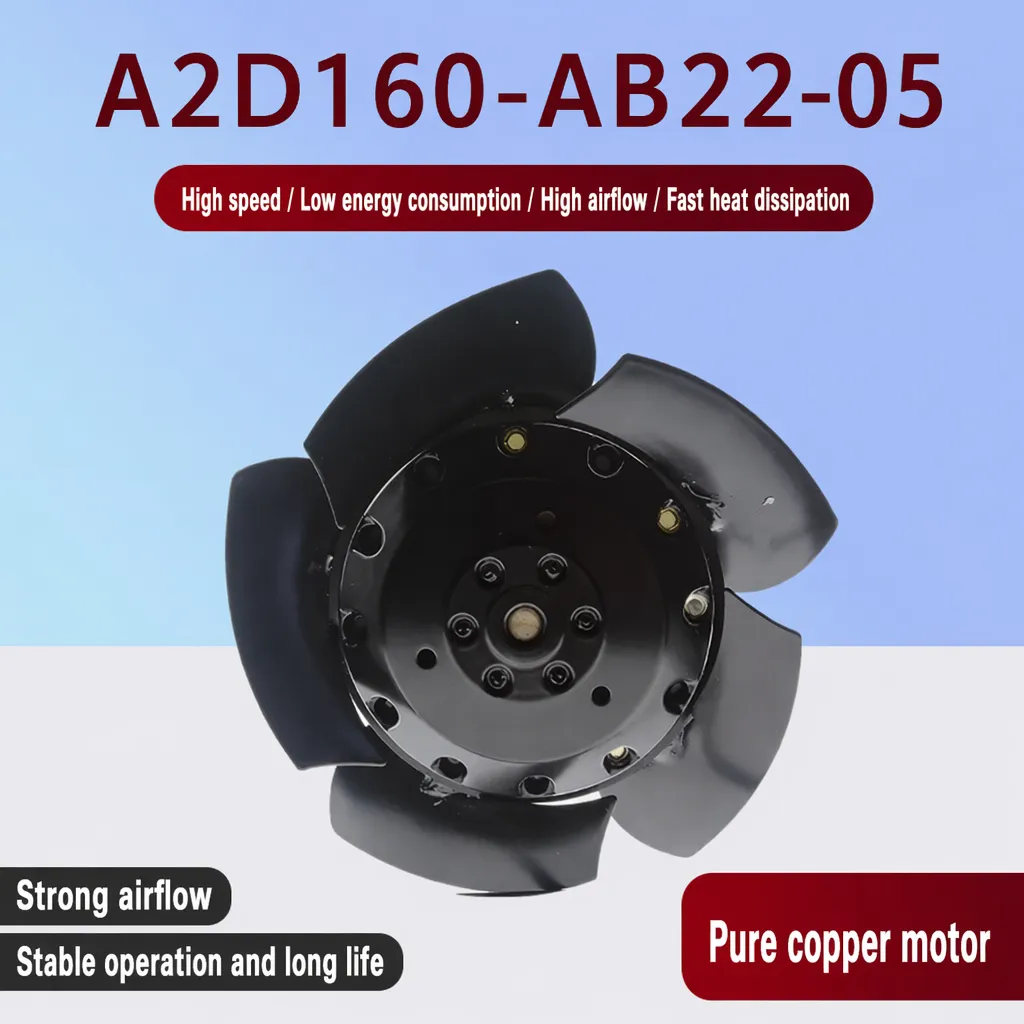
What Air Volume Adjustment Range Does a Variable Speed Backward Curved Fan Offer for Industrial Cooling Systems?
If you've been specifying fans for industrial cooling applications long enough, you know that the rated airflow on a datasheet only tells part of the story. What actually matters in most real-world installations is how much you can reduce that airflow—and still maintain adequate thermal management—without running the fan at full load every hour of the day. That question sits at the heart of why the variable speed backward curved fan has become a preferred choice for engineers and procurement specialists dealing with dynamic industrial cooling loads.
This article focuses specifically on the air volume adjustment range these fans can deliver, the mechanical and control principles behind it, and what that range means when you're selecting equipment for a demanding cooling application.
How Variable Speed Control Works on Backward Curved Fans
A variable speed backward curved fan operates by adjusting motor rotational speed in response to a control signal rather than running at a fixed frequency. The two most common control interfaces on EC-motor-equipped units are a 0–10 V analog input and a PWM (pulse-width modulation) signal. At the lower end of the control range—near 0 V or minimum PWM duty cycle—the fan speed drops to a minimum operating point, which in most industrial units is somewhere in the range of 20% to 30% of maximum rated speed. At the upper limit, speed reaches the design maximum, delivering the fan's rated airflow and static pressure.
The aerodynamic behavior follows the fan affinity laws: airflow is proportional to speed, static pressure varies with the square of speed, and shaft power varies with the cube of speed. That cubic relationship is why the energy savings from turning down a fan even modestly are significant. Reducing a fan to 70% of its rated speed—still delivering approximately 70% of rated airflow—cuts power consumption to roughly 34% of rated power. For a high capacity backward curved fan running 8,000 hours per year in an industrial facility, that difference is substantial in operating cost terms.
What Air Volume Adjustment Range Should You Expect?
The practical air volume adjustment range for a variable speed backward curved fan in industrial cooling applications is typically between 20% and 100% of the rated design airflow, though the usable lower limit can vary by model and application context.
For context, backward curved fans used in industrial cooling configurations are often rated from several hundred to several thousand cubic meters per hour—some references cite airflow capacities in the range of 780 to 3,300 m³/h for mid-size units, while heavy-duty industrial variants can reach volumes well beyond that. The variable speed system doesn't change those rated maximums, but it determines how low you can reliably operate before efficiency drops or motor thermal limits become a concern.
In practical terms, most EC-powered units are specified with a minimum continuous operating speed that corresponds to roughly 20%–30% of full airflow. Operating below that threshold is generally not recommended because the motor's self-cooling becomes marginal in some external rotor designs, and the fan performance curve can become less stable at very low pressure-volume operating points.
For a variable speed backward inclined fan variant—which shares a similar blade geometry and non-overloading characteristic—the adjustment range and governing principles are comparable, though specific minimum speed limits should always be confirmed in the manufacturer's datasheets for the intended application.
Why the Non-Overloading Characteristic Matters for Variable Speed Operation
One of the practical advantages of the backward curved impeller geometry—compared with forward-curved alternatives—is the non-overloading power curve. As system resistance decreases (for example, if a filter is clean or a damper opens), the power drawn by a forward-curved fan can rise sharply. Backward curved designs have a naturally self-limiting power curve: power peaks at a point well within the normal operating range and does not continue climbing as airflow increases. This characteristic makes the backward curved design inherently more forgiving when a variable speed drive is used to push the fan toward higher airflow operating points under changing system conditions.
That said—and this is worth noting for selection purposes—a higher impeller speed does not always translate directly to better cooling performance. If the installation has significant system resistance (ductwork, heat exchanger coil pressure drop, filtration), the fan's operating point on its performance curve at maximum speed may deliver less airflow than the free-air rated value. Accounting for this when sizing a high capacity ahu cooling backward curved fan is important: the 100% rated airflow figure on the datasheet is a free-air measurement, not the delivered airflow under your specific system resistance.
Deciding on the Right Adjustment Range for Your Cooling Application
For most industrial cooling system designers, the practical question is not what the maximum air volume adjustment range is in absolute terms—it is whether the fan can modulate over the range that your thermal load actually demands. A server room or data center may need 60%–100% of rated cooling airflow depending on rack density. A process heat exchanger might require the fan to step between 40% and 85% flow during different production phases. A cabinet cooling application might only need 30%–70% of rated flow for most of its operating hours.
When selecting a variable speed backward curved fan for these scenarios, the key specification to confirm is the minimum speed ratio supported by the drive or EC motor controller. Most reputable EC motor units specify a minimum speed of approximately 15%–20% of synchronous speed, which roughly corresponds to 15%–20% of maximum airflow. For most industrial cooling applications, that floor is low enough to cover demand during off-peak periods or low-load conditions.
The selection decision also involves deciding how much overspeed margin to build into the design. Specifying a fan that achieves your target airflow at 80%–85% of maximum speed—rather than running it at 100%—leaves headroom for capacity degradation over time (filter loading, coil fouling) without requiring immediate maintenance intervention. That kind of design margin is often overlooked when buyers focus only on peak rated specs.
Summary: Air Volume Adjustment Range for Variable Speed Backward Curved Fans
The air volume adjustment range of a variable speed backward curved fan designed for industrial cooling systems is typically 20% to 100% of the rated design airflow, governed by the control signal range (0–10 V or PWM) applied to the EC motor drive. The fan affinity laws determine how airflow, pressure, and power scale across that range, with the cubic power relationship delivering significant energy savings at partial load. The backward curved impeller's non-overloading characteristic makes these units particularly well-suited for variable speed operation where system resistance and thermal load vary over time.
For industrial cooling applications, confirming the manufacturer's minimum speed specification and accounting for real-world system resistance—rather than relying solely on free-air ratings—are the two most important steps in translating the rated adjustment range into a reliable cooling performance specification. If you are sourcing a high capacity backward curved fan for a specific industrial cooling system, requesting performance curves at multiple speed points (100%, 70%, and 50% of rated speed, for example) will give you a clearer picture of how the fan behaves across its full operating range.






