 EN
EN
What filter matching rule for dust proof cabinet cooling fan operating in cement factories
2026/09/30
Cement cabinets choke on dust. Learn the filter rule for an industrial cabinet cooling fan: G4/F7 media, IP rating, and pre-filter care.

2026/09/13
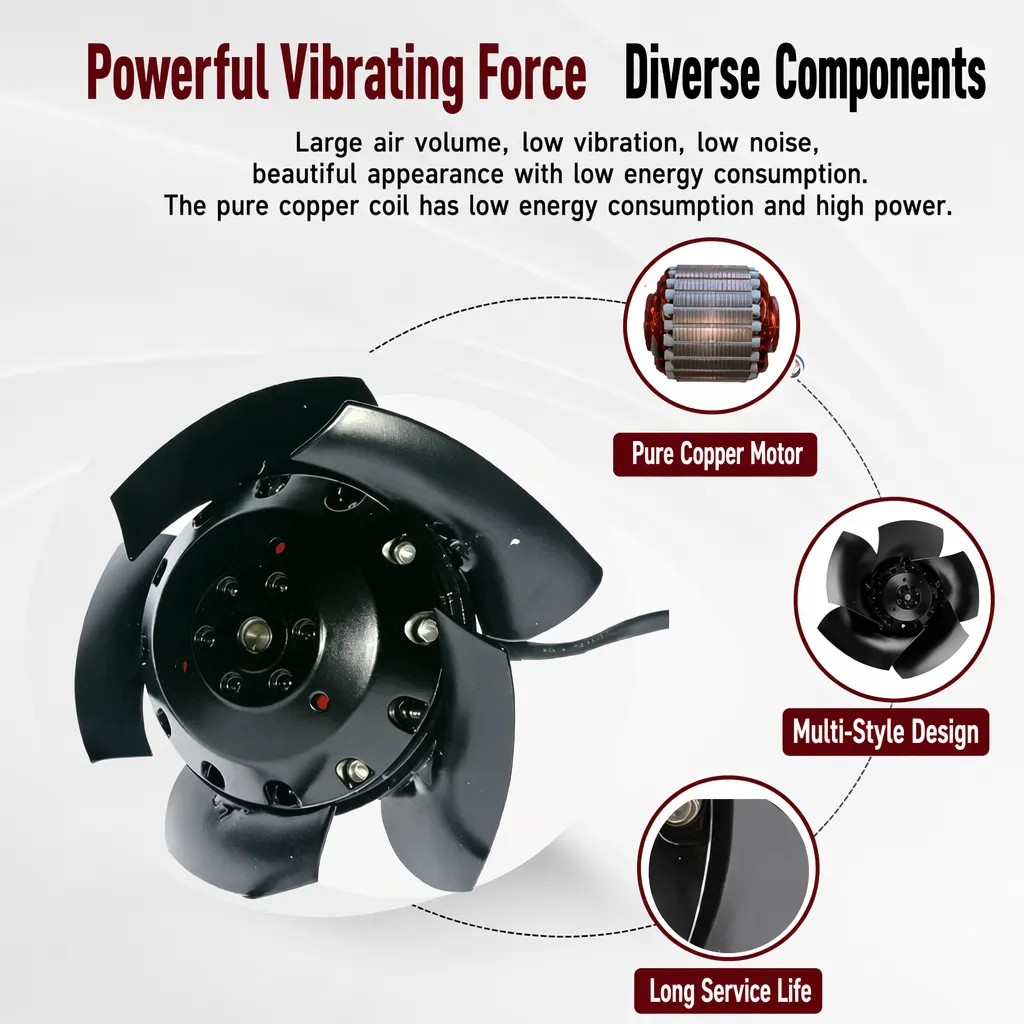
Changing the blade angle of an installed unit is the fastest way to recover lost performance before buying a larger motor. The core relationship sits in the industrial axial fan blade geometry: a small change in pitch reshapes how air enters the impeller and how much work each revolution delivers. Many retrofit projects overlook this lever because pitch is treated as fixed at the factory. In practice, the same fan frame can serve very different duct systems once the blades are set to match the real resistance curve.
Blade pitch sets the angle of attack between each industrial axial fan blade and the incoming air stream. A steeper pitch bites more air per turn, lifting airflow velocity and CFM, but only up to a point. The fan curve shows this trade: as static pressure rises, a given pitch delivers fewer cubic feet per minute until the operating point slides down the curve. AMCA Standard 210 defines how manufacturers measure that curve under controlled inlet conditions, so re-pitching work should be checked against published test data rather than guesswork. Reading the curve correctly is the difference between a usable gain and a wasted motor.
Ducts, filters, and cooling coils add resistance that the fan must push against. At a fixed RPM, raising blade pitch increases static pressure capability, which means the unit holds more CFM when the system is clogged or long. Yet each extra degree of pitch draws more torque, so the motor winding heats faster and the duty cycle shortens. The practical target is the pitch that meets the required CFM at the actual resistance, not the steepest angle the frame allows. Overshooting simply moves the operating point toward a less efficient part of the curve.
Tip speed grows with both RPM and blade diameter, and it caps how aggressive a pitch can be. Past a threshold, the air at the blade tip cannot keep up and energy turns into noise and heat instead of airflow. Precision ball bearings and a solid outer-rotor motor hold the impeller steady through these speeds, but efficiency still drops when pitch fights the system. Thermal management matters: a re-pitched set that runs hotter needs a cooler ambient or a lower duty cycle to stay reliable. Match the setting to the motor, not the other way around.
A distribution warehouse needed exhaust through a long sheet-metal duct run with two 90-degree bends. The stock axial units, shipped at a flat factory pitch, moved almost no air once filters loaded and summer heat arrived. Workers reported stale air and rising enclosure temperatures near the servo drive cabinets. The facility manager faced a choice: buy bigger fans and re-wire the panels, or tune what was already mounted. Measuring static pressure at the inlet showed the real resistance was far above the catalog operating point for the as-shipped industrial axial fan blade angle.
The fix was mechanical, not electrical. Each industrial axial fan blade was set to a steeper, matched pitch using the hub's adjustment marks, then the full impeller was re-balanced on a test stand. Re-balancing matters because an uneven blade set vibrates, loads the bearing, and shortens life. The team confirmed the new setting against the published fan curve and checked symmetry by weight, not by eye. No motor swap was needed; the existing outer-rotor motor and pure-copper winding had ample torque margin once the angle matched the duct.
After re-pitching, the same frames delivered the required CFM at the measured static pressure, and the enclosure temperatures dropped back into a safe band. The servo cabinets stopped tripping on thermal limits, and the duty cycle could run continuously through the hot season. This outcome came from matching the industrial axial fan blade pitch to system resistance, not from adding horsepower. For a vertically integrated buyer, the lesson is concrete: specify pitch for the installed duct, not the catalog free-air number, and verify with a static-pressure reading on site.
Push pitch too far and the angle of attack exceeds what the air can follow. Flow separates near the root, a condition called root-stall, and delivered CFM collapses even as the motor pulls harder. Stall also raises noise and local heating along the industrial axial fan blade, which stresses the material and the nearby bearing. The fan curve warns of this: past the knee, more pitch yields less airflow. Keeping a margin below stall protects both output and the mechanical parts.
A re-pitched impeller must be balanced as a complete set. Small weight differences between blades create vibration that travels into the bearing and the panel, raising wear and acoustic level. Precision ball bearings tolerate some imbalance, but repeated off-balance running shortens life and invites failure. Good thermal management pairs the new pitch with a clean airflow path and, where the site is wet or dusty, an enclosure rated to EN 60529 (IP code) keeps the motor winding protected. Inspect balance after adjusting the industrial axial fan blade set, and re-check during scheduled maintenance.
Setting blade pitch is a low-cost, high-impact adjustment that tunes an axial unit to its real duct, not its catalog rating. A correct industrial axial fan blade angle recovers CFM against resistance, avoids an oversized motor, and keeps the system inside a safe, efficient operating band. The skill combines reading the fan curve, respecting stall limits, and verifying balance after each change. For procurement and maintenance teams, pitch adjustment turns a struggling install into a steady, quiet airflow solution without replacing hardware.
What is the safest blade pitch to gain CFM without stalling?
Answer: The safest pitch meets the required CFM at the measured static pressure while staying below the stall knee on the fan curve. Start from the published curve, add a few degrees, then verify with an on-site pressure reading. Re-balance the set after each change and watch bearing temperature during the first run. Small, verified steps protect output and avoid overload.
Why does static pressure drop airflow on a steep-pitch fan?
Answer: Higher system resistance pushes the operating point down the fan curve. A steep pitch raises possible static pressure, but if the duct demands more than the setting can sustain, CFM falls and the motor works harder for less air. Matching pitch to the actual resistance keeps the operating point in the efficient band and protects the winding from excess heat.
How is blade balance checked after re-pitching?
Answer: Balance the full impeller as one assembly on a test stand, comparing blade weights rather than visual angles. Even a small weight mismatch creates vibration that loads the bearing and raises noise. After adjustment, run the fan and monitor vibration and bearing temperature through a full duty cycle. If readings drift, re-seat the blades and repeat the balance pass before returning the unit to service.
Can an existing motor handle a steeper industrial axial fan blade pitch?
Answer: Often yes, because outer-rotor motors with pure-copper winding carry torque margin at the original pitch. Re-pitching toward the duct demand usually stays inside that margin, so the motor winding does not overload. Confirm with the fan curve and a static-pressure test, and keep the angle below stall. If the measured resistance is extreme, a motor review is the next step rather than a blind pitch increase.
Which maintenance checks follow a pitch adjustment?
Answer: Inspect the full impeller balance after every pitch change and re-check during scheduled service. Monitor bearing temperature and vibration through a normal duty cycle, and keep the airflow path clean so the setting holds. Where the site is wet or dusty, confirm the enclosure rating protects the motor winding. A short log of pitch, pressure, and temperature helps track drift before it becomes a failure.

2026/09/30
Cement cabinets choke on dust. Learn the filter rule for an industrial cabinet cooling fan: G4/F7 media, IP rating, and pre-filter care.

2026/10/07
Right wall-mount height for an industrial axial exhaust fan: room volume, free clearance, brackets, and recirculation control.

2026/10/08
An ec motor fan links to BMS via Modbus, 0-10V and PWM for demand-based cooling, energy scheduling and automatic sensor-driven speed control.

2026/10/06
A radial exhaust fan removes grease, fumes, and odors from food-processing workshops with capture velocity and hygienic washdown design.

2026/10/05
Learn antistatic treatment for industrial cabinet cooling fan in electronics workshops—ESD-safe housing, ionizable plastics, and cleanroom compatibility.

2026/10/04
Discover how a brushless dc servo delivers precise wind speed control for laboratory cooling fans with closed-loop PID feedback and laminar airflow.
