 EN
EN
What filter matching rule for dust proof cabinet cooling fan operating in cement factories
2026/09/30
Cement cabinets choke on dust. Learn the filter rule for an industrial cabinet cooling fan: G4/F7 media, IP rating, and pre-filter care.

2026/09/15
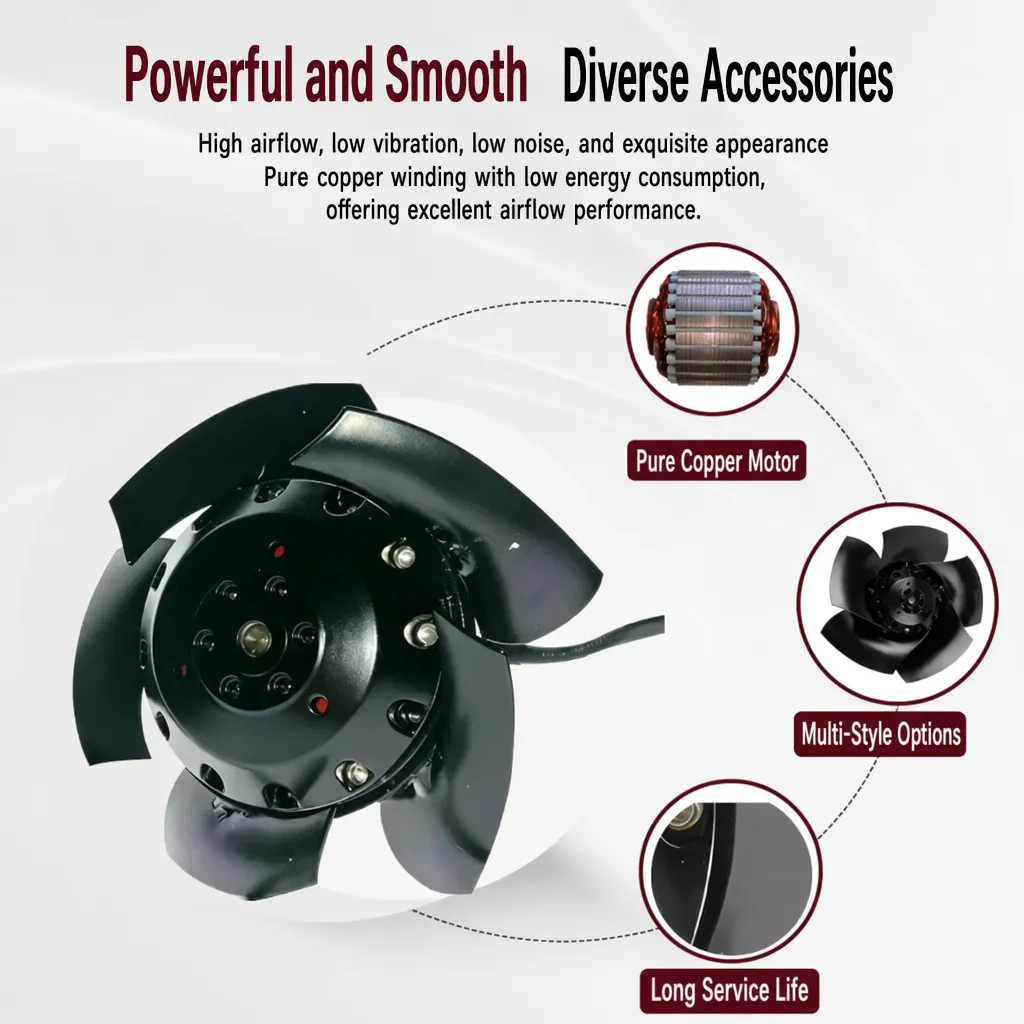
Specifiers often ask what truly separates a dc backward curved fan from its AC counterpart when both spin the same backward-curved impeller. The answer lives less in the blades and more in the drive: how the motor is commutated, how speed is governed, and how efficiency behaves as demand swings. For equipment that rarely runs at a single fixed point, that distinction decides running cost and reliability over the service life.
The backward-curved centrifugal fan earns its name from blades that curve against the direction of rotation. Air enters axially at the inlet, turns through the impeller, and leaves radially with kinetic energy converted into static pressure. This geometry is shared whether the drive is AC or DC, so the wheel itself is not where the two technologies diverge.
The backward-curved blade presents a rising-then-falling power curve. A dc backward curved fan therefore stays protected even if the system curve steepens, because as static pressure rises toward the shut-off point the required shaft power peaks and then declines, so the motor cannot be dragged into overload at low flow. That protects the winding and drive from thermal stress. It exists because the blade angle limits the volume of air the wheel can capture once pressure backs up, naturally capping demand rather than encouraging it.
Centrifugal duty is defined by the fight against resistance. A duct, filter, or heat exchanger imposes static pressure, and the fan must hold airflow as that resistance changes. The backward-curved wheel tolerates steep system curves better than forward-curved designs. Reading the published pressure-versus-flow curve is the only honest way to match a unit to a real system.
The contrast between a dc backward curved fan and an AC model begins at the motor terminals. An AC induction or shaded-pole motor is powered directly from the mains and has almost no built-in means to vary speed beyond taps or an external inverter. The DC variant carries its intelligence in a separate controller.
A dc backward curved fan does not rely on mechanical brushes. An electronic controller switches current through the stator in sequence, synchronizing with rotor position sensed by Hall elements, to spin the outer-rotor brushless motor. Electronic commutation removes brush wear and sparking, cuts losses, and lets the drive accept a wide input range. That is the first and most decisive difference from an AC unit, whose alternating supply drives an induction motor with little room for control beyond tap or frequency change.
In the DC unit, this outer-rotor layout pairs with PWM control so speed tracks demand without throttling loss. The outer-rotor construction places the magnets on the spinning shell around the stator, concentrating inertia at the impeller for smooth, quiet running. Pure copper windings and imported precision ball bearings support long service life, while internal thermal overload protection shuts the unit down before insulation fails. Speed is set by a rapid switching signal that varies effective voltage, so the fan follows the load.
Variable demand is the condition that exposes the gap between the two drives. An AC fan is tuned for a rated point and degrades gracefully but expensively away from it. The DC platform is built to live off that point.
An AC induction motor running below its rated point still draws magnetizing current and slips, so part-load losses stay high. Measured losses from a dc backward curved fan stay low because the drive scales input power with speed, and efficiency holds across the duty cycle. For a unit that spends most hours at partial load, the DC assembly converts far more electricity into moving air and far less into heat.
An HVAC equipment builder designing a variable-speed air-handling unit faced exactly this choice. The cabinet needed stable ventilation across a wide load range, yet the legacy AC fan ran near full speed regardless of demand. After switching to a DC backward-curved platform with PWM control, the unit modulated smoothly, cut audible noise, and trimmed energy draw during partial-load hours.
Choosing well means reading physics before reading prices. The right model is the one whose curve crosses the system requirement at an efficient, stable point.
When comparing a dc backward curved fan against an AC unit, start from the system curve. Locate the intersection of required static pressure and airflow, confirm the operating point sits on the efficient portion of the fan curve, and check the IP rating against the environment. Verify certification marks such as CE, UKCA, or CCC, and for variable duty prioritize a unit with PWM control and a published part-load curve.
On receipt, spin the wheel by hand to confirm free rotation and inspect the die-cast aluminum housing for transit damage. During installation, keep inlet and outlet clear of obstructions. Maintain by cleaning the impeller and checking ball-bearing noise at planned intervals; replace a unit that develops rising vibration or warm-housing symptoms before the thermal overload trips repeatedly.
Selecting between technologies is a question of duty, not of which blade spins. A dc backward curved fan leads where demand varies, because electronic commutation, PWM speed control, and a friendly part-load curve turn variable operation into saved energy rather than wasted heat. The backward-curved impeller provides the shared, non-overloading foundation; the drive decides the result. Match the unit to the real system curve, inspect on arrival, and maintain on a schedule — then the choice pays back across the service life.
What is the main difference between DC and AC backward curved fans?
Answer: The difference lies in the drive, not the wheel. A DC unit uses electronic commutation with a brushless outer-rotor motor and PWM speed control, while an AC unit runs an induction motor at fixed or tapped frequency. That split governs efficiency at part load, noise, and how closely the fan tracks varying demand. The impeller geometry is essentially identical, so selection should follow the duty profile rather than the blade shape.
Why does a DC fan save energy under partial load?
Answer: A brushless DC drive scales input power with speed, so losses stay low when the wheel turns slowly. An AC induction motor keeps drawing magnetizing current and slipping even below its rated point, holding part-load losses high. Across a duty cycle dominated by partial-load hours, the DC unit converts more electricity into airflow and less into heat. Variable-demand systems therefore gain the largest saving from DC drive architecture.
How should the fan be inspected on arrival?
Answer: Spin the impeller by hand to confirm free rotation and listen for roughness that signals bearing damage. Inspect the die-cast aluminum housing and galvanized steel wheel for transit dents, then verify the label matches the ordered model, voltage, and IP rating. Check that the stated enclosure temperature range suits the site. Document any defect before commissioning, because a damaged wheel unbalances the rotor and accelerates bearing wear.
Which standards apply to these fan motors?
Answer: Rotating electrical machines are addressed by IEC 60034, while machinery electrical safety follows EN 60204; manufacturing quality systems rest on ISO 9001. Rotor balance references ISO 1940 to limit vibration. Procurement teams should confirm the marks relevant to the destination market, such as CE or UKCA in Europe and CCC in China. Standards verify safety and consistency, though they do not replace reading the individual pressure-flow curve.
Can an AC backward curved fan be used for variable speed?
Answer: A dc backward curved fan supports smooth variable speed through PWM control, whereas an AC unit needs an external frequency inverter for speed change, adding cost, EMI filtering, and extra losses. For modest variation, AC with taps may suffice, but true modulation favors the DC drive. Specify the DC platform when the duty cycle spans a wide load range, and reserve AC for near-constant, cost-sensitive applications where speed rarely changes.

2026/09/30
Cement cabinets choke on dust. Learn the filter rule for an industrial cabinet cooling fan: G4/F7 media, IP rating, and pre-filter care.

2026/10/07
Right wall-mount height for an industrial axial exhaust fan: room volume, free clearance, brackets, and recirculation control.

2026/10/08
An ec motor fan links to BMS via Modbus, 0-10V and PWM for demand-based cooling, energy scheduling and automatic sensor-driven speed control.

2026/10/06
A radial exhaust fan removes grease, fumes, and odors from food-processing workshops with capture velocity and hygienic washdown design.

2026/10/05
Learn antistatic treatment for industrial cabinet cooling fan in electronics workshops—ESD-safe housing, ionizable plastics, and cleanroom compatibility.

2026/10/04
Discover how a brushless dc servo delivers precise wind speed control for laboratory cooling fans with closed-loop PID feedback and laminar airflow.
