 EN
EN
What filter matching rule for dust proof cabinet cooling fan operating in cement factories
2026/09/30
Cement cabinets choke on dust. Learn the filter rule for an industrial cabinet cooling fan: G4/F7 media, IP rating, and pre-filter care.

2026/09/10
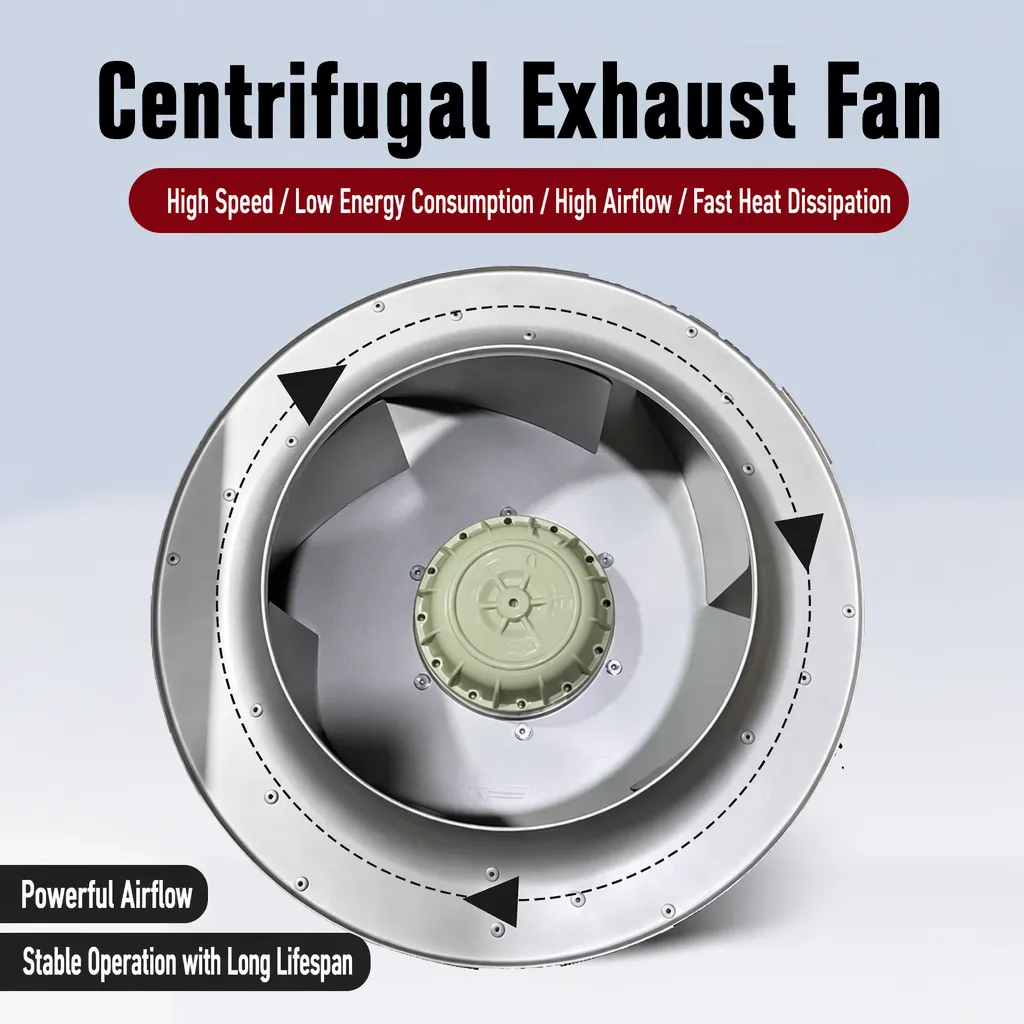
A plant engineer evaluating an energy efficient backward inclined fan rarely sees the nameplate number tell the whole story. Efficiency depends on how airflow, pressure, and input power are measured under controlled conditions. The sections below show how ratings are tested and what the data means.
The energy efficient backward inclined fan earns its reputation because the backward-inclined impeller converts motor power into useful air movement with low turbulence losses. Laboratories separate static efficiency from total efficiency to measure it. Static efficiency uses only static pressure, while total efficiency includes the kinetic energy carried by moving air. A backward-inclined wheel shows a flatter, higher curve than forward-curved designs.
Efficiency itself is a ratio. The fan absorbs shaft or electrical power and delivers pneumatic power, the product of airflow multiplied by pressure. The quotient shows how much input becomes moving air versus heat and noise. Confirm whether a quoted figure is static or total, since the two differ on the same operating point.
Airflow is captured in cubic feet per minute or cubic meters per hour. Pressure is recorded as the rise across inlet and outlet, either static or total. Input power is read from a calibrated wattmeter or dynamometer at the motor terminals. Only together can the efficiency number be trusted.
Modern test cells log these inputs continuously while the fan moves through a range of damper settings. For an energy efficient backward inclined fan, the laboratory report should present the full curve so the buyer can see performance away from the advertised condition.
Standardized testing follows AMCA 210 and ISO 5801, which define mounting, ducting, and instrumentation so results repeat between laboratories. When an energy efficient backward inclined fan enters the rig, it is run at rated voltage and frequency, with ambient conditions recorded so density corrections can be applied to the raw readings.
Instrument accuracy matters. Pressure transducers, flow nozzles, and power analyzers must carry valid calibration certificates. Without that paper trail, even a careful test cannot support a procurement decision, because the buyer has no way to verify the chain of measurement. Lobisong documents its test process to this discipline.backward inclined centrifugal blower, fan efficiency testing, AMCA 210, ISO 5801, BEP
Two recognized approaches dominate airflow measurement. The nozzle method passes all flow through calibrated nozzles and infers volume from the measured pressure drop. The Pitot traverse method places a tube array across the duct and averages point readings. Both methods appear in AMCA 210 and ISO 5801 and give defensible airflow once corrected for density.backward inclined centrifugal blower, fan efficiency testing, AMCA 210, ISO 5801, BEP
Testing an energy efficient backward inclined fan with double inlets demands care, because each side draws air independently. The test standard specifies how to treat each inlet so the reported cubic feet per minute reflects true delivered flow. Skipping this step lets quoted efficiency go unverified in a second lab.backward inclined centrifugal blower, fan efficiency testing, AMCA 210, ISO 5801, BEP
The performance curve plots efficiency against airflow or static pressure. The peak efficiency point, often abbreviated BEP, is where the fan reaches its highest conversion ratio. Operating close to that point keeps energy use low and noise modest. Moving far to either side drops efficiency sharply.
Specifiers should read the curve as a zone, not a single rating. A good energy efficient backward inclined fan holds a broad, flat efficiency plateau near the BEP, meaning small changes in system resistance do not punish the power bill. Narrow, peaky curves leave little margin for filter loading or seasonal shifts.
Backward-inclined blades face against the direction of rotation, so air leaves the wheel with lower absolute velocity than forward-curved blades. Less kinetic energy is wasted, and static efficiency stays high across the operating range. Precision ball bearings and a balanced outer-rotor motor reduce mechanical drag, letting more input become useful airflow.
In a real retrofit, a food-processing plant replaced worn axial units with backward-inclined centrifugal blowers. The existing fans ran near free-delivery where efficiency collapsed, while the new wheels sat close to their BEP after duct redesign. Measured input power dropped at the same airflow, keeping the enclosure within its thermal budget. This is why an energy efficient backward inclined fan suits continuous-duty ventilation.
Lab numbers set the benchmark; field conditions differ. Portable anemometers, Pitot kits, and clamp power meters let technicians verify an installed energy efficient backward inclined fan against its curve. Density shifts from temperature, altitude, and loading change results, so field checks correct to standard air and compare against the operating zone.
A practical field routine measures static pressure at the fan and airflow at a representative grille, then reads motor input watts. Dividing delivered pneumatic power by input watts yields on-site efficiency. Repeated quarterly, it catches bearing wear or impeller buildup early. IP54 ingress protection helps maintain that condition in dusty enclosures.
Procurement should demand the test standard, the efficiency type (static or total), and the operating point used for the claim. Ask for the full AMCA 210 or ISO 5801 report, not just a headline percentage. Confirm motor winding class, duty cycle, and CE or UKCA marks the market requires. For ventilation with heat recovery, an enthalpy recovery ventilator (ERV) paired with the fan changes the system balance and should be evaluated together.
A disciplined buyer treats efficiency as a verified property, not a slogan. Request independent or documented in-house testing, review the BEP curve shape, and validate one unit in the field first. That sequence protects the energy budget and keeps the specification honest across every energy efficient backward inclined fan in the fleet.
What standard methods verify backward inclined fan efficiency?
Answer: Efficiency is verified under AMCA 210 and ISO 5801, which define rig geometry, instrumentation, and correction factors. A calibrated test rig measures airflow through nozzles or a Pitot traverse, static and total pressure rise, and input watts from a wattmeter. The fan is run across damper settings to build a full curve. Buyers should request the documented report so the quoted static or total efficiency can be reproduced in an independent check before purchase.
Why does static efficiency differ from total efficiency?
Answer: Static efficiency counts only the usable pressure delivered to the duct, while total efficiency also includes the kinetic energy of moving air. A backward-inclined wheel recovers more of that kinetic energy, so the gap stays smaller than with forward-curved designs. Specifiers must confirm which value a supplier quotes, because comparing static against total efficiency across products can mislead a procurement decision and inflate apparent savings.
How is airflow measured during a fan test?
Answer: Laboratories use calibrated flow nozzles, where pressure drop across the nozzle infers volume, or a Pitot tube traverse averaging many duct cross-section points. Both methods appear in AMCA 210 and ISO 5801 and require air-density correction for temperature and altitude. For an energy efficient backward inclined fan with double inlets, each inlet is treated per the standard so the reported cubic feet per minute reflects true delivered flow.
Where should a buyer look for the highest-efficiency zone?
Answer: The peak efficiency point, or BEP, marks the highest conversion ratio on the curve, and a broad flat plateau near it is preferable. Specifiers should read efficiency as a zone rather than one rated point, because real systems drift with filter loading and seasonal demand. A wide plateau lets a backward-inclined centrifugal blower keep power low despite resistance changes, avoiding the penalties of narrow, peaky performance curves.
Can field testing confirm laboratory efficiency claims?
Answer: Portable anemometers, Pitot kits, and clamp power meters let technicians verify an installed fan against its published curve. Field checks must correct for density shifts from heat, altitude, and dust loading, then compare against the operating zone rather than a single point. Repeating the measurement quarterly catches bearing wear and impeller buildup early, protecting the energy budget of the ventilation system over its service life.

2026/09/30
Cement cabinets choke on dust. Learn the filter rule for an industrial cabinet cooling fan: G4/F7 media, IP rating, and pre-filter care.

2026/10/07
Right wall-mount height for an industrial axial exhaust fan: room volume, free clearance, brackets, and recirculation control.

2026/10/08
An ec motor fan links to BMS via Modbus, 0-10V and PWM for demand-based cooling, energy scheduling and automatic sensor-driven speed control.

2026/10/06
A radial exhaust fan removes grease, fumes, and odors from food-processing workshops with capture velocity and hygienic washdown design.

2026/10/05
Learn antistatic treatment for industrial cabinet cooling fan in electronics workshops—ESD-safe housing, ionizable plastics, and cleanroom compatibility.

2026/10/04
Discover how a brushless dc servo delivers precise wind speed control for laboratory cooling fans with closed-loop PID feedback and laminar airflow.
