 EN
EN
What filter matching rule for dust proof cabinet cooling fan operating in cement factories
2026/09/30
Cement cabinets choke on dust. Learn the filter rule for an industrial cabinet cooling fan: G4/F7 media, IP rating, and pre-filter care.

2026/09/22
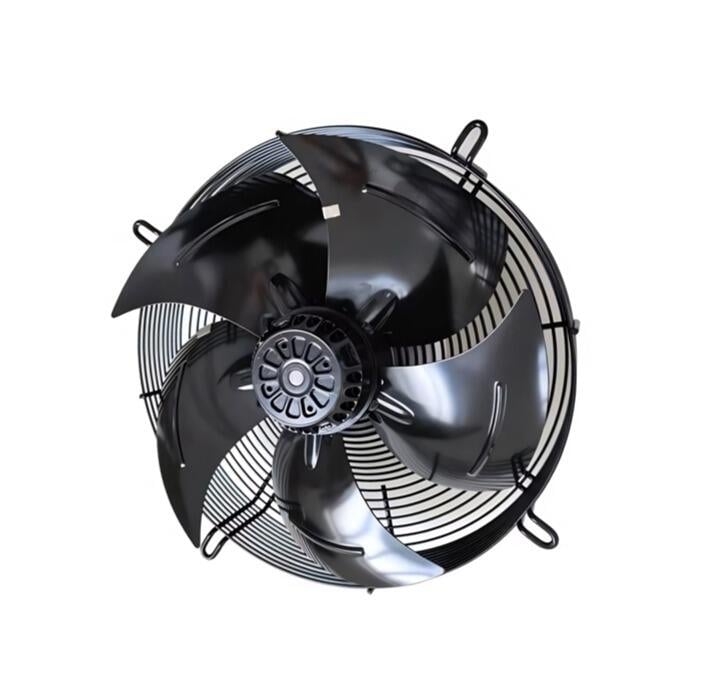
Sales sheets rarely settle the choice between an EC fan and a traditional AC fan, because both can claim similar airflow at top speed. The real consumption difference appears at the operating point where the fan runs for thousands of hours each year. A structured energy consumption test gives a procurement team numbers they can defend to management, and it removes the guesswork that leads plants to keep oversized, Throttled AC equipment in service. Before signing an upgrade contract, an EC fan deserves a fair test against the incumbent AC units under identical conditions.

An EC fan carries an electronically commutated motor: permanent magnets on the rotor, windings switched by integrated electronics, and speed control built into the unit. A traditional AC fan relies on an asynchronous induction motor, which needs an external variable frequency drive if the speed must change, and which loses more energy in slip and rotor heating at partial load. Because the EC fan controls speed through its own electronics, it holds efficiency across a wide operating range instead of peaking at a single point. That characteristic is exactly what an energy test should expose.
A comparison is only valid when both fans deliver the same airflow against the same system resistance. Select two or three duty points from the real installation, for example design flow, a typical partial-load point, and a night setback point. Record the reference airflow with an anemometer grid or a calibrated duct traverse, and hold duct geometry constant so static pressure stays comparable between the AC unit and the EC fan.
Wire each fan through a power analyzer and measure input watts at the supply terminals, including drive losses. Never compare motor nameplate values, because they describe output at rated conditions rather than consumption in the actual system. Log voltage, current, power factor and watts continuously; an EC fan typically keeps a high power factor across speeds, while an AC induction unit may drift, and those details matter to the yearly bill.
Laboratory spot checks flatter both technologies. Instead, run a 24 hour profile that mirrors production: full speed during working shifts, reduced speed overnight. Multiply the measured watts by the hours at each step to obtain kWh per day and per year. When the same profile is applied to the AC reference and the EC fan, the annual consumption gap becomes a concrete figure that finance departments can evaluate against project cost.
At full speed the two fans may consume within a few percent of each other. The separation opens at partial load, where the EC fan follows the cube law advantage: cutting speed by 20 percent reduces power draw by roughly half, while a throttled or inefficiently driven AC unit gives much of that benefit back as heat and slip loss. In ventilation systems that run below design capacity for most of the year, partial-load hours dominate the total, which is why the measured annual saving often surprises teams that only compared peak performance.
One machining workshop replaced six belt-driven AC units on a monitored circuit. The baseline logging showed 42,600 kWh per year for the AC group. After the swap, the same duty profile delivered by the new EC fan group consumed 26,800 kWh, a 37 percent reduction at unchanged measured airflow. Payback calculated against local tariffs came to 21 months, and the EC fan group reached the night setback temperature with quieter operation, because speed modulation replaced on-off cycling.
Several habits ruin an otherwise careful test. Comparing fans at different duty points or through different duct lengths hides the real gap. Ignoring drive and control losses makes the AC side look better than it performs. Testing only at design flow ignores the partial-load hours where an EC fan earns its keep. Finally, short test windows that miss night and weekend profiles underestimate annual totals, so always extend the EC fan measurement across at least one full weekly production cycle before drawing conclusions.
Measured savings depend on duty profile. At constant full speed the difference is often below ten percent, while profiles dominated by partial load commonly show 25 to 40 percent lower consumption for the EC fan. The precise figure comes from logging both units at identical duty points across at least a full production week, then multiplying watts by hours for each speed step.
Yes. Clamp-on power logging at the distribution board captures the AC baseline while production continues. The replacement EC fan is then logged on the same circuit under the same schedule. Keeping ductwork untouched preserves system resistance, so the before-and-after comparison reflects the fan change rather than a system change.
Most industrial EC fan units connect to standard single-phase or three-phase supplies, with speed set by a 0-10 volt signal, a potentiometer or digital input. No separate variable frequency drive is required because the commutation electronics are built in. Coordination with existing building management systems is usually straightforward through standard analog or digital interfaces.
The method stays the same, but instruments must tolerate the environment and air density changes must be corrected. Hot applications often run at higher static pressure, which widens the measured advantage of the EC fan because induction motors lose relative efficiency exactly where the duty is hardest. Log air temperature alongside power so results can be normalized.
One full weekly production cycle is the practical minimum, because it captures day, night and weekend profiles. Seasonal effects matter in ventilated buildings, so where possible repeat spot measurements in different weather. A test that covers at least 150 operating hours gives a stable annual extrapolation for most factory ventilation duties.
A disciplined test turns the EC fan versus AC decision from opinion into arithmetic: identical duty points, true input power, realistic duty cycles and a full production week of data. Plants that follow this method sign upgrade contracts with confidence, because the promised saving has already been measured on their own system.

2026/09/30
Cement cabinets choke on dust. Learn the filter rule for an industrial cabinet cooling fan: G4/F7 media, IP rating, and pre-filter care.

2026/10/07
Right wall-mount height for an industrial axial exhaust fan: room volume, free clearance, brackets, and recirculation control.

2026/10/08
An ec motor fan links to BMS via Modbus, 0-10V and PWM for demand-based cooling, energy scheduling and automatic sensor-driven speed control.

2026/10/06
A radial exhaust fan removes grease, fumes, and odors from food-processing workshops with capture velocity and hygienic washdown design.

2026/10/05
Learn antistatic treatment for industrial cabinet cooling fan in electronics workshops—ESD-safe housing, ionizable plastics, and cleanroom compatibility.

2026/10/04
Discover how a brushless dc servo delivers precise wind speed control for laboratory cooling fans with closed-loop PID feedback and laminar airflow.
