 EN
EN
What filter matching rule for dust proof cabinet cooling fan operating in cement factories
2026/09/30
Cement cabinets choke on dust. Learn the filter rule for an industrial cabinet cooling fan: G4/F7 media, IP rating, and pre-filter care.

2026/09/08

An industrial cooling fan only performs as well as the heat exchanger it feeds. The two parts must be sized together, because airflow that does not match the thermal load leaves hot spots that shorten equipment life. Getting the pairing right starts with reading the actual heat the process rejects.
A plating shop ran a rectifier bank that tripped on overtemperature every afternoon in summer. The maintenance team first blamed the cooling fan, then looked at the whole loop. They suspected the industrial cooling fan was moving air, but not the right amount against the radiator's real demand. The fix turned out to be a matching problem, not a broken part.
The rectifier nameplate listed a rejection figure in kilowatts. That thermal load, plus heat from the pump and ambient, set the target the fan had to meet. The team measured inlet and outlet air and found a delta T far smaller than the design called for, meaning air moved but carried little heat away. The number gave them a real spec instead of a guess.
Rather than buying a bigger unit, they selected a fan whose airflow matched the radiator's rating at the measured delta T. The new industrial cooling fan held the bank within its limit through the next heat wave, and the afternoon trips stopped. The change cost less than a control upgrade and removed a recurring interruption that had been costing throughput.
A fan too small leaves the heat exchanger unable to reject enough watts, so the process runs hot and protection trips cut production. A fan too large wastes power, raises noise, and can overcool sensitive parts. Either way, the mismatch shows up as lost output and shorter component life, and the industrial cooling fan runs outside its design point. The cost is steady and quiet, which makes it easy to accept as normal until a failure forces a stop.
Oversized airflow also drives the unit into a loud, inefficient corner and pulls dust through the fins faster, clogging the very surface that moves heat. Poor convection at the fin means the radiator saturates and the heat sink behind it climbs. Without a clean match, the system oscillates between too hot and too loud, wearing bearings and annoying the floor. The fault is design, not bad luck.
Before selecting an industrial cooling fan, the load must be read. Heat transfer from the process to the air follows a simple balance: the fan must carry away every watt the load rejects. The coefficient that links temperature difference to rejected heat sets how much airflow is needed. A higher thermal load demands more air or a larger surface. Reading the load first, before picking a fan, prevents the common mistake of sizing the moving part before the rejecting part.
Airflow across the fin determines how fast heat leaves the radiator. A tight fin pitch needs higher static pressure to push air through, which changes the fan choice. Delta T between inlet and outlet air is the scoreboard: too small means air is not picking up heat, too large means the surface is starved. Tuning airflow to the fin keeps delta T in the designed band and protects the heat sink from thermal runaway. An industrial cooling fan tuned this way stays efficient across the speed range.
The cooling capacity of the pair is the lesser of what the fan can deliver and what the exchanger can accept. The match rule is to size the fan so its operating point sits on the radiator curve at the required delta T. Oversizing breaks the rule and wastes energy; undersizing breaks production. A documented match, checked at commissioning, keeps the industrial cooling fan honest against the load it was chosen to serve.
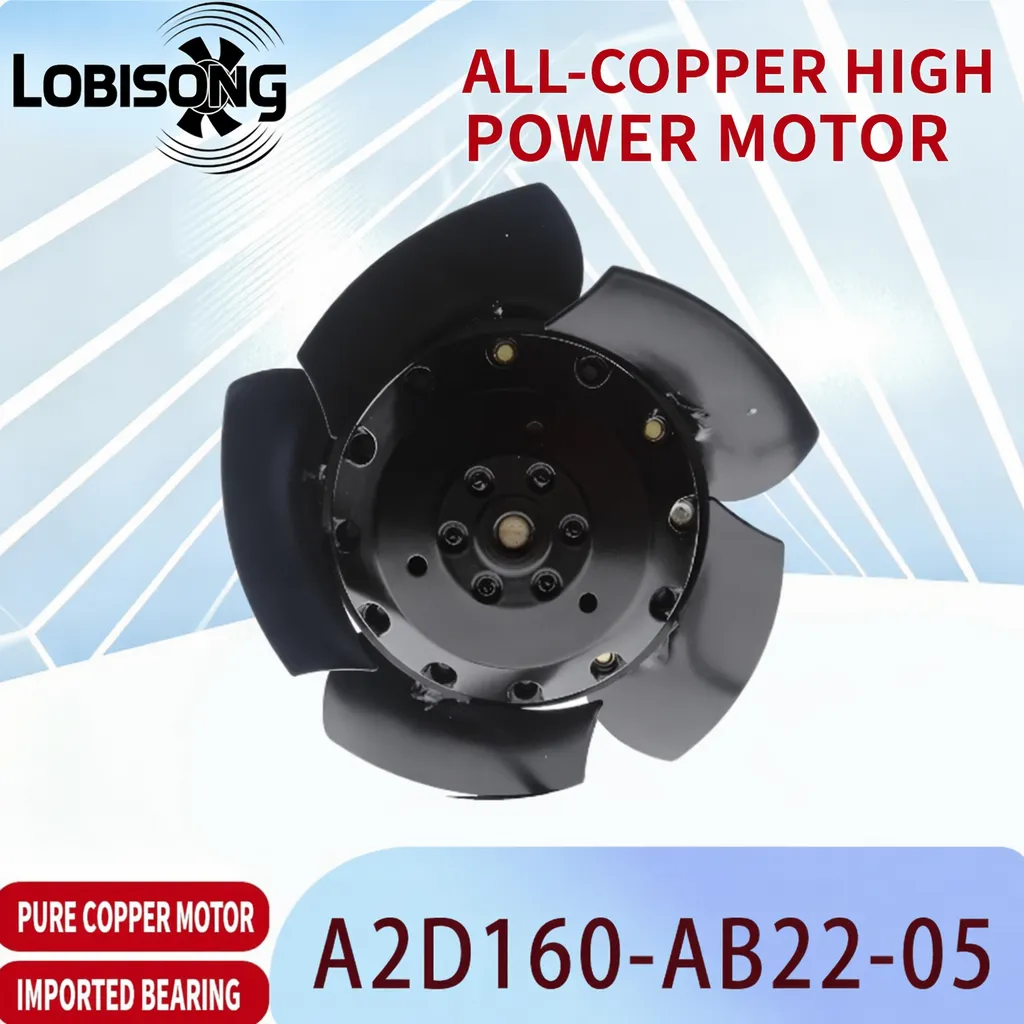
Equipment builders reference IEC 60034 for rotating machines and NFPA 79 for machinery safety, while ISO 9001 frames the test and acceptance records. These do not pick the fan size, but they set the discipline of rated performance and traceable verification. A spec that cites them lets the buyer accept a unit on evidence rather than a sales claim, and gives the supplier a clear, fair bar.
Buyers should state the thermal load in watts, the allowed delta T, and the fin geometry, then confirm the fan's operating point on the radiator curve during a bench trial. In service, keep the fins clear of dust and check the air filter on a schedule. Log inlet and outlet temperatures so drift shows early. A short commissioning check and a simple upkeep routine keep the match stable and avoid the slow creep that eventually trips the protection.
An industrial cooling fan must be matched to the heat exchanger it serves, not chosen alone. Reading the thermal load, sizing airflow to the fin and delta T, and placing the operating point on the radiator curve gives stable cooling. The result is fewer trips, longer component life, and lower wasted energy. Documenting the match at commissioning keeps the benefit real across the installed fleet.
Question: How do you match a fan to a heat exchanger? Answer: Match by reading the thermal load in watts, then sizing the fan so its airflow meets the radiator curve at the required delta T. The cooling capacity of the pair is the lesser of fan delivery and exchanger acceptance. A bench trial confirms the operating point. Documenting that match at commissioning prevents both undersizing that trips production and oversizing that wastes energy.
Question: What does delta T tell you about cooling? Answer: Delta T is the temperature difference between inlet and outlet air across the heat exchanger. Too small means air moves but carries little heat, while too large means the surface is starved of flow. The right delta T shows the fan and fin are working together. Logging it in service reveals drift early, before the radiator saturates and the protected equipment overheats.
Question: Why not just buy a bigger industrial cooling fan? Answer: A larger fan raises power draw, noise, and dust loading through the fins, and can overcool sensitive parts. Oversizing also breaks the match rule by moving the operating point off the radiator curve. The right answer is to size airflow to the measured thermal load and fin geometry. A correct match costs less and protects the equipment better than raw excess capacity.
Question: How is a radiator fan maintained in service? Answer: Keep the fins clear of dust and follow a schedule for the air filter so airflow across the fin stays steady. Log inlet and outlet temperatures to catch a falling delta T before it becomes a trip. Listen for bearing noise that signals wear. A short commissioning check plus routine upkeep keeps the heat transfer stable and avoids the slow creep that ends in an unplanned stop.
Question: Can the fin geometry change the fan choice? Answer: Yes. A tight fin pitch needs higher static pressure to push air through, which shifts the fan selection toward a higher-pressure wheel. Loose fins need more volume but less pressure. Matching the fan to the fin keeps convection efficient and delta T in band. Ignoring geometry leads to a fan that spins fast yet moves too little heat across the radiator surface.

2026/09/30
Cement cabinets choke on dust. Learn the filter rule for an industrial cabinet cooling fan: G4/F7 media, IP rating, and pre-filter care.

2026/10/07
Right wall-mount height for an industrial axial exhaust fan: room volume, free clearance, brackets, and recirculation control.

2026/10/08
An ec motor fan links to BMS via Modbus, 0-10V and PWM for demand-based cooling, energy scheduling and automatic sensor-driven speed control.

2026/10/06
A radial exhaust fan removes grease, fumes, and odors from food-processing workshops with capture velocity and hygienic washdown design.

2026/10/05
Learn antistatic treatment for industrial cabinet cooling fan in electronics workshops—ESD-safe housing, ionizable plastics, and cleanroom compatibility.

2026/10/04
Discover how a brushless dc servo delivers precise wind speed control for laboratory cooling fans with closed-loop PID feedback and laminar airflow.
