 EN
EN
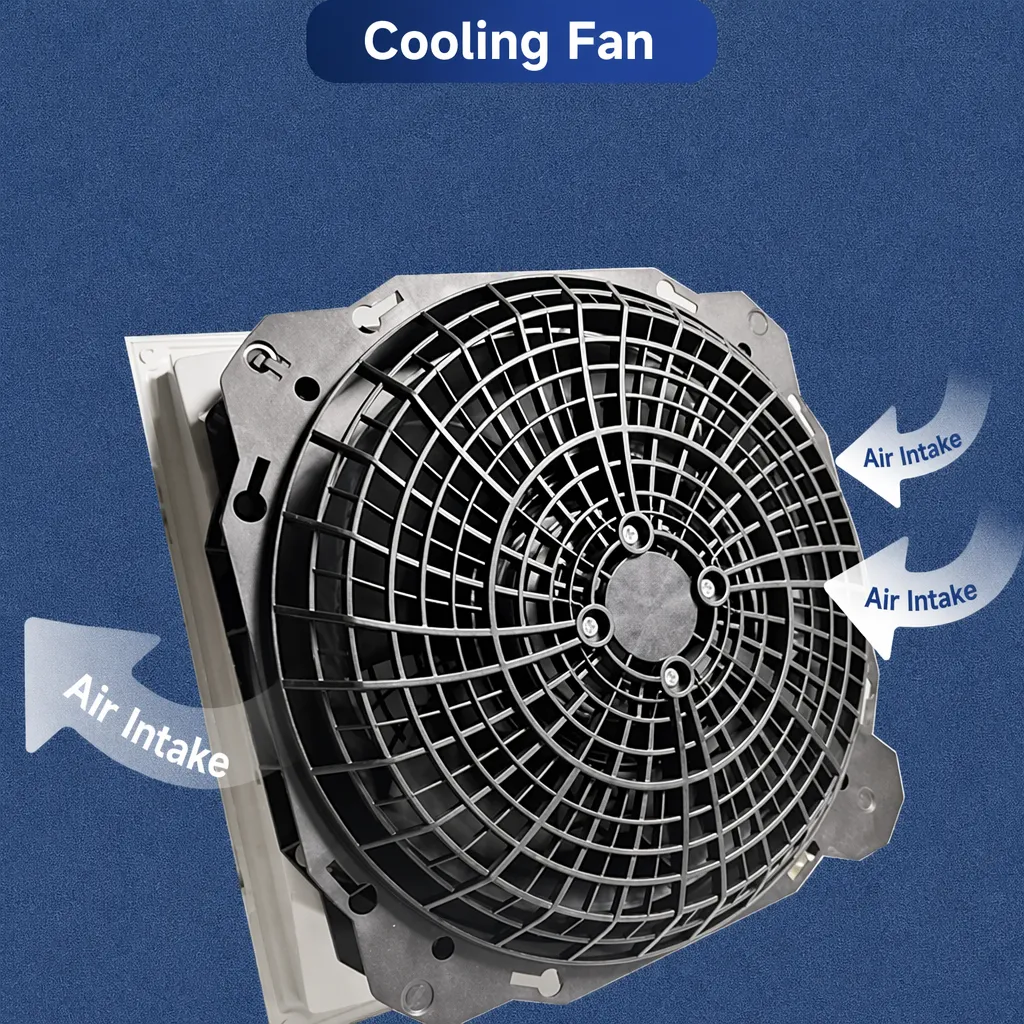
What filter matching rule for dust proof cabinet cooling fan operating in cement factories
2026/09/30
Cement cabinets choke on dust. Learn the filter rule for an industrial cabinet cooling fan: G4/F7 media, IP rating, and pre-filter care.

2026/09/01
Noise control in modern commercial and industrial ventilation is no longer just an optional feature. It has become a strict regulatory standard and a vital worker health requirement. For a high‑performance backward inclined industrial blower, the dominant source of operation sound is the physical interaction between moving blade tips and high‑velocity airflow. Over the past decade, rapid breakthroughs in fluid dynamics have given rise to advanced blade geometries that cut sound output significantly without sacrificing static pressure or aerodynamic efficiency. Modern engineering strategies now allow facilities to meet aggressive acoustic targets without oversized equipment.
Controlling acoustic output requires a clear understanding of how sound originates inside dynamic air handlers. Sound produced by a typical backward inclined industrial blower divides into two foundational mechanisms: mechanical vibration and aeroacoustic noise. Mechanical noise stems from rotating bearing assemblies, motor housing unbalance, and structural frame resonance. Aeroacoustic noise, by contrast, develops directly from turbulent flow patterns around rotating impellers. It breaks down into broadband turbulence and distinct tonal frequencies.
For a backward inclined industrial blower spinning at 2,900 RPM with a 12‑blade wheel, the blade‑passing frequency (BPF) lands around 580 Hz. This frequency sits precisely within the human ear's most sensitive auditory range, making blade passage tone the most noticeable and irritating aspect of operational noise. Addressing this tonal peak requires deliberate alterations to blade geometry and fluid pathways rather than simple acoustic dampening insulation.
Integrating specific geometric modifications into a low‑noise backward curved centrifugal blower wheel yields immediate acoustic benefits. Among these engineering options, non‑uniform blade spacing stands out as one of the most effective methods for fan noise reduction. Spacing blades at calculated, uneven angular intervals scatters sound energy across a broader spectrum instead of concentrating energy at a single spike. This simple change reduces peak tonal amplitude by 3 to 6 dB(A) while preserving volumetric airflow.
Serrated trailing edges provide another powerful path toward meaningful fan noise reduction. Micro‑serrations disrupt the formation of large coherent vortices as air leaves the trailing edge, shedding tiny turbulent structures that dissipate quickly. Computational fluid dynamics show that optimizing serration depth between 5% and 8% of the chord length cuts broadband aeroacoustic noise by an extra 2 to 4 dB(A).
| Design Technique | Typical Sound Drop (dB(A)) | Efficiency Impact | Manufacturing Complexity |
|---|---|---|---|
| Uneven Blade Spacing | 3–6 dB(A) | Negligible | Low (Tooling change) |
| Serrated Trailing Edge | 2–4 dB(A) | 0% to ‑1% | Moderate |
| Tip Clearance Tuning | 1–3 dB(A) | +1% to +2% | Low |
| Splitter Vane Profiles | 2–5 dB(A) | +2% to +3% | Moderate |
| Composite Dampening Materials | 1–3 dB(A) | Negligible | Low to Moderate |
The dynamic gap between impeller blade tips and the intake cone dictates both volumetric losses and acoustic generation. Excess clearance permits internal recirculation flow, creating heavy turbulence that drops static pressure while increasing noise. Conversely, overly tight clearance risks mechanical scraping from thermal expansion or shaft deflection.
For a low‑noise backward curved centrifugal blower, setting blade tip clearance between 1.5% and 3% of the overall wheel diameter delivers the ideal operational compromise. Practical field trials show that refining tip gap tolerances on a 500 mm impeller drops sound output from 82 dB(A) down to 78 dB(A) while raising total mechanical efficiency by 2.5 percentage points. Precise tolerance management remains an economical method to achieve fan noise reduction without adding costly silencer hardware.
Developing modern low‑noise backward curved centrifugal blower equipment relies heavily on computational aeroacoustics (CAA). Utilizing high‑fidelity models like Large Eddy Simulation (LES) lets fluid dynamics engineers visualize turbulent pressure fluctuations and forecast acoustic profiles long before cutting metal.
Virtual testing allows manufacturers to refine complex blade curves, evaluate trailing‑edge serrations, and optimize shroud angles in hours rather than weeks. Physical testing inside semi‑anechoic chambers repeatedly confirms CAA accuracy, with real‑world sound measurements correlating within 90% of numerical predictions. This digital workflow reduces prototyping cycles while ensuring finished blower assemblies deliver rated airflow at minimal sound levels.
The physical properties of the impeller material play a central role in mitigating aeroacoustic noise and structural resonance. Traditional sheet metal or aluminum blades, while strong, readily transfer vibration and radiate sound under unsteady aerodynamic forces. Advanced polymer and composite materials offer built‑in internal friction that converts vibrational energy directly into microscopic heat rather than audible noise.
In a low‑noise backward curved centrifugal blower setup, switching from steel to glass‑reinforced synthetic polymers can yield a 1 to 3 dB(A) sound drop. The natural dampening ratio of composite compounds runs up to twenty times higher than mild steel, suppressing high‑frequency harmonics generated by turbulent blade interactions.
Achieving consistent, quiet air delivery across demanding commercial and industrial environments requires partnering with specialized manufacturing experts. Global suppliers with integrated R&D capabilities—such as Lobisong—combine advanced fluid simulations with automated production to deliver optimized blower hardware. Utilizing ISO 3744 semi‑anechoic testing facilities ensures every custom backward inclined industrial blower design meets strict international noise standards before field deployment.
Whether outfitting high‑efficiency HVAC networks, semiconductor cleanrooms, or sensitive medical facilities, customized impeller geometry combined with robust quality control ensures superior performance. Partnering with proven industrial equipment manufacturers like Lobisong provides global engineering support, scalable production, and reliable thermal management solutions engineered specifically for low‑noise operational targets.

2026/09/30
Cement cabinets choke on dust. Learn the filter rule for an industrial cabinet cooling fan: G4/F7 media, IP rating, and pre-filter care.

2026/10/07
Right wall-mount height for an industrial axial exhaust fan: room volume, free clearance, brackets, and recirculation control.

2026/10/08
An ec motor fan links to BMS via Modbus, 0-10V and PWM for demand-based cooling, energy scheduling and automatic sensor-driven speed control.

2026/10/06
A radial exhaust fan removes grease, fumes, and odors from food-processing workshops with capture velocity and hygienic washdown design.

2026/10/05
Learn antistatic treatment for industrial cabinet cooling fan in electronics workshops—ESD-safe housing, ionizable plastics, and cleanroom compatibility.

2026/10/04
Discover how a brushless dc servo delivers precise wind speed control for laboratory cooling fans with closed-loop PID feedback and laminar airflow.
