 EN
EN
What filter matching rule for dust proof cabinet cooling fan operating in cement factories
2026/09/30
Cement cabinets choke on dust. Learn the filter rule for an industrial cabinet cooling fan: G4/F7 media, IP rating, and pre-filter care.

2026/09/19
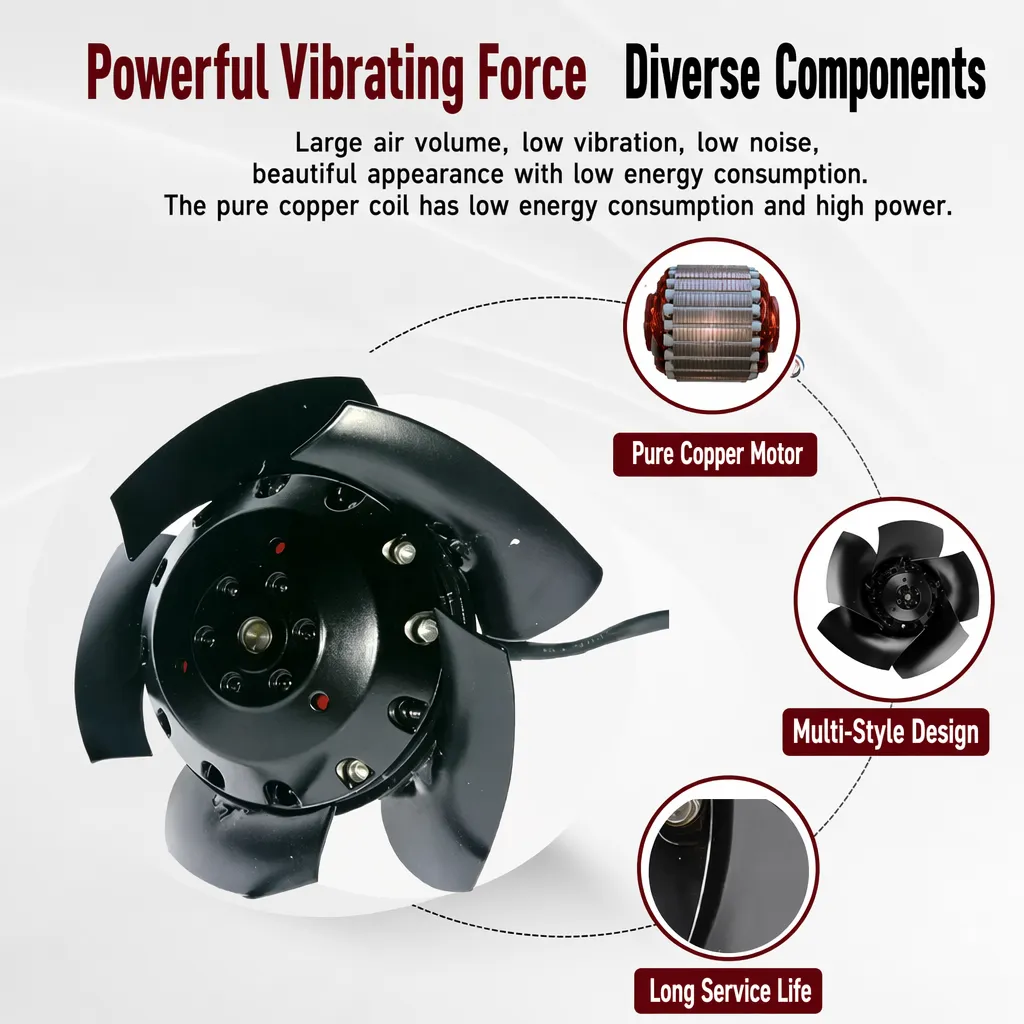
Selecting the right spinning wheel determines how long an industrial ventilator survives in a given plant atmosphere. The backward curved centrifugal blower impeller must resist the exact mix of moisture, chemicals, and particles present in the airstream, because premature metal loss forces unplanned shutdown and rebuild. Material choice therefore starts from duty classification, not from the lowest invoice line.
Galvanized steel remains the default shell for general ventilation where the airstream stays dry and free of reactive agents. A backward curved centrifugal blower impeller built from this sheet handles clean make-up air, comfort cooling, and light dust without premature rust. The zinc coating slows oxidation, yet it offers little defense against acids or salts. Specifiers should reserve galvanized construction for indoor duty with filtered intake and stable humidity.
Cost pressure often pushes buyers toward the thinnest galvanized sheet, yet wall thickness governs how long the wheel survives abrasive or humid air. A slightly heavier gauge delays rust perforation and keeps the wheel balanced between services. Plants in humid coastal sites should treat galvanized as a short-life option and budget for earlier changeout rather than expect multi-year operation.
Stainless steel extends service life where humidity carries chlorides or process vapors. Grade 304 resists ordinary moisture and mild cleaners, while 316 adds molybdenum for stronger defense against pitting in coastal or chemical plants. For a backward curved centrifugal blower impeller exposed to chloride-laden air, grade 316 holds shape long after a coated wheel has thinned. Material thickness also matters because thin walls erode faster under slurry-laden air.
Weld quality decides whether stainless performs to its grade. Poor welds create heat-tint zones that corrode faster than the base metal, so passivation after fabrication restores the protective film. Specifiers should ask for certified alloy stock and a weld map on large wheels. Thin 316 still erodes under slurry, so wall thickness stays the first line of defense even when the alloy resists chemistry.
Aluminum alloy suits light, non-sparking duty in explosive-risk zones where ATEX 2014/34/EU classification applies, such as solvent-handling rooms. Polypropylene resists strong acids and alkalis that destroy metal, making it a fit for plating and etching exhaust. Polypropylene loses strength above warm temperatures, so engineers cap its use to moderate heat. Selecting among these four families follows the duty matrix rather than a single rule, because each trades cost against resistance.
Temperature ceiling separates the four families more than price does. Polypropylene stays reliable below roughly sixty degrees Celsius, while aluminum and stainless tolerate far higher heat before losing strength. Exported units should carry CE and UKCA markings that confirm the construction meets EU and UK requirements. RoHS and REACH filings document substance limits, which procurement teams verify before the unit enters a regulated market.
Every impeller must be balanced to keep vibration and bearing wear low. ISO 1940 defines balance grades such as G6.3 and G2.5 by permitted residual unbalance relative to rotor mass and speed. A backward curved centrifugal blower impeller running at elevated rpm needs a tighter grade than a slow moving wheel. Lobisong production records balance on each finished wheel and marks the grade on the tag. Poor balance shortens bearing life and raises noise, so the grade is not optional.
Tip speed sets the mechanical ceiling for any wheel. As the outer edge accelerates, centrifugal loads rise with the square of speed, so a thin stainless blade can fatigue near welded joints. Material choice and balance grade for a backward curved centrifugal blower impeller must align with the design tip speed from the performance curve. AMCA 210 and ISO 5801 testing confirms the delivered volume and pressure, yet they do not replace a stress check. Overspeed margin should stay within the supplier limit.
Consider a plating workshop that exhausts acidic mist from nickel and chrome baths. The original galvanized wheel showed red rust and coating loss within one season, forcing a changeout and lost production. The plant switched to a stainless 316 backward curved centrifugal blower impeller with ISO 1940 G6.3 balance and documented wall thickness. After the upgrade the wheel ran through multiple seasons with stable airflow and no structural thinning, returning the exhaust line to steady duty.
A duty matrix maps each airstream to a material. Weak acid mist from pickling lines attacks galvanized coating within months, so stainless 316 or polypropylene becomes the safe path. Alkaline wash vapors favor 316 as well, while pure solvent vapor may allow aluminum under ATEX guidance. RoHS and REACH compliance govern substances used in EU-bound equipment, so material certificates should travel with the shipment. The mapping prevents both over-specification waste and under-specification failure.
Erosion differs from corrosion because it removes metal by impact. Fly ash, sand, and granular dust wear the leading edge of blades even when the gas is clean. Hard-faced stainless or thicker walls slow the loss, and some plants add replaceable edge strips. OSHA 29 CFR 1910.94 ventilation rules push plants to capture dust at source, which also protects the wheel. A backward curved centrifugal blower impeller that erodes loses profile and balance together, raising power draw until it stalls.
Specifiers protect uptime by mapping duty to material, then confirming balance grade and wall thickness at acceptance. A backward curved centrifugal blower impeller chosen against the duty matrix resists corrosion, erosion, and fatigue across seasons instead of failing early. Galvanized steel serves clean air, stainless 316 serves chemical vapor, polypropylene serves strong acid, and aluminum serves non-sparking zones. Request material certificates, balance tags, and CE or UKCA markings, then inspect wall thickness during planned shutdowns to extend service life.
What material suits a corrosive exhaust duty?
Answer: Stainless 316 serves chloride and chemical vapor exhaust where galvanized steel fails within a season. Polypropylene fits strong acid and alkali streams at moderate temperature. Aluminum suits light non-sparking zones under ATEX guidance. The selection follows a duty matrix that lists each airstream against resistance, so the wheel survives without costly over-specification or early breakdown.
Why does balance grade matter for impeller life?
Answer: ISO 1940 grades limit residual unbalance that would otherwise shake bearings and loosen fasteners. A wheel above its grade vibrates, heats the motor, and shortens service intervals. Tighter grades such as G2.5 suit high-speed duty, while G6.3 covers general ventilation. Balance is verified on each finished wheel and recorded on the tag, turning a hidden risk into a measurable, documented specification that plants can trust.
How is the correct material specified for a duty?
Answer: A backward curved centrifugal blower impeller is specified by listing the airstream chemistry, temperature, particle load, and target life, then matching those to a material matrix. Stainless 316 covers chloride and chemical vapor, polypropylene covers strong acid at low heat, aluminum covers non-sparking zones. Buyers should request material certificates and balance grade tags, and confirm CE and UKCA markings on exported units before acceptance.
Can polypropylene replace stainless in acid service?
Answer: Polypropylene resists strong acids and alkalis that pit stainless, so it replaces metal in low-temperature plating and etching exhaust. It loses strength above moderate heat and is less rigid under high static pressure. Stainless 316 remains the choice where temperature or mechanical load exceeds the polymer limit. The decision rests on the duty matrix, not on price alone, to keep the exhaust line reliable.
Do abrasive particles require special impeller design?
Answer: Abrasive dust erodes blade leading edges even in clean gas, so plants add hard-faced stainless, thicker walls, or replaceable edge strips. Capturing dust at source under OSHA 29 CFR 1910.94 also protects the wheel. An eroding wheel loses profile and balance together, raising power draw until stall. Inspect wall thickness during shutdowns and re-balance or replace before the loss passes the safe limit.

2026/09/30
Cement cabinets choke on dust. Learn the filter rule for an industrial cabinet cooling fan: G4/F7 media, IP rating, and pre-filter care.

2026/10/07
Right wall-mount height for an industrial axial exhaust fan: room volume, free clearance, brackets, and recirculation control.

2026/10/08
An ec motor fan links to BMS via Modbus, 0-10V and PWM for demand-based cooling, energy scheduling and automatic sensor-driven speed control.

2026/10/06
A radial exhaust fan removes grease, fumes, and odors from food-processing workshops with capture velocity and hygienic washdown design.

2026/10/05
Learn antistatic treatment for industrial cabinet cooling fan in electronics workshops—ESD-safe housing, ionizable plastics, and cleanroom compatibility.

2026/10/04
Discover how a brushless dc servo delivers precise wind speed control for laboratory cooling fans with closed-loop PID feedback and laminar airflow.
