 EN
EN
What filter matching rule for dust proof cabinet cooling fan operating in cement factories
2026/09/30
Cement cabinets choke on dust. Learn the filter rule for an industrial cabinet cooling fan: G4/F7 media, IP rating, and pre-filter care.

2026/09/05
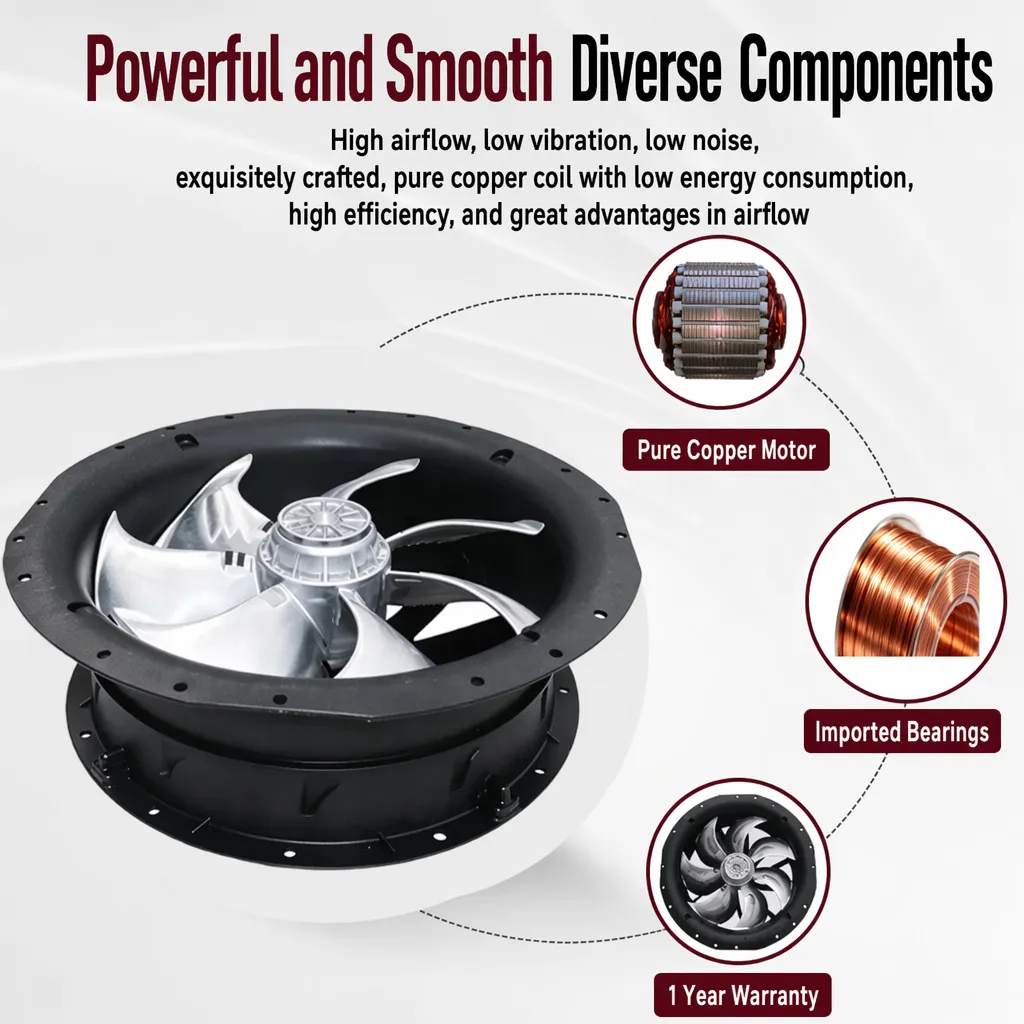
A ventilation retrofit at a plastics extrusion plant shows why the backward curved blade fan earns attention from plant engineers who manage cooling networks. The existing axial units pushed conditioned air through a long duct run fitted with three right-angle elbows and a narrow transfer section, but the line kept losing static pressure and could not hold the required airflow at the production cells located farthest from the source. Operators noticed rising cabinet temperatures during the afternoon peak, and the site had already tried larger axial fans, yet the gain vanished into the bends.
The backward curved blade fan entered the discussion after on-site measurements revealed the root cause of the shortfall. Air leaving the old axial impeller met each elbow as a blunt obstacle, producing flow separation and high turbulence that converted useful energy into heat and noise instead of forward movement. With low static pressure at the fan outlet, the air had little reserve to overcome friction along the pipeline, so distant production cells ran warm while the drive kept raising speed to compensate. Pressure gauges told the same story at every tee and transition: the loss was structural, not seasonal.
Replacing the axial units with centrifugal models placed the energy where the process needed it most. A backward curved blade fan builds pressure through blade curvature rather than brute tip speed, allowing the system to hold design airflow without operating at the ceiling of its curve. After commissioning, the same duct delivered the target volume at a lower motor speed, which also reduced bearing temperature and vibration across the train. The maintenance team logged steadier readings and fewer alarm trips across the shift. Energy consumption dropped without any change to the production schedule, confirming that drawings from the supplier shortened the integration stage and the loss had been built into the layout.
Every pascal lost to friction and turbulence must be replaced by the motor, and that loss scales with the square of airflow, so small inefficiencies compound quickly. Oversized or poorly routed ducts raise system resistance until the drive draws more current than the duty requires, lifting energy consumption across the whole shift. Switching to a backward curved blade fan changes the math, because the unit tolerates the higher system resistance without leaving its efficient zone. Left unchecked, this inefficiency hides inside a normal-looking operating point on the fan curve and quietly inflates the utility bill month after month. Pumps and compressors on the same line showed the same hidden load.
When static pressure collapses downstream, cooling at the cabinets suffers first, and sensitive drives begin to throttle. Operators then push fan speed higher, which moves the unit toward its overload region and shortens service life through thermal stress on the windings and insulation. A backward curved blade fan resists this drift thanks to its non-overloading curve, but only when sized against the real duct rather than a catalogue point. A fan running outside its stable window also risks stall and acoustic penalties that disturb the production floor, creating a second problem while the first remains unsolved. A simple static pressure survey exposes the trend within a single shift.
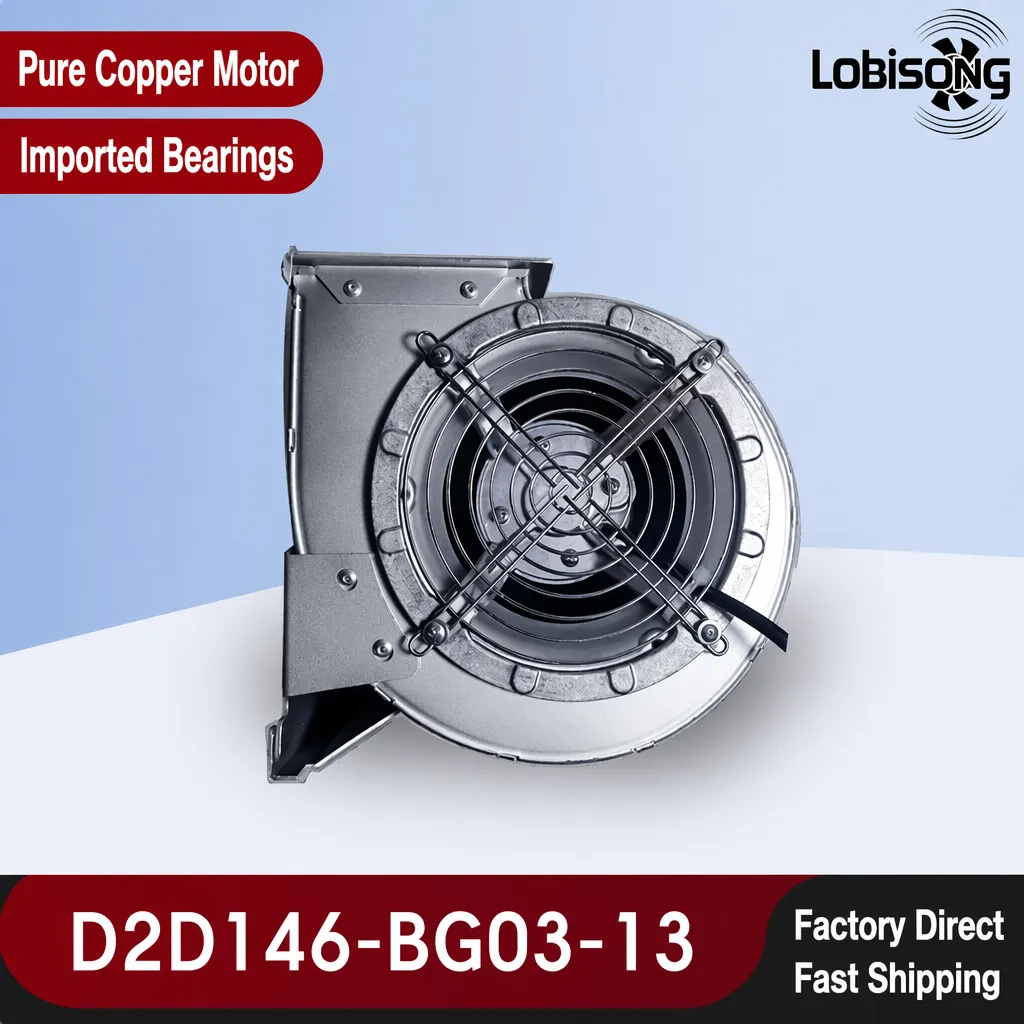
The backward curved blade fan reduces loss because the blade angle works with the airflow instead of against it during rotation. As air turns through the impeller, the curved profile keeps the boundary layer attached longer, delaying separation and trimming turbulence at the exit plane. That aerodynamic quality raises static efficiency and gives a non-overloading characteristic, so the motor stays protected even if the duct partials or a filter loads during service. Precision bearings and balanced rotors preserve the gain, while pure-copper windings limit heat that would otherwise erode the margin. Testing to IEC methods confirms the curve stays honest under load.
Good blade selection only pays off inside a sensible pipeline, because installation geometry decides where the pressure goes. A generous duct diameter lowers velocity and cuts friction loss; long-radius elbows replace sharp turns that would otherwise shed vortices into the stream. Matching the ventilation pipeline geometry to the fan curve means the static pressure the impeller produces is spent moving air, not fighting its own installation. CE and IEC compliant construction, brushless outer-rotor motors, and IP54 protection keep the rotating assembly reliable under dust and moisture that industrial sites present. A backward curved blade fan therefore delivers its rated airflow even after months of dust loading, and good commissioning records make future maintenance predictable.
A backward curved blade fan combined with optimized duct routing offers a practical path to lower pressure loss in industrial cooling ventilation. By reducing turbulence at the blade and trimming friction through better pipeline design, plants recover static pressure, steady their airflow, and avoid the energy and overload penalties that careless layouts create. The result is quieter operation, longer service life, and a ventilation pipeline that meets its duty without constant intervention from the control system. Procurement teams gain a defensible specification that survives audit.
What distinguishes backward curved blades from forward curved wheels? The backward curved blade fan uses blades angled away from rotation, which keeps airflow attached and limits turbulence at the impeller exit. Forward curved wheels accelerate air with many shallow blades but suffer higher loss at speed. For industrial ventilation pipelines where static pressure must survive a long duct run, the backward design holds efficiency and avoids overload. Proper sizing against the system curve remains essential for reliable duty.
Why does static pressure drop along a long ventilation pipeline? Friction between moving air and duct walls, plus turbulence at elbows and transitions, removes energy from the stream. Each bend and restriction adds system resistance, so the static pressure measured at the far end falls well below the fan outlet. Selecting the right diameter and smooth fittings preserves more of the pressure the impeller produces, keeping airflow stable where the process needs it most.
How should a buyer select the right centrifugal fan for a cooling duty? Start from the required airflow and the static pressure the duct will consume, then read the fan curve at that operating point. Confirm the motor type, IP rating, and bearing specification suit the environment, and request CAD drawings to check fit. Units with pure-copper windings and brushless outer-rotor motors give stable output across the speed range and tolerate dirty air without rapid degradation.
Can poor duct design cancel the benefit of a good fan? Yes. Even a well-built impeller loses its advantage inside a restrictive layout. Sharp elbows, undersized branches, and blocked filters raise system resistance until the fan operates off its efficient zone. Commissioning checks that measure static pressure at key points expose these losses early, before the duty drifts and energy consumption climbs beyond the budgeted figure for the site.
Where do standards such as ISO, IEC, and CE apply in fan selection? CE and UKCA marks confirm the product meets European safety and EMC requirements, while IEC and EN standards govern motor performance and thermal classification. ISO guidance supports consistent test and rating methods, so published curves stay comparable between suppliers. Specifying compliant fans helps procurement pass audits and protects the installation across export markets in Europe and beyond.

2026/09/30
Cement cabinets choke on dust. Learn the filter rule for an industrial cabinet cooling fan: G4/F7 media, IP rating, and pre-filter care.

2026/10/07
Right wall-mount height for an industrial axial exhaust fan: room volume, free clearance, brackets, and recirculation control.

2026/10/08
An ec motor fan links to BMS via Modbus, 0-10V and PWM for demand-based cooling, energy scheduling and automatic sensor-driven speed control.

2026/10/06
A radial exhaust fan removes grease, fumes, and odors from food-processing workshops with capture velocity and hygienic washdown design.

2026/10/05
Learn antistatic treatment for industrial cabinet cooling fan in electronics workshops—ESD-safe housing, ionizable plastics, and cleanroom compatibility.

2026/10/04
Discover how a brushless dc servo delivers precise wind speed control for laboratory cooling fans with closed-loop PID feedback and laminar airflow.
