 EN
EN
What filter matching rule for dust proof cabinet cooling fan operating in cement factories
2026/09/30
Cement cabinets choke on dust. Learn the filter rule for an industrial cabinet cooling fan: G4/F7 media, IP rating, and pre-filter care.

2026/09/04

A plastics extrusion plant in Poland ran a 40-meter duct from its cooling section to a roof exhaust. As output rose, the axial fans could not hold pressure past the third elbow, and the curing oven overheated twice in one quarter. The root cause was air resistance, not fan speed. A backward curved blower answers this at the source. Its wheel redirects flow so the air leaves the impeller with direction and energy the duct can use. Specifiers fighting hot spots and pressure drops usually find the wrong fan type, not the wrong speed. After the retrofit, field readings showed the duct outlet holding target pressure through all four elbows, and the curing oven temperature settled back inside its set band. The plant recorded the recovery as a lower specific energy per cubic meter moved, a figure European buyers watch when comparing ventilation spend.
The core of the device is the backward curved impeller, a wheel whose blades tilt away from the direction of rotation. As the wheel spins, air enters axially at the center and is flung outward by centrifugal force. Because the blades curve backward, the relative air velocity at the trailing edge stays low, which avoids dangerous flow separation. A backward curved blower therefore keeps a stable pressure–flow curve even when the duct narrows or a filter clogs. This geometry is why the same unit performs well across a wide static pressure range without surging or hunting for a stable point. Blade count is matched to the wheel diameter so the velocity triangle at the inlet stays near radial, which keeps the incidence angle small across the operating band. A small incidence angle limits the stall margin loss that forward-curved wheels show near part load.
The volute housing converts the impeller's kinetic energy into useful static pressure. In a backward curved design, the blade tip speed and the housing shape are matched so pressure builds smoothly rather than in spikes. A backward curved blower delivers this headroom with a flat power curve, which protects the drive when the duct restricts. Higher static pressure lets the air overcome friction in a long pipeline and push through bends, dampers, and heat exchangers. Industrial ventilation systems depend on this reserve because real duct runs include filters that load over time and raise the required pressure. Pressure loss inside the volute grows with the square of velocity, so a matched scroll recovers more of the tip kinetic energy than a tight one. That recovered energy reaches the discharge flange as usable static pressure instead of heat in the casing wall.
A forward-curved wheel can draw rising current as the system throttles, risking overload on the motor. The backward curved impeller shows the opposite trend: shaft power peaks at a certain flow and then falls, so the motor stays safe as the duct closes. A backward curved blower therefore holds non-overloading characteristics that suit long, filtered pipelines. Against an axial fan, the centrifugal wheel keeps pressure where the duct needs it instead of losing head the moment a bend or filter is added. This is why engineers specify it for demanding ventilation systems.
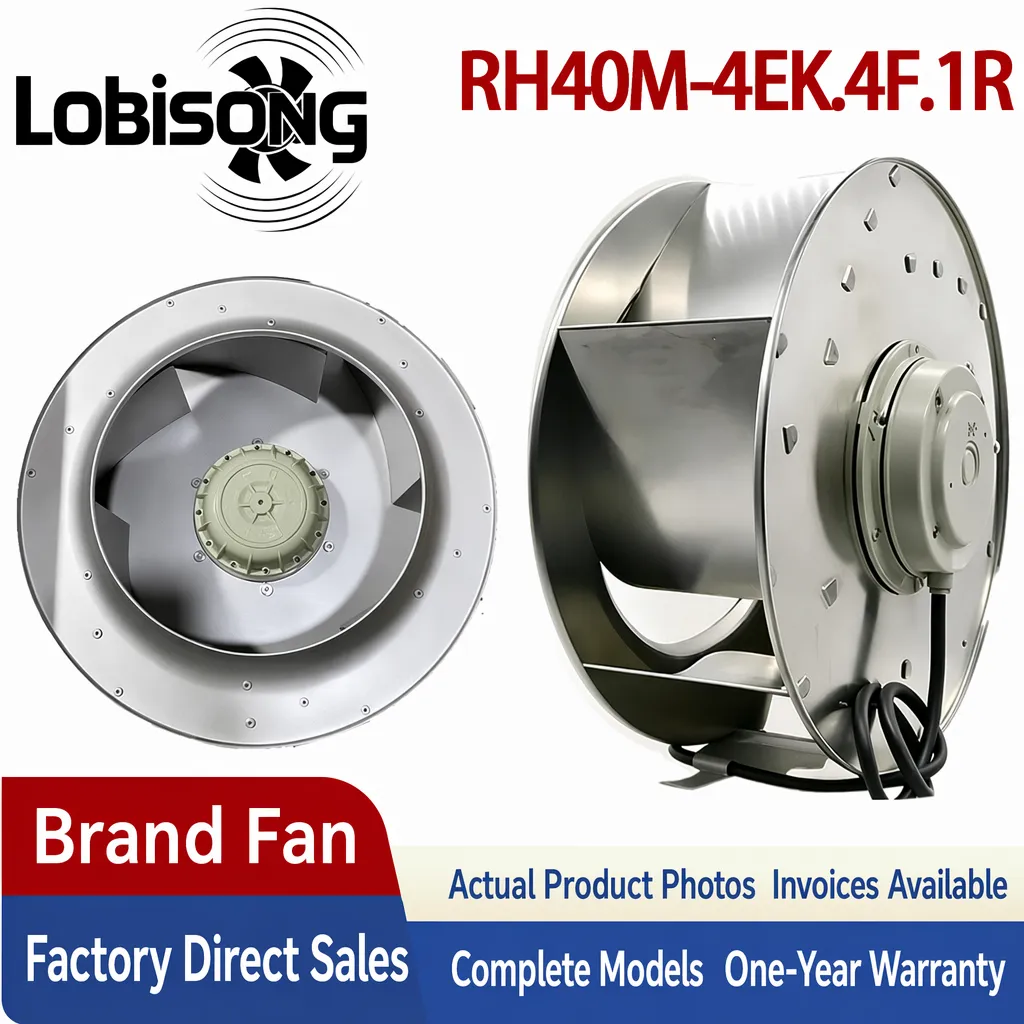
Every meter of duct adds friction, and every elbow, branch, or damper adds local loss. In that Polish plant's 40-meter pipeline, these losses stacked until the available pressure at the outlet collapsed. A backward curved blower restores margin because its pressure–flow curve stays high where axial fans fall away. Air resistance also rises with dust loading on filters and with temperature swings that change air density. Specifiers who ignore the system curve end up with a fan that spins fast yet moves little air, wasting energy and letting heat build in the process area.
Turbulence is wasted energy: swirling, reversing flow that heats the air and shakes the duct. Forward-curved wheels create strong vortex shedding at the blade tips, especially near part load. A backward curved blower uses the blade angle to keep flow attached, so the wake behind each blade is small and orderly. Lower turbulence means lower noise and less vibration transmitted into the structure. For a plant running around the clock, that quiet, steady flow reduces fatigue on bearings and gaskets and keeps the ventilation system predictable under changing loads.
Correct selection starts with the system curve, not the catalogue number. Engineers measure total duct length, count elbows, and estimate the filter pressure drop at end of life. A backward curved blower should be chosen so its peak efficiency sits near the expected operating point, leaving reserve for summer ambient heat. Standards such as IEC 60034 and EN 60335 guide motor insulation and thermal limits, while CE marking confirms conformity for European buyers. Mount the unit on a rigid base, align the inlet ring to the duct flange, and fit a pre-filter to protect the impeller. Monthly checks for vibration and temperature, plus an IP54 enclosure seal check, catch faults before shutdown and preserve efficiency for years.
Industrial duct networks live or die on pressure margin. A backward curved blower earns its place by turning impeller geometry into stable static pressure, low turbulence, and non-overloading operation that survives clogged filters and long pipeline runs. Proper sizing against the real system curve, clean installation, and routine inspection let the ventilation system hold efficiency without surprising the motor. For buyers specifying fans across Europe, Russia, and India, the backward curved design remains the practical answer to persistent air resistance in demanding duct layouts.
What defines a backward curved centrifugal fan? A backward curved blower is a centrifugal fan with blades curving away from rotation. That shape keeps airflow attached, cuts turbulence, and builds static pressure efficiently. The non-overloading power curve keeps motor current safe as the duct restricts. In industrial ventilation it pushes air through long pipelines and filters where axial fans lose pressure. Lobisong pairs these wheels with brushless outer-rotor motors, pure-copper windings, and CE/IEC compliance for global B2B buyers.
Why does the impeller reduce turbulence in ducts? The backward-curved blade angle lets air leave the wheel at low relative velocity, so each blade wake stays small. Flow remains attached instead of separating into vortices that shake the duct. Less turbulence means steadier pressure and quieter part-load operation. In a filtered ventilation system this orderly flow protects bearings and gaskets from fatigue, giving predictable performance as filters load and the system curve shifts during production.
How should static pressure be sized for a ventilation system? Start from the system curve, not the catalogue. Measure total duct length, count elbows, and estimate filter pressure drop at end of life. Select a unit whose peak efficiency sits near the expected operating point, with reserve for summer heat. IEC 60034 and EN 60335 guide motor thermal limits, while CE marking confirms European conformity. Plotting the fan curve against the duct curve removes guesswork and prevents both wasted power and starved processes.
Can this blower run in continuous duty? Yes. Precision bearings, pure-copper windings, and a brushless outer-rotor motor tolerate uninterrupted operation across the rated temperature range. The non-overloading curve prevents current spikes when the duct closes, protecting the drive. Monthly checks for vibration and temperature catch faults before shutdown. With an IP54 enclosure and a pre-filter to keep the impeller clean, these units sustain efficiency for years in demanding industrial ventilation duty.
Where are these blowers installed in industrial plants? Common sites include cabinet filter fans for VFD and inverter cooling, drying ovens, dust extraction arms, and process ventilation feeding long duct runs. Anywhere a pipeline must hold static pressure against filters and bends, a backward curved wheel fits. Lobisong supplies matched motors for Europe, Russia, India, and the Americas, with CAD drawings on request and certification to CE, UKCA, CCC, and IEC for straightforward import and commissioning.

2026/09/30
Cement cabinets choke on dust. Learn the filter rule for an industrial cabinet cooling fan: G4/F7 media, IP rating, and pre-filter care.

2026/10/07
Right wall-mount height for an industrial axial exhaust fan: room volume, free clearance, brackets, and recirculation control.

2026/10/08
An ec motor fan links to BMS via Modbus, 0-10V and PWM for demand-based cooling, energy scheduling and automatic sensor-driven speed control.

2026/10/06
A radial exhaust fan removes grease, fumes, and odors from food-processing workshops with capture velocity and hygienic washdown design.

2026/10/05
Learn antistatic treatment for industrial cabinet cooling fan in electronics workshops—ESD-safe housing, ionizable plastics, and cleanroom compatibility.

2026/10/04
Discover how a brushless dc servo delivers precise wind speed control for laboratory cooling fans with closed-loop PID feedback and laminar airflow.
