 EN
EN
What filter matching rule for dust proof cabinet cooling fan operating in cement factories
2026/09/30
Cement cabinets choke on dust. Learn the filter rule for an industrial cabinet cooling fan: G4/F7 media, IP rating, and pre-filter care.

2026/09/23
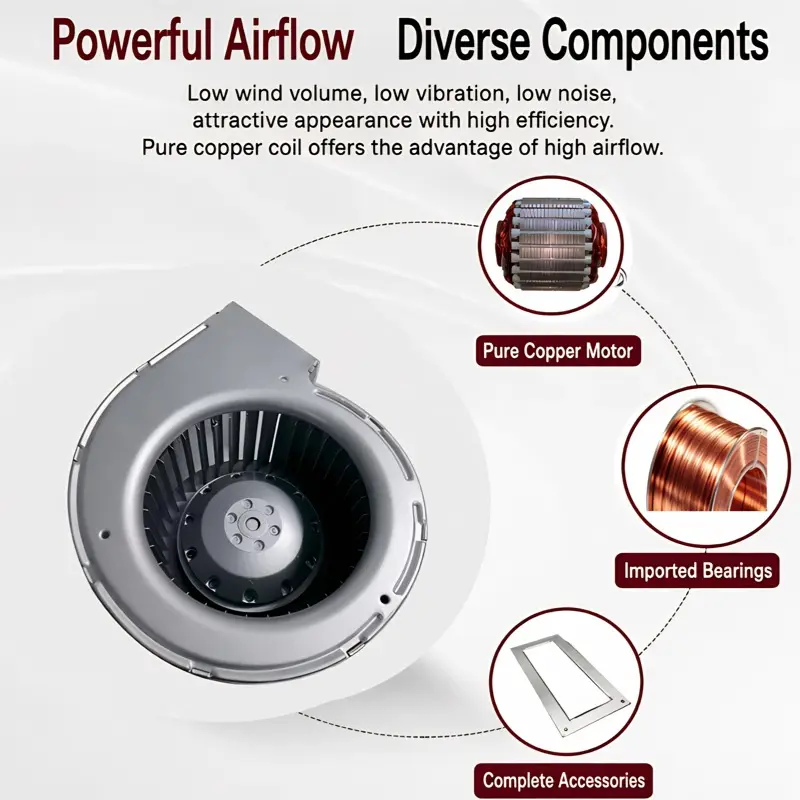
Control cabinets concentrate variable-frequency drives, PLCs and power modules inside a sealed sheet-metal enclosure, so internal temperature climbs fast under load. A brushless cabinet cooling fan removes that heat without the friction and sparking of a brushed motor, which is why reliability engineers increasingly specify the technology for critical panels. Lower operating temperature directly slows the aging of capacitors and semiconductors, and it keeps the protection relay from acting on a thermal trip during normal production.
Every semiconductor has a maximum junction temperature, beyond which it either derates or shuts down. A brushless cabinet cooling fan keeps air moving so the thermal trip never engages during normal duty, preserving continuous operation. When an electronic component overheats, its resistance rises and losses grow, creating a feedback loop that ends in premature failure. Steady airflow breaks that loop before the protection relay acts, and it protects the surrounding control cabinet wiring from heat soak.
In an inverter cabinet the IGBT switches kilowatts several times per second, dissipating concentrated heat into the heat sink behind it. Without forced enclosure cooling, that heat soaks adjacent control cards and raises the gradient across every electronic component in the panel. Mounting the brushless cabinet cooling fan to draw air across the heat sink, rather than only along the cabinet wall, targets the true hot zone and lowers the steady-state temperature the IGBT sees.
A conventional DC motor relies on carbon brushes and a commutator that physically rub thousands of times per minute. Brushless DC technology moves commutation into solid-state electronics, so no contact surface erodes. The rotor carries permanent magnets while the outer-rotor motor drives the impeller directly. Removing brush dust also protects sensitive electronic component boards from conductive contamination inside the control cabinet, which is a frequent but hidden cause of intermittent faults.
Precision ball bearing assemblies rated for continuous duty typically outlast brushed commutation by a wide margin, and that difference shows directly in MTBF calculations. A ball bearing running at moderate speed under an IP54-sealed environment can deliver tens of thousands of hours before the lubrication film degrades. A water-treatment plant once ran PLC cabinets beside a clarifier where summer ambient pushed panel temperature past 60°C and brushed fans failed every few months from brush and dust; adopting a brushless cabinet cooling fan with precision ball bearings and a washable fan filter ended the brush-related stops and restored predictable uptime, raising measured MTBF without altering the control cabinet layout.
Sizing starts with the heat load in watts and the enclosure volume in cubic metres; divide the watts to be removed by the allowable temperature rise to get the necessary airflow. Oversizing wastes energy while undersizing invites a thermal trip, so the fan curve must meet system resistance at the duty point. A brushless cabinet cooling fan with a matched controller holds the setpoint even as the fan filter loads up, keeping the electronic component temperature stable through the maintenance interval.
A brushless cabinet cooling fan paired with a washable fan filter stops lint and dust from reaching the heat sink, but a clogged filter raises static pressure and cuts airflow. Choose a snap-on filter and place the intake where ambient is cleanest; IP54 protection per IEC 60529 keeps coolant mist and washdown spray out of the inverter cabinet. Good internal layout separates hot IGBT banks from sensitive control wiring, and CE or UKCA documentation supports enclosure cooling designs built to IEC 61439 for low-voltage switchgear.
Inspect the fan filter every month in dusty plants and listen for a coarse ball bearing rumble that signals failing lubrication. Compare actual airflow against the nameplate; a 20 percent drop usually means the impeller or filter is restricted. Catching the warning early lets maintenance swap the brushless cabinet cooling fan during a planned stop instead of after a shutdown, avoiding a thermal trip that would halt the line and stress every electronic component downstream.
Trend the cabinet internal temperature over weeks rather than reacting to a single alarm. When steady-state temperature creeps upward despite a clean filter, the ball bearing or motor is aging and replacement is due. Many sites pair the brushless cabinet cooling fan with a temperature sensor and alarm so the control cabinet is serviced before any electronic component reaches its limit. For cleanroom-adjacent panels, ISO 14644 Class guidance helps define the particle exposure the fan filter must manage.
Stocking a spare unit near the control cabinet prevents a single-point failure in peak season. A worn ball bearing can stall the impeller and let the IGBT heat sink climb until a thermal trip halts the production line.
Selecting the right brushless cabinet cooling fan is less about peak airflow and more about sustained, predictable heat removal across the duty cycle. Combined with precision ball bearing quality, IP54 sealing and disciplined inspection, the brushless DC design measurably lowers the control-cabinet failure rate and protects MTBF through the plant's operating life, turning enclosure cooling from a hidden risk into a managed parameter.
What role does forced enclosure airflow play inside a control cabinet?
Answer: A brushless cabinet cooling fan forces continuous airflow through the enclosure to carry heat away from IGBT modules, heat sinks and control cards. By holding the internal temperature below the thermal trip threshold, it prevents derating and unplanned stops. The brushless DC design removes carbon brushes, so no conductive dust forms and ball bearing life stays long, which directly supports a higher MTBF for the whole control cabinet.
Why does brushless DC technology improve MTBF compared with brushed motors?
Answer: Brushed motors wear carbon brushes and a commutator through constant physical contact, generating dust and eventual open circuits. Brushless DC moves switching into electronics, eliminating that contact wear entirely. Precision ball bearings then become the main life limit, and they run far longer under IP54 sealing. Fewer wear parts means fewer random failures, so the control cabinet reaches a higher MTBF with less unplanned maintenance across the operating life.
How should airflow be sized for an inverter cabinet?
Answer: Start from the total heat load in watts and the allowable temperature rise, then divide to get required airflow in cubic metres per hour. Match the fan curve to the system resistance at the duty point so the setpoint holds as the fan filter clogs. Oversizing wastes energy while undersizing risks a thermal trip. A brushless DC unit with a controller keeps the IGBT and heat sink within safe limits through the full maintenance interval.
Can IP54 protection handle washdown and coolant-mist environments?
Answer: IP54 per IEC 60529 blocks solid particles larger than 1 mm and protects against water spray from any direction, so it suits most inverter cabinet bays with occasional washdown or coolant mist. It does not cover immersion or high-pressure jetting, which need higher ratings. Pair IP54 with a washable fan filter and keep intake away from direct spray to maintain reliable enclosure cooling and protect sensitive electronic component boards.
Where should the fan filter be placed for the longest service interval?
Answer: Mount the intake on the cleanest side of the enclosure, away from dust sources, conveyors or grinding areas, and use a snap-on washable fan filter for quick cleaning. Position the exhaust to draw air across the heat sink and hot IGBT bank rather than just the cabinet wall. Regular filter checks prevent static-pressure buildup that would force a thermal trip and shorten the ball bearing service life.

2026/09/30
Cement cabinets choke on dust. Learn the filter rule for an industrial cabinet cooling fan: G4/F7 media, IP rating, and pre-filter care.

2026/10/07
Right wall-mount height for an industrial axial exhaust fan: room volume, free clearance, brackets, and recirculation control.

2026/10/08
An ec motor fan links to BMS via Modbus, 0-10V and PWM for demand-based cooling, energy scheduling and automatic sensor-driven speed control.

2026/10/06
A radial exhaust fan removes grease, fumes, and odors from food-processing workshops with capture velocity and hygienic washdown design.

2026/10/05
Learn antistatic treatment for industrial cabinet cooling fan in electronics workshops—ESD-safe housing, ionizable plastics, and cleanroom compatibility.

2026/10/04
Discover how a brushless dc servo delivers precise wind speed control for laboratory cooling fans with closed-loop PID feedback and laminar airflow.
