 EN
EN
What filter matching rule for dust proof cabinet cooling fan operating in cement factories
2026/09/30
Cement cabinets choke on dust. Learn the filter rule for an industrial cabinet cooling fan: G4/F7 media, IP rating, and pre-filter care.

2026/09/05
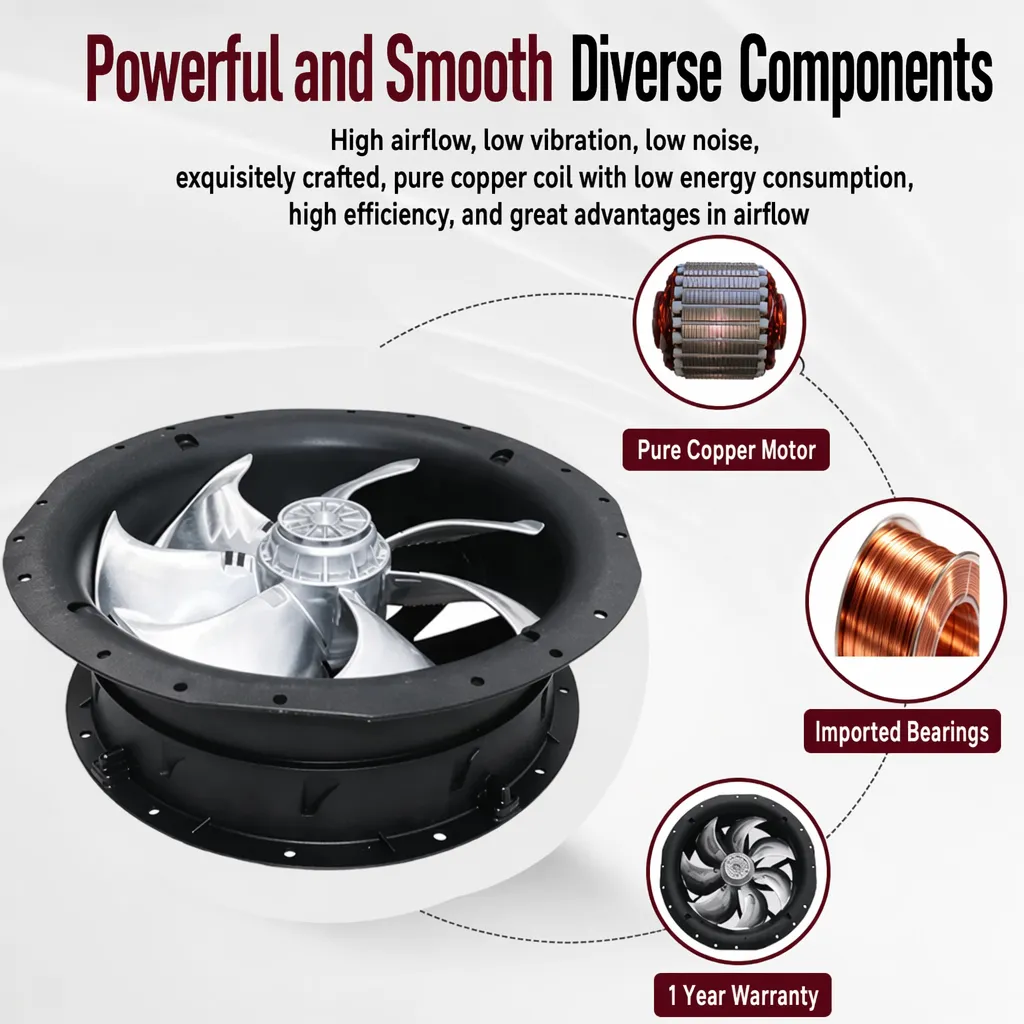
Pharmaceutical clean rooms are judged on numbers that never sit still. Room-to-room pressure differentials, recovery times and particle counts all live inside a validated envelope, and the ventilation equipment either holds that envelope or breaks it. Catalogue selections rarely fit, because every suite carries its own filter loading, duct length and airlock sequence. That gap is where a custom backward inclined fan manufacturer joins the design conversation instead of simply shipping hardware, shaping the fan curve around the pressure cascade a facility has to prove during qualification.
Classification under ISO 14644 sets particle limits, and GMP annexes turn those limits into operating rules: a measurable pressure differential between adjacent grades, commonly 10 to 15 Pa, plus documented recovery after a door opening. The cascade behaves as a chain, running from corridor to airlock to filling room, and every link depends on volumetric flow meeting resistance at a predictable point on the fan curve. A custom backward inclined fan manufacturer starts from that chain rather than a nominal airflow figure, because the same 3,000 m3/h can arrive at very different static pressure depending on HEPA filter loading and duct geometry. Terminal filters gain resistance as they load, so a unit sized only for clean-filter conditions surrenders its differential long before change-out.
Loss of differential is seldom dramatic. Pressure sags a few pascals, a door swings more easily, and airflow across a threshold turns neutral or reverses. The barrier between a Grade C corridor and a Grade B area then stops existing, and cross-contamination becomes a recorded deviation rather than a theoretical concern. Inspectors read trend data, so a slow decline surfaces as a batch-record question: which lots were exposed, and did the contamination control strategy still hold? Costs stack fast through quarantined product, revalidation of the affected suite and observations that follow a site into its next audit. Fan choice sits upstream of all of it, which is why a custom backward inclined fan manufacturer is usually engaged before ductwork is frozen.
Backward inclined blades sweep away from the direction of rotation, releasing air at a lower relative velocity than forward-curved geometry produces. Less kinetic energy needs recovering inside the housing, which lifts static efficiency and flattens the useful span of the curve. For a clean room the decisive property is a non-overloading power characteristic: as resistance climbs with filter loading, absorbed power peaks and then falls instead of running away, keeping the motor inside its thermal limits without derating tricks. A steep pressure curve near the duty point also means small shifts in system resistance produce small shifts in flow, and a custom backward inclined fan manufacturer exploits that behaviour so pressure control loops work against a predictable actuator rather than a hunting fan.
Aerodynamics only pay off when the drive holds speed. A brushless motor built as an outer rotor design carries the magnet assembly around the stator, allowing direct impeller mounting, a compact body and no belt to tension inside an air handling unit. Pure-copper windings cut resistive losses and keep winding temperature moderate at continuous duty, which matters in suites operating around the clock. An EC motor closes the loop, trimming speed from a 0-10 V or Modbus signal as room sensors report drift. Precision ball bearing sets and balanced impellers hold vibration low, protecting bearing service life and the filter seals that vibration slowly loosens. Insulation class and IP rating are specified by a custom backward inclined fan manufacturer for disinfectant and wash-down exposure.
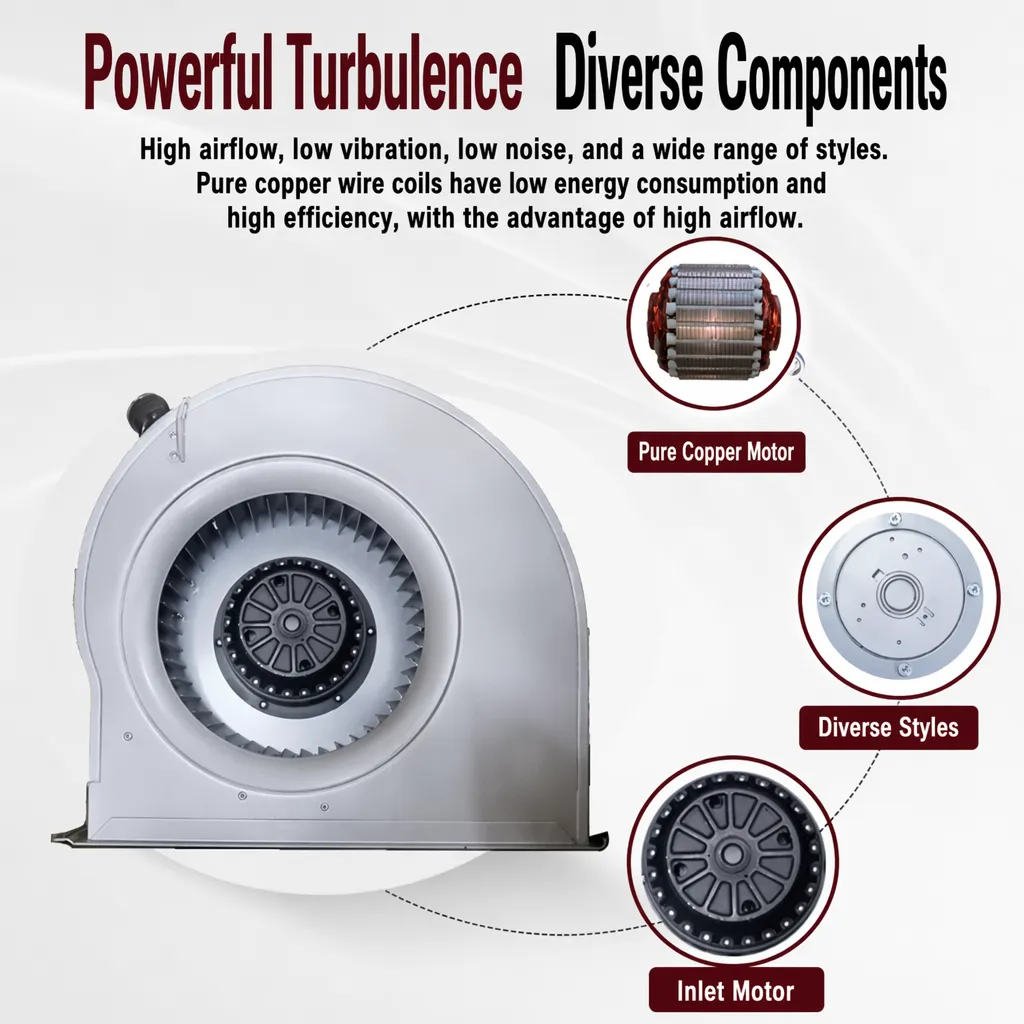
A contract manufacturer in Central Europe extended an oral solid dose plant with a second granulation suite. Commissioning passed on volume yet failed the cascade: the airlock held only 4 Pa against the corridor, and recovery after door opening exceeded the validated window. The installed generic centrifugal units had been picked on flow alone, and their curves ran flat exactly where loaded HEPA filters demanded authority. Duct runs, final filter resistance and door leakage area were rebuilt into a duty specification, and a custom backward inclined fan manufacturer supplied dual inlet backward curved units with a steeper curve and EC control matched to the measured system line. Retesting held 15 Pa across clean and loaded filter states, with recovery inside 20 seconds.
A workable specification names both ends of filter life: airflow at clean resistance and at final resistance, with the differential to be held in each state. Ambient temperature range, disinfectant exposure, control signal type and CE or IEC compliance expectations remove most later disputes, while a fan curve showing the tolerance band makes site verification possible. On delivery, confirm balance marks, rotation direction and nameplate data before a unit disappears into a ceiling void. In service, log differential pressure across filters and rooms, trend absorbed current, and treat rising current at steady flow as early loading. Quarterly maintenance covering bearing noise, impeller deposits and gasket condition catches faults while a planned shutdown remains available.
Pressure control in a pharmaceutical clean room is an engineered outcome, not a setting. Backward inclined impellers earn their place through a steep, stable curve and non-overloading power draw, while brushless outer rotor motors and EC control keep that curve intact as filters load and rooms change duty. ISO 14644 and GMP annexes define the target, and IEC or EN certification keeps the electrical side defensible under inspection. Partnering with a custom backward inclined fan manufacturer aligns the fan curve with the real system line, so contamination control stays measurable across the entire filter life.
Most pharmaceutical facilities design for 10 to 15 Pa between adjacent grades, with the exact figure set by the contamination control strategy and local regulatory expectations. The number matters less than the condition attached to it: the differential has to hold with terminal filters at final resistance and doors closed, and recovery after an opening must return within the validated time window.
Backward inclined blades deliver a steeper, more stable pressure curve and a non-overloading power characteristic. As HEPA filters load and system resistance rises, flow changes gradually and absorbed power peaks rather than climbing without limit. Control loops react smoothly, static pressure stays inside tolerance, and the motor keeps operating within its thermal design instead of drifting toward a thermal trip.
Sizing against the whole system line rather than a single duty point is the practical answer. Airflow is specified at clean and final filter resistance, an EC motor with closed-loop speed control trims output as a differential pressure sensor reports drift, and a steep fan curve limits flow loss. Trending absorbed current alongside filter differential reveals loading before the cascade weakens.
A fan curve with tolerance band, sound data, motor performance figures, a materials list and a CE or IEC declaration cover most technical review needs. Dimensional drawings and control interface details prevent installation surprises. A custom backward inclined fan manufacturer able to supply that package with test data, plus support for factory acceptance testing, shortens qualification and gives auditors a traceable equipment file.
EC drives allow speed to be set precisely during commissioning and adjusted later without changing pulleys or dampers, so the balanced condition recorded in validation can be restored exactly after service work. Continuous feedback from room sensors keeps the cascade steady as conditions change, and lower energy consumption at part load reduces running cost across long production campaigns.

2026/09/30
Cement cabinets choke on dust. Learn the filter rule for an industrial cabinet cooling fan: G4/F7 media, IP rating, and pre-filter care.

2026/10/07
Right wall-mount height for an industrial axial exhaust fan: room volume, free clearance, brackets, and recirculation control.

2026/10/08
An ec motor fan links to BMS via Modbus, 0-10V and PWM for demand-based cooling, energy scheduling and automatic sensor-driven speed control.

2026/10/06
A radial exhaust fan removes grease, fumes, and odors from food-processing workshops with capture velocity and hygienic washdown design.

2026/10/05
Learn antistatic treatment for industrial cabinet cooling fan in electronics workshops—ESD-safe housing, ionizable plastics, and cleanroom compatibility.

2026/10/04
Discover how a brushless dc servo delivers precise wind speed control for laboratory cooling fans with closed-loop PID feedback and laminar airflow.
