 EN
EN
What filter matching rule for dust proof cabinet cooling fan operating in cement factories
2026/09/30
Cement cabinets choke on dust. Learn the filter rule for an industrial cabinet cooling fan: G4/F7 media, IP rating, and pre-filter care.

2026/09/29
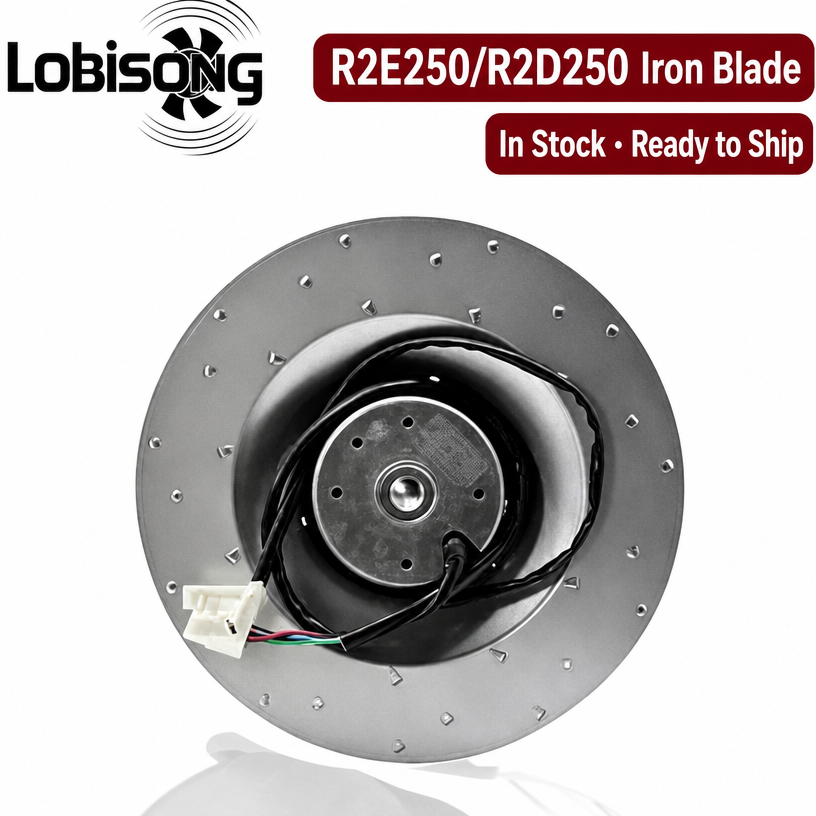
A dc backward curved fan avoids the classic weakness of an AC induction motor at switch-on. In an induction unit the rotor is stationary, so the stator sees almost no back-EMF and pulls a locked-rotor current several times the running value. The winding acts like a near-short circuit for a brief instant. That surge stresses the supply, heats the copper windings, and can sag the bus voltage that feeds nearby controllers. Inrush is not a defect of the impeller; it is an inherent property of how an AC machine must be magnetized before it spins.
Compact enclosures such as wall-mounted panels and small machine housings are fed by modest branch breakers, often 6 A to 10 A in European installations. A single AC fan that demands six times running current at start can approach that limit before the rotor reaches speed. Add a contactor, a servo drive, and a PLC on the same circuit and the cumulative inrush trips the breaker. The result is an unplanned stoppage that costs far more than the fan itself, especially in continuous process lines.
A brushless DC drive rewrites the start sequence. Instead of waiting for the rotor to build back-EMF on its own, the driver sets the current. Electronic commutation energizes the winding in a timed sequence synced to rotor position, so torque rises smoothly from zero. There is no locked-rotor window and therefore no current spike. A dc backward curved fan reaches its target RPM along a software-defined ramp that the power supply barely notices.
A dc backward curved fan benefits from a current-limited startup profile built into the driver firmware. The controller measures rotor angle through hall sensors or sensorless estimation, then applies just enough voltage to accelerate. Because current is regulated every switching cycle, the peak never exceeds the running level by more than a small margin. This is why the same 24 V or 48 V supply that runs the fan can also start it without a dedicated soft-starter relay.
Static pressure changes as filters clog or ducts narrow. A good driver holds acceleration constant by trimming the duty cycle, so the fan never stalls into a high-backpressure load and draws excess current. Driver thermal management relies on copper windings at the motor and a small control-side heatsink. The outcome is predictable inrush-free starting even after months of dust accumulation in a ventilation path.
Real installations show the value of controlled starting more clearly than any datasheet.
A precision workshop ran a small CNC with a 400 V AC spindle and a control cabinet cooled by a 160 mm axial AC fan. Every Monday morning the main panel breaker tripped when the cabinet fan and spindle contactor energized together. The maintenance team suspected the spindle, but the real cause was cumulative inrush: the AC fan alone pulled roughly five times its running current for nearly a second, pushing the branch over its rating during the shared startup moment.
The workshop replaced the AC unit with a dc backward curved fan rated for the same airflow and static pressure. The brushless driver ramped the impeller from rest over about two seconds, so the cabinet breaker never saw a surge. Spindle and fan now start on the same circuit without tripping. Engineers also gained PWM speed control, letting them slow the fan during light cuts and cut both noise and power draw. The retrofit needed only a 24 V supply tap and a small mounting adapter.
Specify the driver for the worst-case current, not the average running current, even though starting is controlled. Confirm the supply can deliver the continuous amperage plus any co-located loads. Match the impeller diameter and blade angle to the required CFM and static pressure so the fan does not run near its upper RPM band, where copper and bearing temperatures climb. Pure-copper motor windings and precision bearings extend service life in dusty, warm enclosures.
A dc backward curved fan assembly should be verified against CE and UKCA documentation and checked for the correct IP rating of the enclosure. Wiring should follow NFPA 70 and local EN harmonized practice, with a grounded conduit and adequate conductor gauge. Inspect the impeller and filter every quarter; a clogged filter raises backpressure and forces the driver to work harder. Replace bearings at the first sign of vibration to protect the commutation timing and the surrounding electronics.
Small industrial cooling equipment lives on tight electrical budgets where every ampere at startup counts. Replacing an AC induction unit with a dc backward curved fan moves the start from a violent locked-rotor surge to a controlled current ramp, protecting breakers, controllers, and the process itself. In small equipment cooling, this difference decides whether a shared branch stays online or trips. Procurement teams should weigh starting current alongside airflow and static pressure, and request CE or UKCA documentation before specifying. A low starting current fan is not a luxury in compact enclosures; it is the baseline for reliable operation. The quieter, inrush-free start of a BLDC cooling fan is the hidden reliability gain.
Frequently Asked Questions
Question
What causes the high starting current in an AC cooling fan?
Answer: An AC induction motor starts from rest with no back-EMF, so its stator winding behaves like a near-short circuit and pulls several times the running current for a moment. The locked-rotor condition lasts until the rotor reaches speed. In a small enclosure shared with other loads, that surge can exceed the branch breaker rating and trip the circuit. Soft-start control removes the spike by ramping current gradually, which is why a soft start fan motor is preferred in small equipment cooling.
Question
Why does a brushless driver prevent inrush in small equipment?
Answer: Electronic commutation lets the driver set torque from zero by controlling voltage and current each switching cycle. The rotor position is tracked through hall sensors or sensorless estimation, so the winding is energized only when needed. No locked-rotor window exists, which means peak current stays near the running level. A dc backward curved fan therefore starts on the same supply as sensitive controllers without disturbing the bus voltage or tripping nearby breakers. This is the core advantage of a low starting current fan over an AC induction equivalent.
Question
How can an existing AC fan be replaced with a soft start fan motor?
Answer: Confirm the required CFM and static pressure, then select a brushless BLDC cooling fan with a matching impeller and frame. Provide a 24 V or 48 V supply tap and keep conductor gauge per NFPA 70. Mount with the existing holes or a small adapter, then set the ramp time in the driver. Test the startup with the original loads still on the branch to verify the breaker no longer trips during shared energization. In small equipment cooling retrofits, this step-by-step check is what makes the upgrade predictable.
Question
Can soft start fan motor control protect other devices on the same circuit?
Answer: Yes. Because the fan no longer creates a current spike at startup, the shared branch breaker keeps headroom for contactors, servo drives, and PLC power supplies. The stable bus voltage also protects sensitive measurement electronics from sag during energization. Pairing the driver with a small filter further reduces conducted noise. The result is a cleaner startup profile that lowers the risk of nuisance trips across the whole enclosure. For any BLDC cooling fan installed alongside sensitive loads, this protection is the main reason to choose a low starting current fan.
Question
Do brushless fans need more maintenance than AC types?
Answer: Not generally. The absence of brushes removes a wear item, and precision bearings handle the rotor load for long periods. Maintenance focuses on the impeller and filter: clear dust that raises backpressure, and check the IP rating stays intact. Inspect the driver heatsink for blockage and verify commutation timing after any impact. With quarterly checks, a dc backward curved fan runs reliably and keeps its inrush-free starting advantage, which is exactly what small equipment cooling needs for long-term stability.

2026/09/30
Cement cabinets choke on dust. Learn the filter rule for an industrial cabinet cooling fan: G4/F7 media, IP rating, and pre-filter care.

2026/10/07
Right wall-mount height for an industrial axial exhaust fan: room volume, free clearance, brackets, and recirculation control.

2026/10/08
An ec motor fan links to BMS via Modbus, 0-10V and PWM for demand-based cooling, energy scheduling and automatic sensor-driven speed control.

2026/10/06
A radial exhaust fan removes grease, fumes, and odors from food-processing workshops with capture velocity and hygienic washdown design.

2026/10/05
Learn antistatic treatment for industrial cabinet cooling fan in electronics workshops—ESD-safe housing, ionizable plastics, and cleanroom compatibility.

2026/10/04
Discover how a brushless dc servo delivers precise wind speed control for laboratory cooling fans with closed-loop PID feedback and laminar airflow.
