 EN
EN
What filter matching rule for dust proof cabinet cooling fan operating in cement factories
2026/09/30
Cement cabinets choke on dust. Learn the filter rule for an industrial cabinet cooling fan: G4/F7 media, IP rating, and pre-filter care.

2026/09/07

Industrial ventilation moves enormous volumes of air, and moving air costs electricity every hour of every shift. An EC backward curved centrifugal blower changes that equation because its motor and wheel are designed together for efficiency, not borrowed from a generic parts bin. The result is lower power consumption at the duty point where the system actually runs, which is where savings are earned. For plant engineers facing energy targets, the difference shows up on the utility bill rather than the spec sheet.
A packaging plant ran a make-up air system with belt-driven AC centrifugal fans sized for peak summer load. Most of the year the dampers throttled airflow while the motors drew near-full current, wasting energy as heat and vibration. After replacing them with an EC backward curved centrifugal blower controlled by a duct-pressure signal, the plant cut fan energy by roughly a third across a heating season. The air volume stayed the same; only the wasted margin disappeared.
A standard AC induction motor spins at a speed set by line frequency, so reducing airflow means restricting the outlet and forcing the motor to fight its own backpressure. That throttling burns electricity without moving more air. Worse, the motor runs hottest and least efficient exactly when the load is light. In many factories the ventilation runs 24/7, so those losses compound into a permanent, invisible cost that nobody sees on a single invoice but every month's totals quietly reveal. Part-load operation is the norm in most plants, yet that is precisely where a fixed-speed AC motor is least efficient, because it cannot shed the magnetizing and windage losses that exist even at zero flow. The energy saving opportunity therefore lives in the part-load hours, not the rare peak.
The "EC" stands for electronically commutated. Instead of brushes or a fixed line-frequency supply, an EC backward curved centrifugal blower uses a permanent-magnet rotor and an outer rotor design driven by an integrated controller that switches current precisely with rotor position. This electronic commutation keeps torque smooth and efficiency high across the whole variable speed range. Because the drive and motor share one housing, there is no belt, no coupling, and far less that can drift out of tune. The integrated drive also enables soft start and precise speed control, which protects the supply and the downstream ductwork from sudden pressure spikes. IEC 60034 covers rotating electrical machines and the efficiency classes that matter here.
The wheel's blades curve against the direction of rotation, which lets the impeller shed air cleanly at the tip and resist overloading as pressure rises. A backward curved impeller is naturally stable across a wide operating band, so the blower holds its curve instead of surging. Centrifugal force accelerates air outward along the blade, and the backward curve means the tip does not fight the exiting flow, so the wheel stays efficient as it speeds up. This is why the same impeller tolerates a dirty filter far better than a forward-curved alternative would. For ducted air handling, this means the EC backward curved centrifugal blower delivers rated airflow against real static pressure from filters and long runs, without the steep power penalty an axial fan would pay in the same spot.
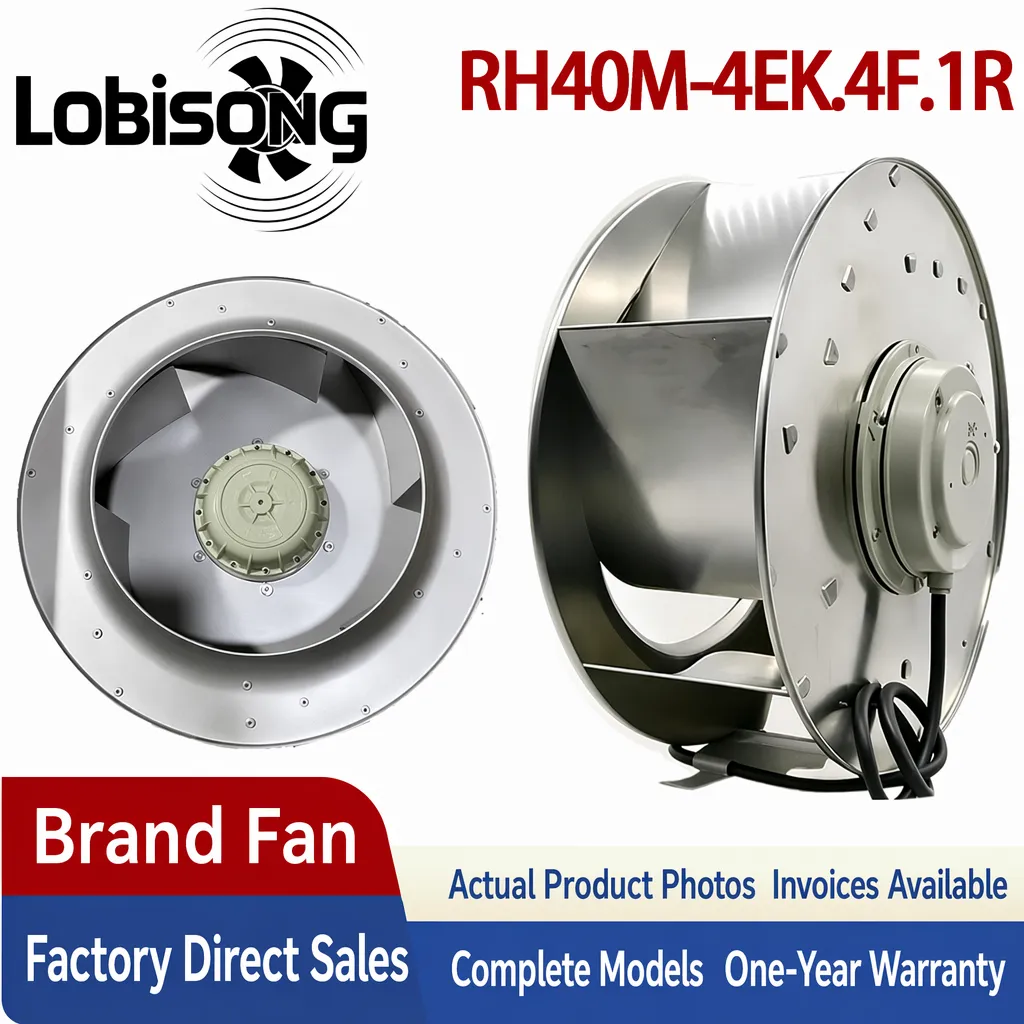
Efficiency is earned at the duty point, not at the nameplate peak. Plot the system resistance curve and pick the blower whose curve crosses it near its high-efficiency island. Oversizing forces throttling again; undersizing forces the motor to strain. Ask the supplier for the EC backward curved centrifugal blower performance map at several speeds, and confirm the IE class and any regional efficiency expectation such as the ERP directive for fans placed on the European market.
Connect the blower to a pressure or temperature sensor so it modulates instead of running flat out. Check the impeller for dust buildup quarterly, because a dirty wheel loses airflow and draws more current to compensate. Listen for bearing change and verify current against the commissioning baseline. A well-specified EC backward curved centrifugal blower with sealed bearings can run for years, but only if the inlet stays clear and the control loop is actually tuned to the space it serves. Good energy efficiency also depends on commissioning: place the sensor where it reads the real condition, not in a dead pocket, and set the setpoint with the actual load in mind. A blower left at a guessed speed wastes the very efficiency it was bought to deliver.
Cutting ventilation energy starts with matching the machine to how the system truly runs. An EC backward curved centrifugal blower earns its place when the motor, impeller, and control are chosen together and set to the real duty point. Procurement gains the most by requesting performance maps, confirming efficiency class, and wiring the unit to a sensor-driven control loop from day one. The outcome is lower power consumption, steadier airflow, and a ventilation asset that pays back through reduced operating cost. Most sites recover the price gap over a standard AC setup within a couple of heating or cooling seasons, after which the saving is pure margin on the energy bill.
Question: How does an EC backward curved centrifugal blower save energy? Answer: It pairs a permanent-magnet EC motor with electronic commutation that holds high efficiency across speed, and a backward curved impeller that stays stable under pressure. The blower modulates to the real duty point instead of throttling, so it draws only the power the airflow actually needs rather than running near-full current all the time.
Question: Is a backward curved impeller better than forward curved? Answer: For ducted industrial air handling, a backward curved wheel resists overloading and keeps efficiency across a wide pressure band, while a forward curved wheel suits low-pressure, high-volume jobs. The right choice follows the system curve, not a general rule, so compare both against the measured static pressure before deciding. In practice the backward curved option also tolerates filter loading better, keeping airflow stable as resistance climbs.
Question: Can an EC blower be controlled by a building system? Answer: Yes. Most EC motors accept 0–10 V, PWM, or a communication signal, so a PLC or building management system can set speed from a pressure or temperature sensor. That closed loop is what delivers the savings, because the blower runs only as hard as the current condition requires rather than at a fixed rate.
Question: What maintenance does an EC centrifugal blower need? Answer: Inspect the impeller for dust quarterly and clean it before buildup cuts airflow. Verify current against the commissioning baseline, listen for bearing change, and keep the inlet clear. Sealed bearings last for years, but the efficiency gain disappears if the control loop is left untuned or the wheel is allowed to clog with debris.
Question: Does an EC centrifugal blower need a separate frequency drive? Answer: No external drive is required, because the commutation electronics are built into the motor. That removes the belt, coupling, and separate VFD from the bill of materials, which lowers install effort and eliminates a common failure point found in older AC fan setups on the plant floor. It also simplifies spare parts, since one integrated unit replaces three separate components and their associated wiring runs.

2026/09/30
Cement cabinets choke on dust. Learn the filter rule for an industrial cabinet cooling fan: G4/F7 media, IP rating, and pre-filter care.

2026/10/07
Right wall-mount height for an industrial axial exhaust fan: room volume, free clearance, brackets, and recirculation control.

2026/10/08
An ec motor fan links to BMS via Modbus, 0-10V and PWM for demand-based cooling, energy scheduling and automatic sensor-driven speed control.

2026/10/06
A radial exhaust fan removes grease, fumes, and odors from food-processing workshops with capture velocity and hygienic washdown design.

2026/10/05
Learn antistatic treatment for industrial cabinet cooling fan in electronics workshops—ESD-safe housing, ionizable plastics, and cleanroom compatibility.

2026/10/04
Discover how a brushless dc servo delivers precise wind speed control for laboratory cooling fans with closed-loop PID feedback and laminar airflow.
