 EN
EN
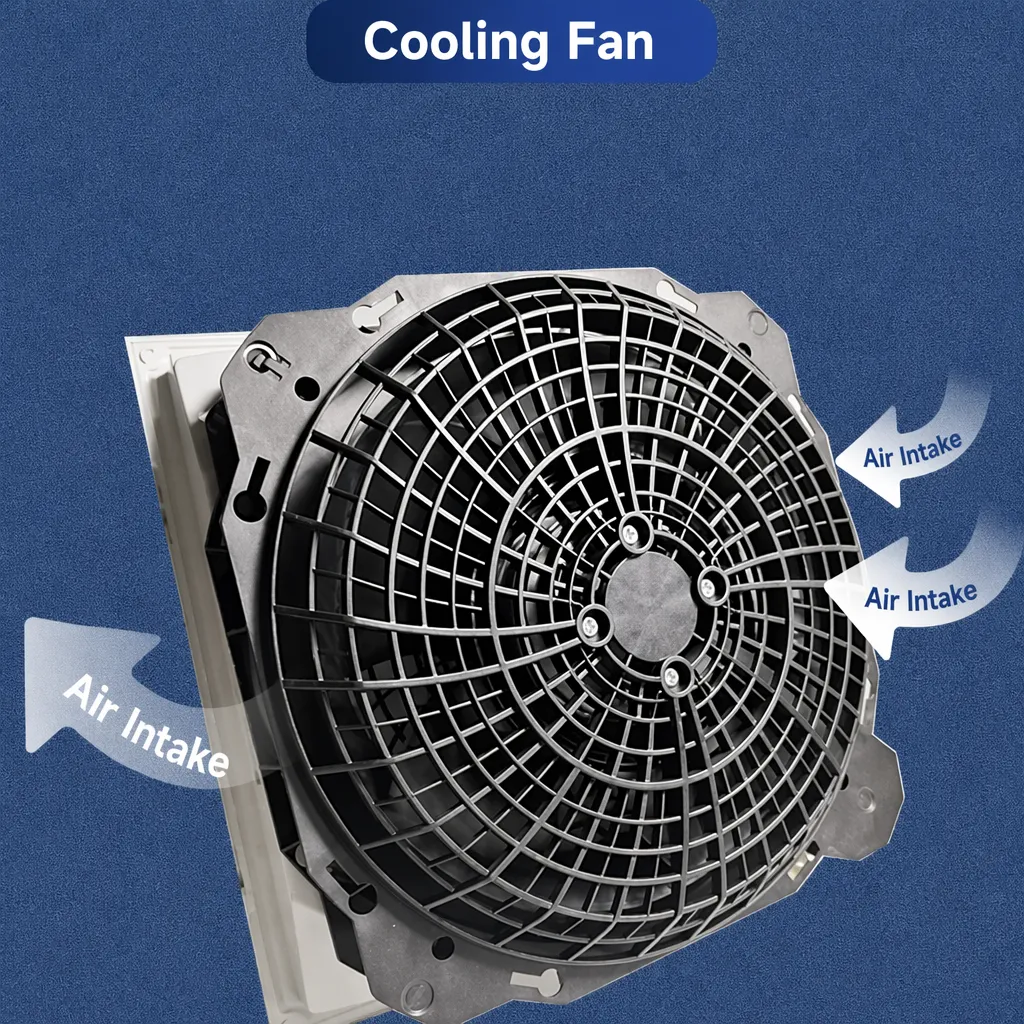
What filter matching rule for dust proof cabinet cooling fan operating in cement factories
2026/09/30
Cement cabinets choke on dust. Learn the filter rule for an industrial cabinet cooling fan: G4/F7 media, IP rating, and pre-filter care.

2026/09/25
Cooling systems in commercial and industrial buildings rarely run at full capacity. Most air-handling units, chillers and process coolers spend the bulk of their operating hours at reduced demand, yet traditional AC or fixed-speed installations keep drawing near-peak power. Energy bills track those low-demand hours far more than the occasional peak, so the control strategy decides the annual cost. That mismatch is where ec centrifugal fans and drives deliver their strongest advantage: the motor and its control electronics adapt output to actual load instead of forcing full-speed operation.
An electronically commutated motor, often called an ECM, replaces the mechanical commutator and brushes of older designs with solid-state switching controlled by the drive. The brushless outer-rotor construction used in ec centrifugal fans and drives eliminates friction losses at the commutator and lets the rotor run cooler. Electronics sense rotor position and energize the correct stator winding at the right moment, so torque stays smooth across the whole speed range. That precise commutation is the foundation of the efficiency gain.
The integrated drive converts incoming AC to DC and back to controlled AC, or runs the motor directly as a brushless DC machine. EC technology lets the unit accept a 0–10 V, PWM or MODBUS speed command and set speed accordingly. Because the drive handles modulation internally, there is no separate inverter to cool and no extra conversion stage that wastes energy. Ec centrifugal fans and drives therefore make variable speed control part of the fan rather than an add-on.
IEC 60034-30 defines IE efficiency classes for motors, and many EC units reach IE4 or IE5 levels that conventional AC induction fans cannot match at part load. Motor efficiency at 50% speed is the figure that matters most in ventilation duty, not the nameplate full-load rating. Specifiers who read the IE efficiency class on the label avoid buying a fan that looks efficient on paper yet wastes power during the long partial-load hours that dominate real operation. The ErP regulation in the European Union sets minimum efficiency requirements that push the market toward high-IE motors, and an EC centrifugal design meets those thresholds while keeping motor efficiency high at the partial load that ventilation duty demands.
Fan affinity laws state that airflow scales with speed, pressure with speed squared, and power with speed cubed. A centrifugal fan running at 70% speed consumes roughly 34% of full-load power, not 70%. This cubic relation is why trimming speed by a modest amount produces large power saving. Ec centrifugal fans and drives exploit that physics directly: slowing the wheel to match demand removes the bulk of wasted energy.
A constant-volume AC system meets lower cooling demand by throttling dampers or bypassing air, which wastes the pressure the fan already built. EC centrifugal fans and drives instead reduce motor speed so the fan simply moves less air at far lower power. The drive reads a temperature or pressure signal and trims output continuously. During mild weather or light occupancy, the unit may sit at 40–60% speed for days, and the cubic law turns that into a dominant share of the annual energy consumption reduction.
Consider an air-handling unit retrofit in a mid-size distribution warehouse. The original belt-drive AC fan ran at one speed and met part-load by recirculating air through a bypass. Replacing it with a direct-coupled EC centrifugal fan controlled by duct static pressure cut the hours spent at high speed dramatically. Maintenance also improved: no belts to tension, fewer bearing failures, and the integrated drive reported speed and current to the building management system. Such a scenario shows why partial-load control, not peak rating, drives the real saving for ec centrifugal fans and drives.
Before purchase, confirm the voltage rating, IP44 or IP54 protection for the environment, and CE or UKCA documentation for the target market. Verify the IE class on the motor nameplate and ask the supplier for a part-load efficiency curve rather than a single full-load number. Confirm the control interface matches the existing BMS, whether 0–10 V, PWM or MODBUS. Sizing the wheel to the system curve avoids running ec centrifugal fans and drives at an inefficient operating point later.
EC units are largely maintenance-free, but the air side still needs attention. Clean the impeller and inlet cone on a schedule tied to dust load, because fouling shifts the fan curve and forces higher speed for the same airflow. Check the filter, since a clogged prefilter starves the wheel and raises motor current. Verify the drive's reported current against baseline readings; a slow creep upward signals bearing wear or imbalance. A short commissioning log with baseline speed, current and static pressure gives the maintenance team a reference to spot drift before it becomes a failure.
The result is a cooling setup where ec centrifugal fans and drives let energy consumption track real demand instead of a fixed worst case. Pairing the EC motor with its native drive removes the conversion losses that separate inverters add, while the centrifugal wheel delivers the static pressure that ducted systems require. Procurement teams that weigh part-load performance, not just nameplate figures, secure the most durable power saving over the equipment service life.
What makes ec centrifugal fans and drives more efficient than AC fans at part load?
Answer: An electronically commutated motor paired with an integrated drive adjusts speed to actual demand instead of running at fixed speed. At partial load the centrifugal fan follows the cubic affinity law, so a small speed reduction yields a large drop in power. Conventional AC systems often meet lower demand by throttling, which wastes built pressure. EC technology captures that lost energy as direct power saving across long low-demand operating hours.
Why does motor efficiency at partial load matter more than full-load rating?
Answer: Ventilation duty keeps a fan at reduced speed for most operating hours, so the part-load efficiency curve decides annual energy use. IEC 60034-30 IE classes show that an IE4 or IE5 EC motor holds high motor efficiency well below nameplate speed, while a standard induction motor drops sharply. Reading the part-load curve prevents selecting a fan that appears efficient at full load yet wastes power during the partial-load periods that dominate real cooling demand.
How should a facility verify the claimed energy consumption savings?
Answer: Commission the unit with a baseline measurement of speed, current and static pressure, then log values through a full seasonal cycle. Compare drive-reported current against the expected part-load curve for the duty point. Inspect the filter and impeller on schedule, because fouling forces higher speed for the same airflow. Independent verification against the manufacturer curve and the ErP reference values confirms that the installed EC centrifugal solution delivers the expected power saving.
Can an EC centrifugal fan connect to an existing building management system?
Answer: Most units accept standard control signals such as 0–10 V, PWM or a MODBUS register that sets speed from a temperature or pressure sensor. The integrated drive translates that command into precise commutation without an external inverter. Matching the interface during specification avoids later control gaps. For documented compliance in European or UK projects, confirm CE and UKCA markings and request the declared IE efficiency class so the unit fits the building management system and local regulatory expectations.
Where is regular inspection most valuable for keeping power saving intact?
Answer: The air side demands attention. A clogged prefilter or dirty impeller raises system resistance and forces the fan to spin faster for the same airflow, eroding the power saving. Scheduled cleaning, filter replacement and current-trend checks catch creeping losses early. In cleanroom or filtered spaces, align the routine with ISO 14644 guidance. The drive's reported current is the early-warning signal that motor efficiency or balance is drifting from baseline.

2026/09/30
Cement cabinets choke on dust. Learn the filter rule for an industrial cabinet cooling fan: G4/F7 media, IP rating, and pre-filter care.

2026/10/07
Right wall-mount height for an industrial axial exhaust fan: room volume, free clearance, brackets, and recirculation control.

2026/10/08
An ec motor fan links to BMS via Modbus, 0-10V and PWM for demand-based cooling, energy scheduling and automatic sensor-driven speed control.

2026/10/06
A radial exhaust fan removes grease, fumes, and odors from food-processing workshops with capture velocity and hygienic washdown design.

2026/10/05
Learn antistatic treatment for industrial cabinet cooling fan in electronics workshops—ESD-safe housing, ionizable plastics, and cleanroom compatibility.

2026/10/04
Discover how a brushless dc servo delivers precise wind speed control for laboratory cooling fans with closed-loop PID feedback and laminar airflow.
