 EN
EN
What filter matching rule for dust proof cabinet cooling fan operating in cement factories
2026/09/30
Cement cabinets choke on dust. Learn the filter rule for an industrial cabinet cooling fan: G4/F7 media, IP rating, and pre-filter care.

2026/09/14
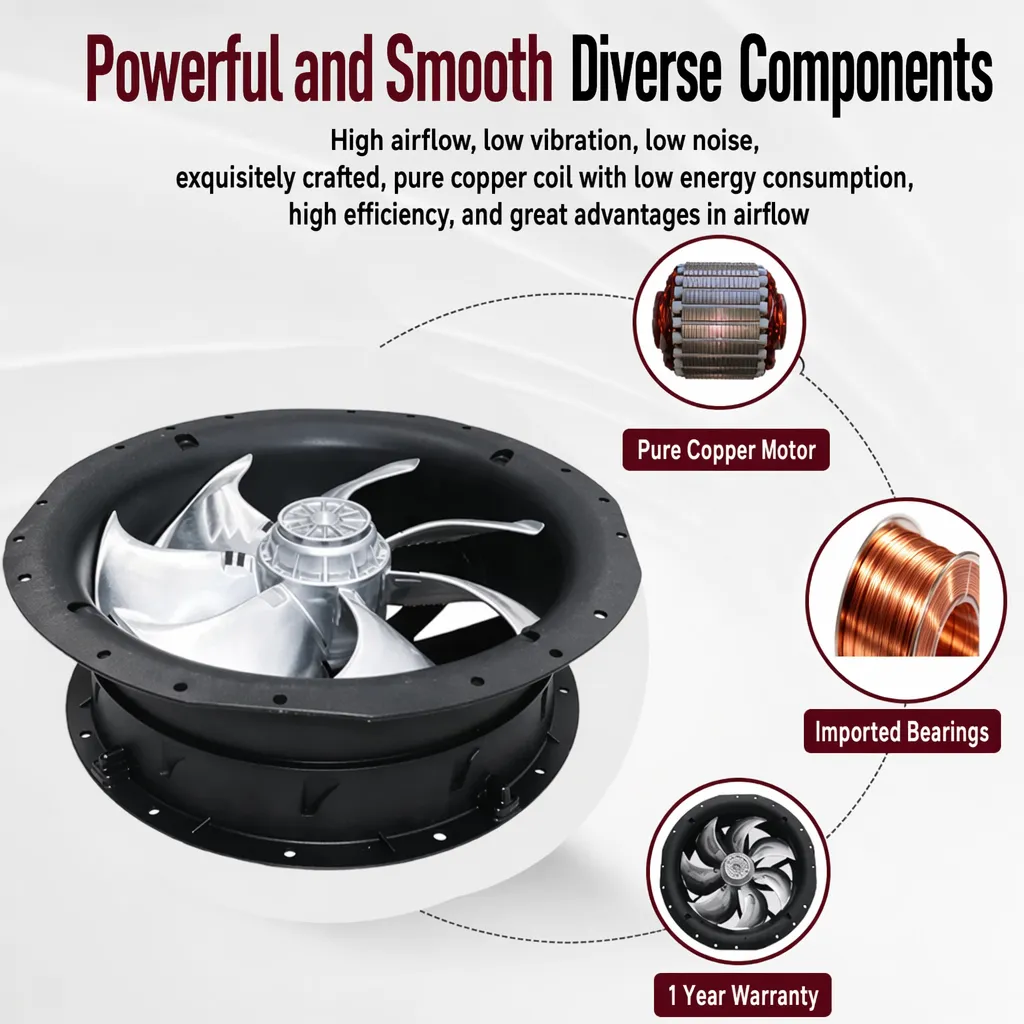
When an engineering team needs to fit forced cooling into a cabinet that is already crowded with drives, breakers, and busbars, every millimeter of depth counts. The external rotor backward curved fan answers that constraint by merging the motor and the impeller into a single shallow package, so the cooling unit no longer demands a long shaft tunnel or a separate mounting plinth inside the enclosure. For procurement teams, that translates into fewer custom cutouts, lower panel fabrication cost, and a cooler that fits where a traditional blower simply would not.
The external rotor backward curved fan places the motor windings and the laminated rotor on the outside of the impeller hub, with the stationary stator sitting in the center. Because the rotor shell doubles as the spinning wheel that carries the backward curved blades, there is no traditional shaft cantilever reaching through the panel. That integration is what lets the assembly sit almost flush against the mounting surface and claim back the axial room that a foot-mounted blower would otherwise consume.
A conventional centrifugal unit needs clearance behind the impeller for the motor body, the bracket, and the inlet cone. Removing those staged parts shrinks the installed length by a noticeable margin. In a 600 mm deep control cabinet, the recovered space can mean the difference between a forced-air solution that fits and one that forces a larger enclosure to be specified, which then grows floor footprint and shipping volume for the whole project. From a procurement view, standardizing on a shallow cooler lets several cabinet sizes share one wall cutout pattern, which simplifies spare-part planning and shortens the bill of materials. When the cooling unit no longer dictates enclosure depth, the panel builder can keep thermal headroom for future drive upgrades without resizing the entire structure.
Belt-drive and foot-mounted arrangements add a motor footprint beside the wheel plus tension hardware and guards. The external rotor backward curved fan keeps the moving parts concentric, so the projected outline is essentially the scroll or ring housing. For OEMs building skid-mounted HVAC or machinery enclosures, that smaller envelope simplifies layout and reduces the cutout area that must be reinforced on the cabinet wall. The same concentric layout also lowers vibration transfer into the panel, which helps sensitive instruments mounted nearby stay within their specified tolerance during normal operation.
Because the unit is shallow and self-contained, the external rotor backward curved fan mounts straight to the enclosure wall with a ring flange and a gasket seal. There is no interior bracket to weld or align, which shortens assembly time on the line. The saved interior volume stays available for busbars, terminal blocks, and the heat-generating devices that actually need the airflow, rather than being eaten by the cooler itself.
In a variable-frequency drive cabinet, the hot zone sits behind the IGBT modules and the DC bus. The external rotor backward curved fan holds pressure across tight plenums because the backward curved wheel develops steady static pressure, so air can be ducted past component rows without stalling. That pressure characteristic matters more than raw volume when the path is obstructed by drives and servo spindle controllers stacked in a narrow bay.
European installations often reference CE marking and EN equipment standards for thermal management of enclosures. A compact sealed unit with an appropriate IP rating supports a clean ventilation boundary between the dirty cabinet interior and the room. Specifiers can document the cooling method without reserving a bulky separate air-handler footprint beside the panel, which keeps the layout lean. During factory acceptance, inspectors look for a declared ventilation path and a verified protection rating, so a self-contained cooler with clear IP and balance data shortens the review. Pairing the unit with a basic temperature switch also gives operators an early warning before any hotspot crosses the allowed limit, supporting safer routine checks.
One integrator faced a retrofit where the original axial fan could not hold temperature after extra drives were added. Switching to an external rotor backward curved fan let the team mount the replacement on the existing wall cutout, with no extra depth, and route ducting to the new hot spots. The cabinet stayed the same size, and steady low-noise operation returned without a panel rebuild or a bigger enclosure.
A machine tool builder needed spindle drive cooling inside a bay already packed with the servo amplifier and a small heat exchanger. The external rotor backward curved fan slotted into a side panel cutout, freeing the internal aisle for cabling. The backward curved profile kept pressure up across the restricted path, and the shorter assembly avoided clashing with the moving axes during service access.
Before ordering, confirm the available wall cutout, the required CFM at the system static pressure, and the IP rating for the environment. Check bearing type and balance grade, since imported precision ball bearings and blade balancing support quiet running. An external rotor backward curved fan should be sized from the real airflow and pressure budget, not from a generic catalog number, so ask the supplier for pre-design selection support.
What makes this integrated fan shallower than a standard blower?
Answer: The motor rotor forms the outer shell of the impeller, so the windings and blades share one rotating body instead of sitting in a separate long housing. Removing the shaft cantilever and bracket shrinks axial depth. That single-package layout is what lets the external rotor backward curved fan mount nearly flush on a cabinet wall and recover interior space a foot-mounted blower would occupy.
Why does the integrated design help in a dense electrical cabinet?
Answer: A crowded enclosure leaves little room behind the panel for a deep motor and bracket. The compact unit mounts directly to the wall with a flange and seal, so interior volume stays free for drives and busbars. The recovered depth can prevent specifying a larger cabinet, keeping floor footprint, shipping size, and assembly labor lower across the project.
How should the cooling unit be matched to the available gap?
Answer: Sizing must start from the real static pressure and required airflow, not a catalog guess. Read the CFM at the system resistance created by drives and ducting, then pick the wheel that holds pressure across that path. Confirm the cutout diameter and wall thickness, and request pre-design selection help so the chosen unit fits the physical gap and thermal load.
Can this fan type be used for servo or spindle cooling?
Answer: Yes. The backward curved wheel develops steady static pressure, which suits obstructed paths inside servo amplifier bays and spindle drive cabinets. Its shallow profile slips into a side panel cutout without clashing with moving axes. That makes it practical for machine tools where the cooling must pass tight plenums yet stay clear of service access routes.
Where does an appropriate IP rating matter for this fan type?
Answer: IP rating matters where the cabinet interior is dirty, humid, or exposed during service. A sealed external rotor unit with the right IP level keeps the room air separate from the enclosure and protects the motor. Specifiers should match IP44 or IP54 to the duty, then verify the gasket and flange seal so the ventilation boundary stays clean and reliable.

2026/09/30
Cement cabinets choke on dust. Learn the filter rule for an industrial cabinet cooling fan: G4/F7 media, IP rating, and pre-filter care.

2026/10/07
Right wall-mount height for an industrial axial exhaust fan: room volume, free clearance, brackets, and recirculation control.

2026/10/08
An ec motor fan links to BMS via Modbus, 0-10V and PWM for demand-based cooling, energy scheduling and automatic sensor-driven speed control.

2026/10/06
A radial exhaust fan removes grease, fumes, and odors from food-processing workshops with capture velocity and hygienic washdown design.

2026/10/05
Learn antistatic treatment for industrial cabinet cooling fan in electronics workshops—ESD-safe housing, ionizable plastics, and cleanroom compatibility.

2026/10/04
Discover how a brushless dc servo delivers precise wind speed control for laboratory cooling fans with closed-loop PID feedback and laminar airflow.
