 EN
EN
What filter matching rule for dust proof cabinet cooling fan operating in cement factories
2026/09/30
Cement cabinets choke on dust. Learn the filter rule for an industrial cabinet cooling fan: G4/F7 media, IP rating, and pre-filter care.

2026/09/10
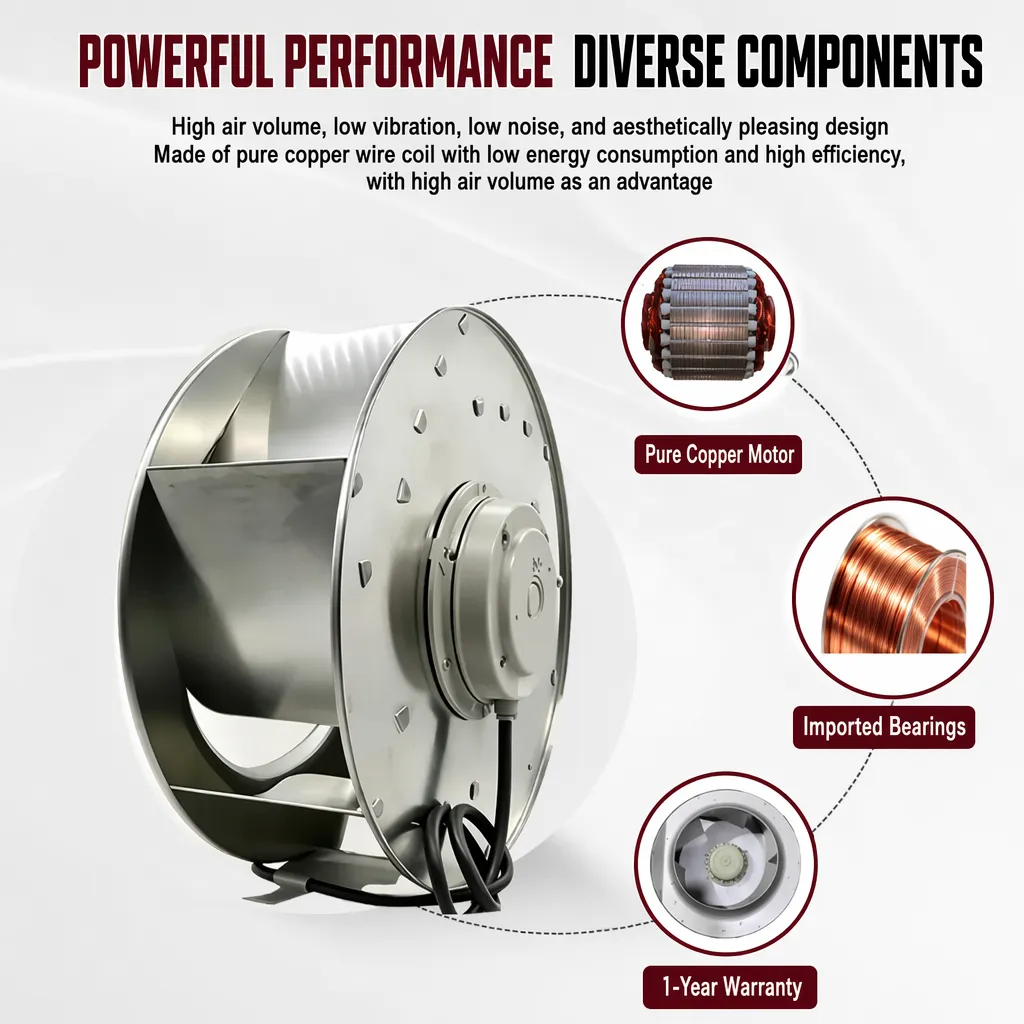
A large size backward curved fan moves enormous air volumes through a factory that may span tens of thousands of square meters. In such voluminous spaces, ventilation is about sustaining safe temperatures, removing process heat, and keeping humidity and contaminants within limits. Teams that underestimate the link between airflow and pressure end up with undersized equipment that cannot overcome duct resistance. Understanding why a centrifugal impeller with backward-curved blades suits these buildings helps engineers specify the right machine from the start.
The large size backward curved fan earns its place in big buildings through blade geometry. Each blade sweeps air backward relative to rotation, so the air leaves the impeller with high kinetic energy the volute converts into useful static pressure. This curvature resists stall and lets the wheel hold stable operation across a wide flow range. Compared with forward-curved wheels, the backward-curved impeller sheds dust and moisture more readily, protecting long-term performance in dirty industrial air. The result is consistent cubic feet per minute delivery even as shift demand changes. After the air exits the wheel, the volute slows the stream, trading velocity for pressure.
A key reason engineers trust this design is the non-overloading power characteristic. As airflow approaches free-delivery conditions, required shaft power peaks then declines rather than climbing without limit. The motor therefore stays within a safe duty cycle instead of drawing trip current. When this impeller is paired with a variable-speed drive, the controller holds the operating point below the power peak and avoids load spikes. Pairing the wheel with a precision ball bearing and pure copper motor winding gives smooth running and predictable thermal management across seasonal changes. That stability is why a large size backward curved fan stays dependable through seasonal peaks instead of drifting toward overload.
Static pressure, not free-air volume, decides whether a fan can do its job in a real building. Ductwork, filters, dampers, and long sheet-metal runs add resistance the machine must overcome. A large centrifugal machine holds a steep pressure rise near its peak efficiency point, so modest duct changes do not collapse delivered CFM. AMCA publication 210 and ISO 5801 define how these curves are measured, giving buyers a common language for comparing quoted performance. Reading the fan curve together with the system resistance line prevents the classic error of selecting on free-air numbers alone.
Free delivery describes airflow with no duct attached, a figure that looks strong on a datasheet but rarely matches the plant. Installed performance is what matters: the volume actually moved after filters clog and dampers close. A large size backward curved fan tolerates this drift better than many alternatives because its curve is stable rather than steeply falling. Specifiers should demand certified test data instead of catalog free-air ratings alone. When ventilation serves a heat-treatment workshop or food processing line, the gap between free and installed flow directly affects worker safety and product quality. Field data often show installed volume falling below free-air claims once filters age.
Against axial fans, the backward-curved centrifugal design shows clear strengths in pressure-dependent duty. Axial units move air cheaply at low resistance but lose efficiency fast once ducts add static pressure. A large size backward curved fan sustains total efficiency and avoids the energy penalty of forcing an axial fan against a load it was not built for. Over a year of continuous duty, the kilowatt-hour difference can offset the higher first cost. Lobisong supplies matched EC and brushless DC motors that widen the efficient band through variable speed control.
Axial fans remain the right choice for certain tasks. Where resistance is minimal and the priority is moving vast volumes across an open bay, an axial unit costs and weighs less. The practical approach is layered: use axial fans for general extract near open roofs, and deploy a large size backward curved fan where ducted supply, filtration, or pressure stability governs. Matching the machine to the duty avoids both overspend and underperformance. Outdoor portable equipment and simple enclosure cooling often suit axial or smaller centrifugal blowers better than a heavy industrial impeller. The aim is the right tool per zone.
A practical case shows the method. A metal fabrication hall of 18,000 square meters suffered summer heat buildup that slowed welders and tripped servo drives. The team first measured heat load from process equipment and calculated required air changes per hour. They then selected a large size backward curved fan sized to deliver the needed CFM at the expected static pressure after filters. After installation, spot readings confirmed temperatures dropped within the design band and the VFD cabinets stopped overheating. The outcome came from matching airflow to the envelope rather than guessing from floor area alone, and commissioning measurements locked in a baseline for later audits.
Sustained performance depends on disciplined upkeep. Inspect impeller balance and blade deposits every quarter, because buildup shifts the center of mass and raises vibration. Check ball bearings for noise and temperature, and verify ingress protection seals remain intact where washdown or dust occurs. Monitor motor winding insulation and current draw against the baseline. Clean filters on schedule, since clogged media push the fan toward free delivery and waste energy. Keeping an AMCA-informed log of operating points lets a large size backward curved fan stay inside its design envelope and avoids unplanned downtime. Vibration trending deserves attention, because a slow rise often precedes bearing failure, so monthly recording builds an early-warning picture.
What makes a backward-curved impeller suitable for huge factory buildings?
Answer: A backward-curved impeller converts rotational energy into stable static pressure while maintaining high cubic feet per minute output. Its blade shape resists stall and sheds dust, so performance stays consistent in dirty industrial air. The non-overloading power curve protects the motor from overcurrent as resistance falls. For voluminous spaces with long ducts and filters, this design delivers the airflow and pressure a large building needs without the instability of simpler wheels.
How does static pressure affect fan selection for large spaces?
Answer: Static pressure represents the resistance that ductwork, filters, and dampers add to airflow. In a huge factory building, that resistance determines the real delivered volume, not the free-air rating. The fan curve shows airflow against pressure, and the operating point meets the system line. A large centrifugal fan holds pressure near its peak efficiency point, so modest duct changes do not collapse CFM. Specifiers should rely on certified test data rather than catalog free-air numbers when sizing equipment.
Why choose a centrifugal fan over an axial model for big buildings?
Answer: An axial fan moves air economically where resistance is low, but its efficiency falls sharply once ducts and filters add static pressure. A large size backward curved fan sustains total efficiency under pressure-dependent duty typical of big buildings. Although the centrifugal unit costs more initially, the annual energy saving during continuous operation often recovers the difference. Layered design works well: axial fans for open extract, centrifugal fans where ducted supply and pressure stability matter most.
Where should facility teams place inspection focus during maintenance?
Answer: Quarterly checks should cover impeller balance, blade deposits, and bearing condition, since buildup raises vibration and shortens life. Verify ingress protection seals remain intact in dusty or washdown areas, and record motor winding insulation and current against baseline values. Replace filters on schedule to avoid pushing the fan toward wasteful free delivery. Logging operating points with AMCA-informed reference helps detect drift early. Consistent inspection prevents unexpected downtime in continuous-production environments.
Can a backward-curved centrifugal fan handle dusty industrial air?
Answer: Yes. The backward blade curvature sheds dust and moisture more readily than forward-curved wheels, which helps maintain airflow in contaminated air. Pairing the impeller with precision ball bearings and sealed motor windings supports reliable running where particles are present. However, very abrasive loads still require filtration and periodic cleaning to protect balance. Matching ingress protection rating to the site and following a routine inspection plan keeps the centrifugal machine performing within its design envelope.

2026/09/30
Cement cabinets choke on dust. Learn the filter rule for an industrial cabinet cooling fan: G4/F7 media, IP rating, and pre-filter care.

2026/10/07
Right wall-mount height for an industrial axial exhaust fan: room volume, free clearance, brackets, and recirculation control.

2026/10/08
An ec motor fan links to BMS via Modbus, 0-10V and PWM for demand-based cooling, energy scheduling and automatic sensor-driven speed control.

2026/10/06
A radial exhaust fan removes grease, fumes, and odors from food-processing workshops with capture velocity and hygienic washdown design.

2026/10/05
Learn antistatic treatment for industrial cabinet cooling fan in electronics workshops—ESD-safe housing, ionizable plastics, and cleanroom compatibility.

2026/10/04
Discover how a brushless dc servo delivers precise wind speed control for laboratory cooling fans with closed-loop PID feedback and laminar airflow.
