
 EN
EN
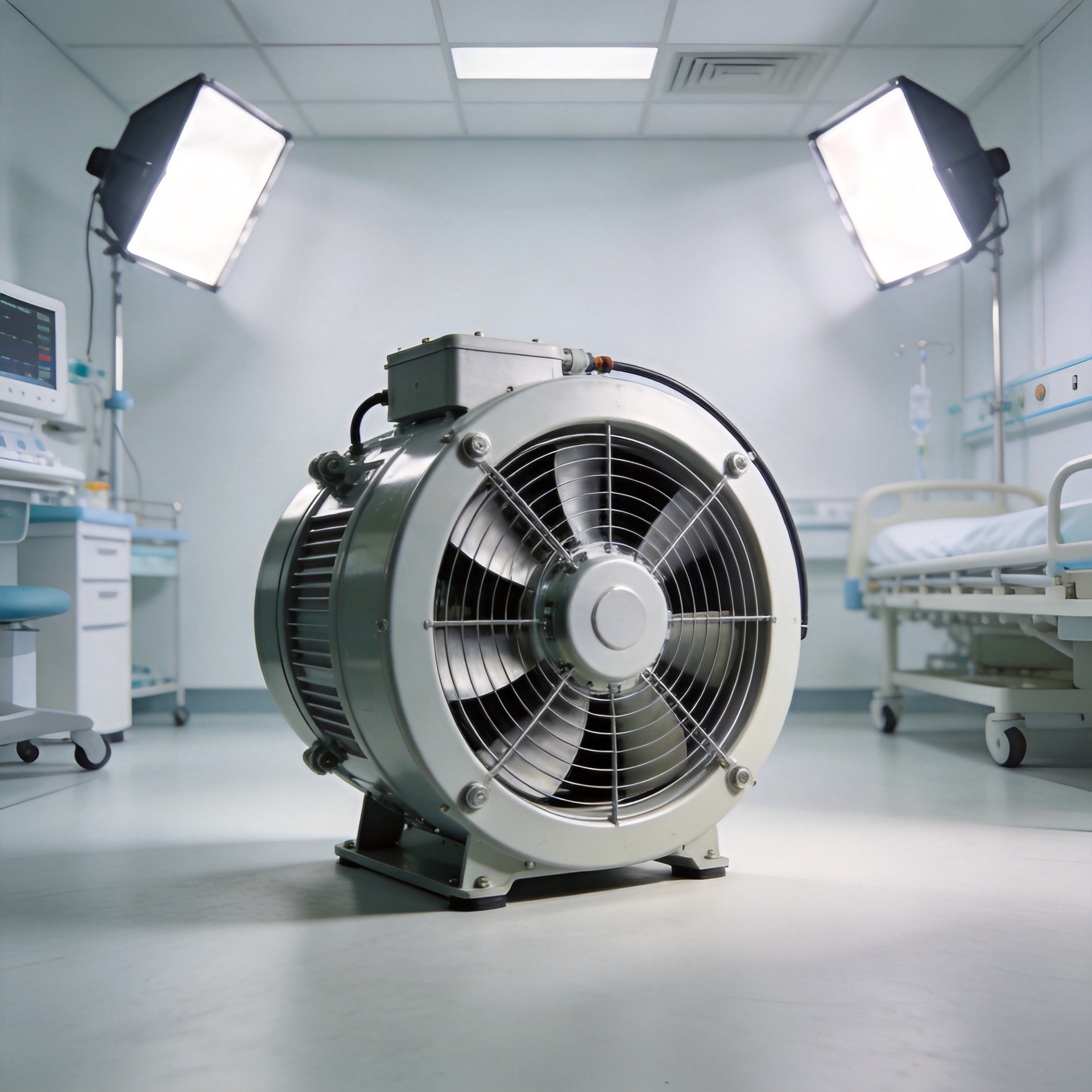
Why Low Noise EC Fans and Drives Avoid Noise Interference of Hospital Precision Inspection Equipment
As an equipment integration engineer who has worked on HVAC and cooling system installations in clinical facilities, I have seen firsthand how the wrong fan selection can create interference problems that are difficult to trace back to their source. Hospital environments are uniquely sensitive spaces: precision diagnostic instruments (including MRI coils, ECG monitors, ultrasound transducers, and X-ray detectors) operate on signal levels so low that even minor acoustic or electromagnetic disturbances can compromise measurement accuracy. Choosing the right low noise ec fans and drives is not simply a matter of comfort; it is a clinical requirement.
Why Hospital Precision Equipment Is Vulnerable to Fan-Related Interference
Modern diagnostic instruments in clinical settings are designed to detect physiological signals with extremely low amplitude. An ECG machine, for instance, must reliably resolve cardiac signal voltages in the microvolt range. An MRI gradient coil operates with precise electromagnetic field gradients that can be distorted by external magnetic flux from nearby electrical machinery. In this environment, any mechanical vibration or conducted electromagnetic emission from cooling equipment becomes a potential error source.
The challenge is compounded by how hospitals are built. Diagnostic imaging rooms, cardiac monitoring suites, and laboratory analysis stations are often located near electrical distribution panels, server rooms, and environmental control equipment, all of which require active cooling. When that cooling equipment generates tonal mechanical noise or radiates conducted emissions onto shared power lines, the effects can appear as signal artifacts, baseline drift, or erroneous readings in precision instrumentation.
How Conventional AC Fans Generate Noise and EMI in Clinical Settings
Traditional AC induction fans used in HVAC and cabinet cooling generate noise through two primary mechanisms. The first is mechanical: the rotating mass of the impeller and the interaction between blade tips and airflow create broadband aerodynamic noise, while the motor itself produces tonal noise at the line frequency (50 or 60 Hz) and its harmonics. The second is electromagnetic: AC motors draw inrush current at startup and introduce harmonic distortion onto the supply line, generating conducted electromagnetic interference (EMI) that propagates along shared power infrastructure.
In typical industrial installations, neither issue is critical. But in a hospital diagnostic zone, even a quiet industrial fan running on AC power can introduce 50 Hz or 100 Hz tonal components into the acoustic environment and onto the power rail, and these frequencies directly overlap with ECG, EEG, or respiratory monitoring frequencies. The result is rarely obvious noise; in most cases it appears as subtle degradation in signal fidelity that is difficult to attribute without systematic analysis.
What Makes Low Noise EC Fans and Drives a Better Choice
Low noise ec fans and drives address both the acoustic and electromagnetic interference problems through fundamentally different motor and drive technology. EC (electronically commutated) fans use brushless DC motors controlled by an integrated electronic drive, which replaces the direct AC line-frequency excitation with sinusoidal or trapezoidal commutation under precise digital control. The design eliminates torque ripple and switching transients associated with brush commutation or AC induction operation, reducing motor-generated acoustic noise across the entire operating speed range.
The drive side is equally significant. A well-designed EC drive includes built-in EMI filtering (typically a combination of common-mode chokes, differential-mode capacitors, and a regulated output stage) that suppresses both conducted and radiated electromagnetic emissions to levels compliant with IEC 60601-1-2, the international standard governing EMI requirements for medical electrical equipment. This means the low noise ec fans and drives combination does not just produce less acoustic noise; it also reduces the electromagnetic footprint of the cooling system on the clinical power infrastructure.
Variable Speed Control and Its Impact on Acoustic Profile
One of the most clinically relevant advantages of low noise ec fans and drives is the ability to operate at partial speed without generating the tonal noise that characterizes fixed-speed AC fans. An AC fan running at full speed creates a consistent 50 or 60 Hz fundamental and its harmonics. When the same fan is speed-controlled via a variable frequency drive (VFD), it generates additional switching harmonics from the inverter stage that can be more disruptive than the original motor noise.
EC fans operate differently. The drive electronics are designed as an integrated system with the motor, and the control algorithm is optimized to maintain smooth commutation even at low speeds. In practical terms, this means a quiet industrial fan based on EC technology can be throttled to 40–60% of rated speed, delivering the airflow required for a clinical-grade equipment room, while keeping acoustic output well within the 30–40 dB(A) range that hospital ward and equipment room guidelines recommend. There is no sudden tonal step-change when speed is adjusted, which would otherwise appear as a structured noise artifact in sensitive measurement systems.
The System-Level Case for Low Noise EC Fans and Drives
A common mistake in hospital facility planning is evaluating fans and drives as independent components rather than as a system. A fan with acceptable rated noise specifications may still produce audible resonance or low-frequency vibration when mounted on a structural panel, if the drive generates speed fluctuations or torque ripple that excite the mounting structure. Similarly, an otherwise compliant drive can introduce EMI if paired with a motor whose winding inductance is not matched to the drive's output characteristics.
That is why low noise ec fans and drives designed as integrated units are the preferred solution for hospitals. The fan motor, impeller geometry, and drive electronics are co-optimized to minimize vibration, tonal noise, and electromagnetic emissions as a combined system, rather than at the component level alone. When the installation also uses vibration-damped mounting hardware and shielded cable runs, the complete assembly can meet clinical-grade acoustic and EMI requirements without requiring post-installation corrective measures.
Selecting the Right Quiet Industrial Fan for Clinical Applications
When specifying a quiet industrial fan for hospital precision inspection equipment zones, there are several parameters to verify beyond the headline noise rating. First, confirm that the published dB(A) figure is measured at a standardized distance and under installation conditions representative of your actual deployment, since many datasheets omit installation variables that can add 3–8 dB(A) to real-world levels. Second, verify that the drive meets IEC 60601-1-2 conducted and radiated emission limits rather than only the general industrial EMC directive. Third, review the vibration isolation specifications: EC motor fans with dynamic balancing and bearing designs suited for continuous operation are significantly less likely to transmit structural vibration to adjacent equipment panels.
For Lebisen's range of low noise ec fans and drives, all three design criteria are addressed in the standard product configuration: integrated EC drives with built-in filtering, aerodynamically optimized impeller geometry that reduces turbulence noise, and balanced motor assemblies suitable for noise-sensitive environments. Trading companies supplying hospital projects benefit from having a supplier who can provide compliant documentation and clear technical specifications that simplify the procurement qualification process for clinical facilities.
Conclusion
The reason low noise ec fans and drives are the right choice for hospital precision inspection equipment environments comes down to their ability to address interference at both the acoustic and electromagnetic level simultaneously. They operate at low dB(A) levels without tonal artifacts at clinical monitoring frequencies, and their integrated drives reduce EMI on shared power infrastructure to levels compatible with IEC 60601-1-2 requirements. For facilities where diagnostic accuracy depends on a clean signal environment, selecting a quiet industrial fan based on EC technology is a technical requirement, not an optional upgrade.






