 EN
EN
What filter matching rule for dust proof cabinet cooling fan operating in cement factories
2026/09/30
Cement cabinets choke on dust. Learn the filter rule for an industrial cabinet cooling fan: G4/F7 media, IP rating, and pre-filter care.

2026/09/10
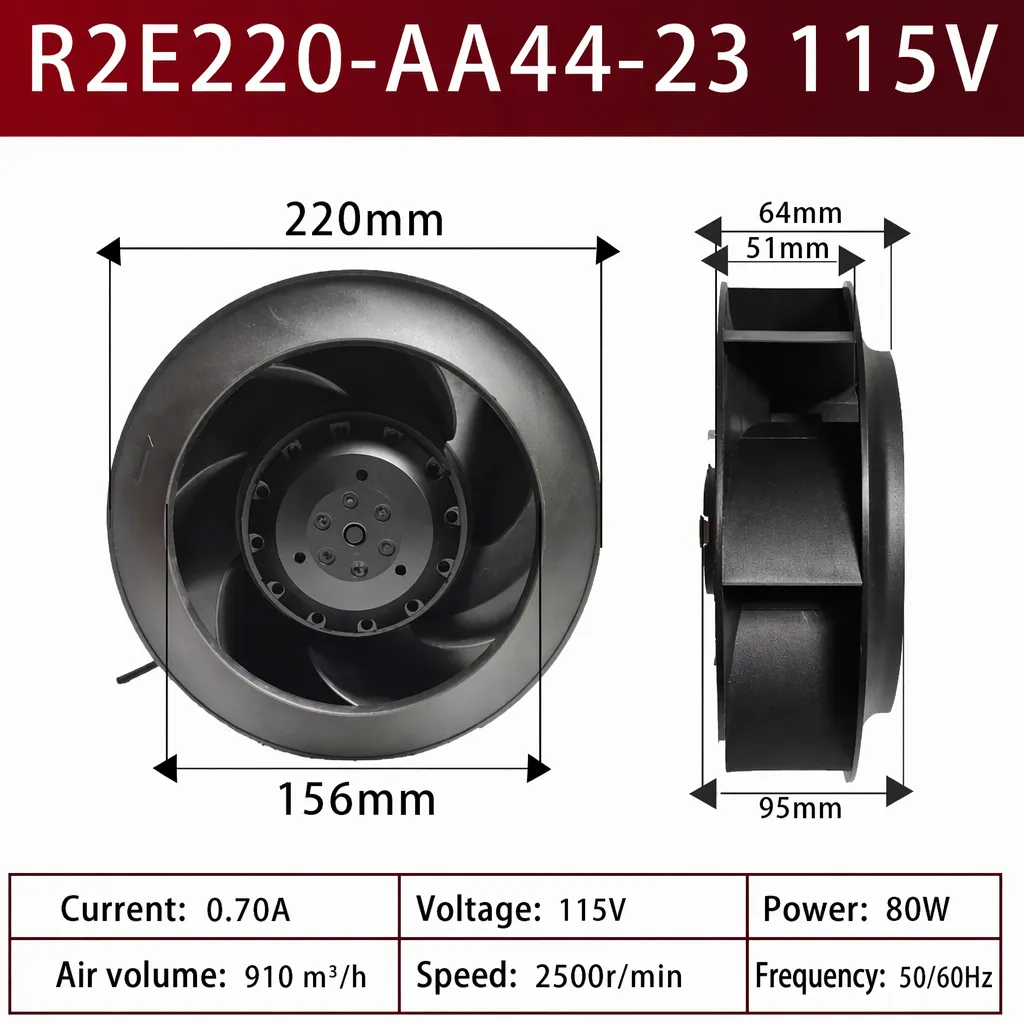
How radial blade geometry withstands abrasive ore dust
A radial blade centrifugal fan earns its place in underground mining because the blade profile meets abrasive load head-on. Curved (forward or backward curved) blades present a glancing surface where fine ore dust slides and gouges along the curve, concentrating wear near the trailing edge. The radial blade is a flat plate set at roughly 90 degrees to the impeller hub. When abrasive particulate strikes, the impact angle is steep and the load distributes across a short, thick blade. Less material is dragged away per contact, so service intervals stretch longer under identical duty cycle. The straight profile also simplifies replacement, since each blade is a simple cut plate rather than a formed vane.
The straight, radial orientation keeps the leading edge perpendicular to the incoming airstream. In a curved blade, the tangent whips dust along a longer path and lets particles re-accelerate between vanes, raising kinetic erosion. A radial blade offers no low-pressure pocket where fines accumulate; the short chord sheds load quickly. Combined with a hardened impeller and precision ball bearings, the arrangement holds balance longer, which protects the pure copper motor windings from vibration-induced thermal stress during continuous mine ventilation. Blade tip speed stays manageable, keeping the erosion rate tied to particle hardness rather than to unpredictable swirl. For high-volume mine ventilation, the radial blade centrifugal fan keeps the impeller balanced longer than a curved alternative under identical load.
Storm-load describes sudden surges of ore dust and rock fines carried by the airstream. Three mechanisms dominate: micro-cutting (hard particles plough the surface), fatigue (repeated impacts crack the blade root), and adhesion (sticky fines build mass and destroy balance). A radial blade resists micro-cutting because its flat face presents uniform hardness; the thick root resists fatigue. Specifying abrasion-resistant plate and a wear liner at the blade tip directly slows material loss without oversizing the motor or enclosure. The radial blade centrifugal fan handles these loads because the flat face presents no relief angle for particles to embed.
Mine ventilation must push cubic feet per minute (CFM) through long duct runs, regulators, and bends that create high static pressure. A radial blade centrifugal fan maintains useful airflow where axial units stall. The flat blade tolerates the pressure swings of a blocked or partially choked line without surging. For procurement, match the fan curve to the measured system resistance, not free-air rating, and reserve margin for filter loading so airflow never collapses during peak particulate load.
A copper-ore drift retrofit shows the logic. The site ran a backward-curved unit that eroded within four months; imbalance tripped the drive and stopped face ventilation. Engineers installed a radial blade centrifugal fan with a hardened impeller and bolt-on tip liners, sized to the measured duct resistance rather than catalogue free air. Service interval extended past fourteen months, and airflow held steady through blast-cleaning surges. The change reduced unplanned downtime without raising installed power.
Coal and some ore dust form explosive atmospheres when suspended. A radial blade, built with non-sparking considerations and an outer-rotor motor in a sealed enclosure, reduces ignition sources. Airflow design should keep dust from settling in dead zones where concentration builds. Ventilation planning follows the principle that dilution and capture beat containment; continuous airflow below the explosive threshold protects personnel and equipment in classified mining zones. In a classified zone, the radial blade centrifugal fan paired with a sealed drive lowers the chance of an ignition path forming.
European operations reference ATEX 2014/34/EU for equipment in explosive atmospheres; many mining authorities apply mine technical inspection (MTI) dust rules for respirable and combustible dust control. A radial blade centrifugal fan itself rarely carries a current ATEX certificate unless specified, but the ventilation system design must respect zone classification and dust ignition risk. Buyers should request documented airflow, IP rating, and motor certification (CE/UKCA) and verify ingress protection suits the wet, dusty pit environment. Where airflow performance is verified, reference AMCA 210 or ISO 5801 methods so quoted CFM reflects real system resistance.
A practical inspection checklist: measure blade thickness monthly at the tip and root, watch impeller balance and bearing temperature, and log motor current against baseline. Replace liners before through-wear reaches the base plate. Pure copper windings and precision ball bearings extend life, yet only scheduled downtime prevents catastrophic failure. Train crews to spot rising vibration early; a small imbalance in an abrasive duty cycle grows fast and can trip the drive. Keep a spare liner kit on the bench so a planned stop replaces wear parts instead of the whole wheel. Even a well-built radial blade centrifugal fan needs scheduled liner swaps to keep erosion predictable.
Selecting the right radial blade centrifugal fan for dusty mining ventilation is a balance of abrasion resistance, airflow stability, and compliance awareness. The straight blade geometry survives where curved profiles erode, and disciplined inspection keeps the unit running through storm-load. Pair material choice with valid standards references and the ventilation system delivers reliable mine airflow under the harshest particulate conditions.
What makes a radial blade design more wear-resistant than a curved blade in mining dust?
Answer: The radial blade is a flat plate set near 90 degrees to the hub, so abrasive ore dust strikes at a steep impact angle and the load spreads across a short, thick blade. Curved blades present a glancing surface where fines slide and gouge, concentrating wear near the trailing edge. Uniform blade hardness and a thick root resist micro-cutting and fatigue, so service intervals stretch longer under the same particulate duty.
Why does mine ventilation need stable airflow under high static pressure?
Answer: Long duct runs, regulators, and bends create high static pressure that stalls axial units and chokes free-air rated fans. A radial blade centrifugal fan holds useful cubic feet per minute through pressure swings without surging, keeping face ventilation reliable. Specifying the fan to measured system resistance, not catalogue free air, reserves margin for filter loading so airflow never collapses during peak particulate load and blast-cleaning surges that stress the whole ventilation network.
How should buyers inspect a fan used in abrasive mining service?
Answer: Measure blade thickness monthly at the tip and root, watch impeller balance and bearing temperature, and log motor current against a baseline. Replace wear liners before through-wear reaches the base plate, and keep a spare liner kit so a planned stop swaps parts instead of the whole wheel. Train crews to spot rising vibration early, because a small imbalance in abrasive duty grows fast and can trip the drive.
Can a radial blade fan reduce explosion risk from suspended mine dust?
Answer: It lowers ignition sources when built with non-sparking considerations and a sealed outer-rotor motor inside an enclosure that keeps hot surfaces away from the airstream. Ventilation design should prevent dust settling in dead zones where concentration builds, and maintain continuous airflow below the explosive threshold. The fan alone does not certify a zone; system design must respect ATEX and MTI dust rules, with documented airflow and valid motor certification.
Which standards apply when specifying ventilation for dusty mining zones?
Answer: European sites reference ATEX 2014/34/EU for equipment in explosive atmospheres, while mining authorities apply mine technical inspection (MTI) dust rules for respirable and combustible dust. Buyers should request documented airflow tested by AMCA 210 or ISO 5801 methods, plus IP rating and CE or UKCA motor certification. Verify ingress protection suits the wet, dusty pit, and confirm the fan curve matches measured system resistance rather than free-air rating.

2026/09/30
Cement cabinets choke on dust. Learn the filter rule for an industrial cabinet cooling fan: G4/F7 media, IP rating, and pre-filter care.

2026/10/07
Right wall-mount height for an industrial axial exhaust fan: room volume, free clearance, brackets, and recirculation control.

2026/10/08
An ec motor fan links to BMS via Modbus, 0-10V and PWM for demand-based cooling, energy scheduling and automatic sensor-driven speed control.

2026/10/06
A radial exhaust fan removes grease, fumes, and odors from food-processing workshops with capture velocity and hygienic washdown design.

2026/10/05
Learn antistatic treatment for industrial cabinet cooling fan in electronics workshops—ESD-safe housing, ionizable plastics, and cleanroom compatibility.

2026/10/04
Discover how a brushless dc servo delivers precise wind speed control for laboratory cooling fans with closed-loop PID feedback and laminar airflow.
