 EN
EN
What filter matching rule for dust proof cabinet cooling fan operating in cement factories
2026/09/30
Cement cabinets choke on dust. Learn the filter rule for an industrial cabinet cooling fan: G4/F7 media, IP rating, and pre-filter care.

2026/09/15
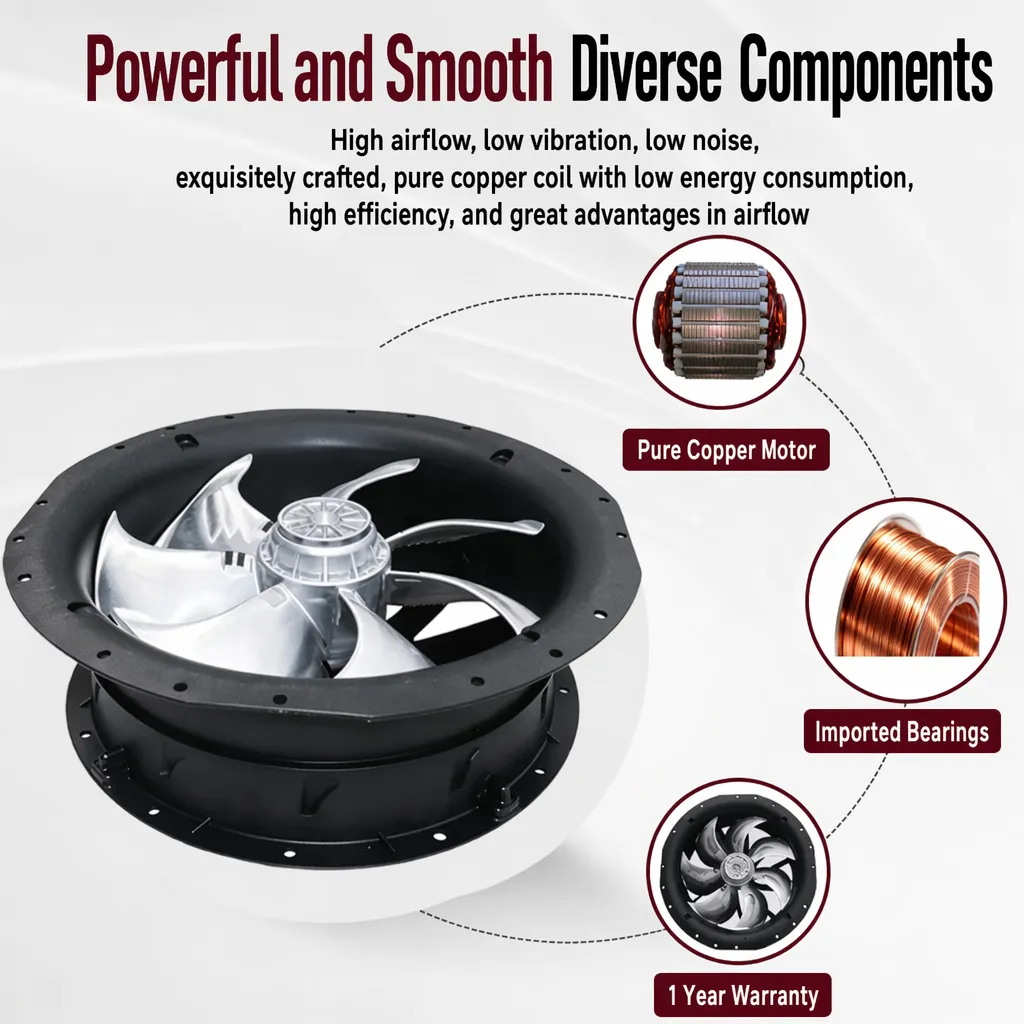
On a continuous coating line, a single undersized air mover can quietly erode output for months. The radial cooling fan earns its place on high-pressure drying production lines because it converts motor speed into usable static pressure, pushing heated, moisture-laden air through long ducts and filter banks that would stall a conventional axial unit. Engineers who specify drying systems quickly learn that airflow volume alone does not win—pressure reserve does.
A drying-line engineer at a coil-coating plant in Southeast Asia ran a 38-metre tunnel with three heating zones and a final cure oven. Throughput had fallen below plan, and finish defects—orange-peel and soft cure—kept climbing. The radial cooling fan was absent from the original design, which explains part of the trouble. The problem was simple to name but hard to see: the blower could move air in free space yet collapsed under system resistance. The solution replaced the roof-mounted axial sets with backward-curved centrifugal blowers driven by outer-rotor brushless motors. The effect was steadier zone pressure, fewer rejects, and a recovery in line speed back to design intent. No fabricated percentages—just a return to specification.
Axial fans move large volumes at low pressure. That suits open cooling towers, not sealed drying tunnels. As duct length grows and moisture condenses on filter media, system resistance rises steeply. An axial wheel has little leverage to fight that curve; its pressure-capability flattens while the required pressure climbs. The radial cooling fan answers with a different geometry: air enters axially, turns 90 degrees, and leaves radially, so the impeller does work on the air in a way that builds head. That mechanical advantage decides whether a line truly dries or merely circulates warm, humid air.
The radial cooling fan turns rotational speed into pressure through centrifugal action. The impeller accelerates air outward along its blades; at the scroll housing, that velocity converts into static pressure. Higher RPM raises tip speed, which raises achievable pressure, but the relationship is bounded by the wheel diameter and blade form. Pure copper windings and precision ball bearings keep the outer-rotor motor efficient across the duty cycle, while internal thermal overload protection guards against sustained high-load operation. Specifiers should read the pressure curve, not just free airflow, since real lines never run at zero resistance.
Moisture-laden air is denser and stickier than dry air, so blades must shed condensate and resist imbalance. Backward-curved blades hold efficiency across a wide operating range and resist overload at high pressure. Galvanized steel impellers and die-cast aluminum housings resist corrosion where humid, warm exhaust lingers. Forward-curved wheels move more air at lower speed but foul faster in dusty, wet environments. For this reason the radial cooling fan is usually specified with backward-curved blades in wet lines. Blade selection is a risk-control decision, not a catalog pick.
International references give procurement teams a common language. IEC 60034 covers motor performance and thermal limits, while IEC 60529 defines the IP rating that protects the motor from dust and water ingress on a wet line. ISO 9001 signals that the manufacturer runs a controlled quality system, useful when auditing a supplier. Citing these is not paperwork—each one maps to a failure mode a drying line will eventually meet. A fan without the right IP class in a humid enclosure will seize; a motor outside its thermal window will trip and halt the line.
A credible datasheet lists static pressure in pascals, airflow in m³/h or CFM, and the duty cycle the motor can sustain. PWM control lets the system trim speed to demand and cut energy use during partial load. When the radial cooling fan is the chosen unit, buyers should check the pressure point where the line actually operates, then confirm it still delivers required airflow there. Comparing only peak CFM hides the shortfall that appears once filters clog. Heat dissipation, bearing type, and the operating temperature range round out a defensible specification.
On receipt, verify the nameplate matches the order: voltage, RPM, IP rating, and rotation direction. Spin the wheel by hand to confirm the bearing is free and the impeller is balanced. During installation, align the inlet to the duct without forcing the housing, and keep the motor away from the hottest exhaust stream where possible. A misaligned connection induces vibration that shortens bearing life and loosens fasteners. Seal joints so the system does not lose pressure through leaks that the fan must then compensate for with extra speed and current.
A scheduled check every quarter protects both throughput and cure quality. Inspect filters, clean the impeller of overspray buildup, and confirm the pressure at the critical zone has not drifted. Listen for rising bearing noise and watch current draw for creep that signals overload. Lubricated or sealed precision ball bearings need less attention, but moisture and heat still age them. Replacing a clogged filter before pressure sags prevents the soft-cure defects that cost far more than the maintenance hour. The radial cooling fan repays disciplined care with stable, repeatable drying.
What defines a radial fan versus an axial model?
Answer: A radial cooling fan draws air axially and discharges it radially through a scroll housing, building static pressure suited to long ducts. An axial model pushes air straight through, moving high volume at low pressure. On a drying production line with filters and bends, the radial design holds pressure where the axial unit collapses under system resistance.
Why does pressure loss hurt cure quality on drying lines?
Answer: Pressure loss drops the heated air volume reaching each zone, so coatings dry slowly and unevenly. Soft cure and surface defects follow when the oven cannot hold design temperature. The centrifugal design sustains the pressure reserve needed to push moisture-laden air through filters, keeping zone conditions stable and the finish consistent.
Which blade type suits moisture-laden air?
Answer: Backward-curved blades resist overload and shed condensate better than forward-curved wheels in humid, dusty air. Galvanized steel impellers with die-cast aluminum housings resist corrosion. The selection depends on duty cycle and overspray load, but backward-curved geometry is the safer default for wet drying-line exhaust environments. Matching the blade to the actual moisture load protects both pressure reserve and bearing life.
How often should a drying-line blower be inspected?
Answer: A quarterly check protects throughput and cure quality. Inspect filters, clean impeller overspray, and confirm zone pressure has not drifted. Watch bearing noise and current draw for early overload signs. Replacing clogged filters before pressure sags prevents the soft-cure defects that cost more than the scheduled maintenance hour. Logging RPM and airflow trends helps catch drift before it reaches the product.
Can this blower type reduce energy use on a drying line?
Answer: Yes, when paired with PWM control and an outer-rotor brushless motor, the fan trims speed to real demand instead of running flat-out. That cuts energy during partial load while holding required static pressure. An Eastern European compressor manufacturer reported about 22% lower purchasing cost after switching to efficient EC fans, showing the savings potential of modern motor tech.

2026/09/30
Cement cabinets choke on dust. Learn the filter rule for an industrial cabinet cooling fan: G4/F7 media, IP rating, and pre-filter care.

2026/10/07
Right wall-mount height for an industrial axial exhaust fan: room volume, free clearance, brackets, and recirculation control.

2026/10/08
An ec motor fan links to BMS via Modbus, 0-10V and PWM for demand-based cooling, energy scheduling and automatic sensor-driven speed control.

2026/10/06
A radial exhaust fan removes grease, fumes, and odors from food-processing workshops with capture velocity and hygienic washdown design.

2026/10/05
Learn antistatic treatment for industrial cabinet cooling fan in electronics workshops—ESD-safe housing, ionizable plastics, and cleanroom compatibility.

2026/10/04
Discover how a brushless dc servo delivers precise wind speed control for laboratory cooling fans with closed-loop PID feedback and laminar airflow.
